Nude Beaches in the US Virgin Islands (2026): Why They're Gone
Table of Contents
The Reality of Nude Beaches in the US Virgin Islands
Nude beaches in the US Virgin Islands no longer legally exist. The territory has no officially designated clothing-optional beach, public nudity is illegal under Virgin Islands Code Title 14, and the Virgin Islands National Park on St. John has ticketed nudity since a 1997 federal court ruling ended Salomon Bay's run as the islands' one informal nude beach. The closest legal naturism — Saint Martin's Orient Bay and St. Barths' Grande Saline — is a short flight away.
What follows is the honest breakdown: what the law actually says, what happened to Salomon Bay, why the beaches of St. Thomas, St. John, and St. Croix are uniformly textile today, and where naturists can realistically go on the same trip. The honest version: enjoy the USVI for its snorkeling, its national park trails, and Magens Bay, then hop to the French Caribbean if a clothing-optional beach is non-negotiable.
Why the US Virgin Islands Are Textile-Only
The US Virgin Islands are an unincorporated US territory, and public nudity is prohibited under Virgin Islands Code Title 14, section 1022 (obscene and indecent conduct). The statute is unusually broad: beyond exposing "private parts" in any public place, it even reaches appearing on a public street "in bathing costume or any similarly abbreviated attire such as to offend public decency." Breastfeeding is explicitly exempted, but there is no naturist carve-out anywhere in the code.
Layered on top of territorial law is federal jurisdiction. Roughly two-thirds of St. John, plus underwater acreage and Hassel Island off St. Thomas, sit inside Virgin Islands National Park, where the National Park Service enforces both federal regulations and the territory's anti-nudity statute. That double layer — territorial law plus a federal land manager with its own ranger force — is why the USVI ended up stricter in practice than several independent Caribbean nations that merely have an unenforced colonial-era indecency law on the books.
Salomon Bay: The Nude Beach That Used to Be
For decades, Salomon Bay (also spelled Solomon Bay) on the north shore of St. John was the one genuinely clothing-optional beach in the US Virgin Islands. Reachable only by a footpath from the Lind Point trailhead near Cruz Bay or by dinghy, its seclusion made it a de facto naturist beach that old-timers still remember fondly. It was never legally designated — it was simply tolerated because it was remote and lightly patrolled.
That changed after a 1997 federal court decision confirmed that Virgin Islands National Park could enforce the territory's public-nudity law on park land. Rangers stepped up patrols on the Salomon–Honeymoon stretch, and by the 2000s the beach had gone textile. Travel guides to St. John report that rangers now issue citations to offenders; the commonly cited penalty is a fine on the order of $100 plus the possibility of jail time, though figures vary by source and should be treated as indicative rather than exact. The practical takeaway is simple: Salomon Bay is a beautiful, quiet swimming and snorkeling beach, but it is not clothing-optional anymore.
The National Park and Main Beaches: All Textile
St. John's National Park Beaches
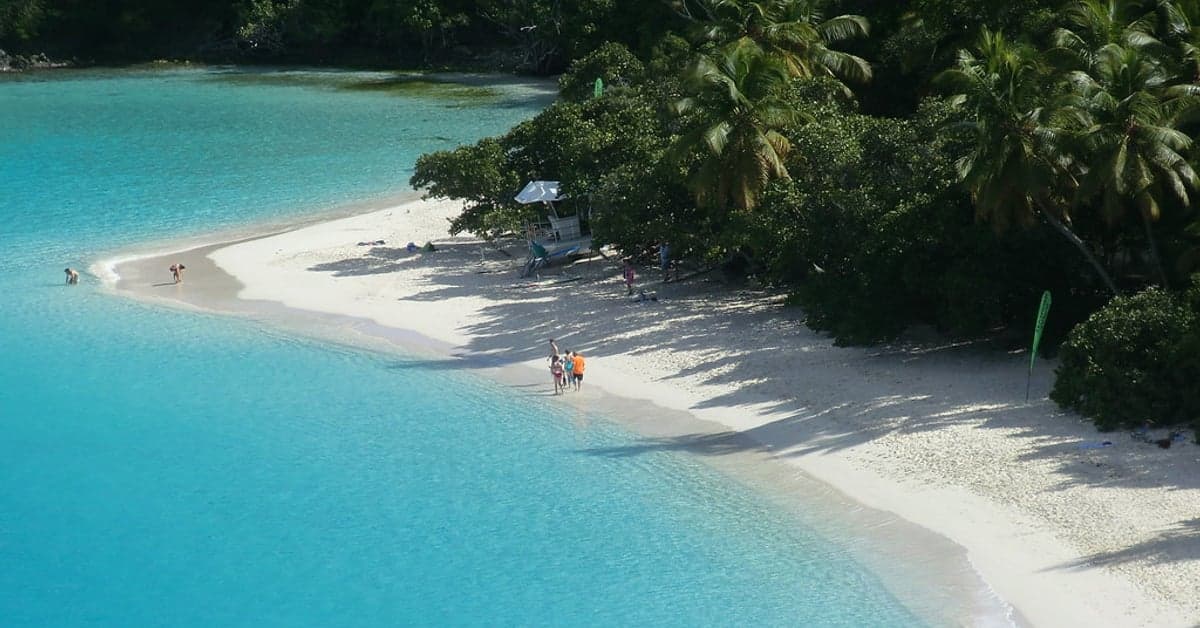
Trunk Bay (famous for its underwater snorkeling trail), Cinnamon Bay, Maho Bay, Hawksnest, and Honeymoon Beach are all inside Virgin Islands National Park and are patrolled by NPS rangers. Nudity and topless sunbathing draw citations here, and the park's family-oriented, high-traffic character means there is no realistic expectation of privacy. These are world-class snorkeling and swimming beaches — just plan on swimwear.
St. Thomas and St. Croix
On St. Thomas, Magens Bay — routinely ranked among the Caribbean's best beaches — is a public, ticketed, heavily used bay with lifeguards and vendors; it is fully textile. Sapphire Beach, Lindquist Beach, and the Coki Point snorkeling beach are the same. On St. Croix, the beaches around Christiansted, Frederiksted, and Cane Bay follow the same rule. None of the three main islands has an informal naturist stretch that survives, and the small resident populations mean discreet skinny-dipping at remote coves is easily noticed and reported.
The Closest Legal Alternatives
The good news for naturists is that two of the Caribbean's best clothing-optional beaches sit barely 130 miles east, in the French islands, where designated public nudity is legal rather than merely tolerated.
Saint Martin: Orient Bay
Orient Bay (Baie Orientale) on the French side of Saint Martin is the most developed naturist beach in the Caribbean, anchored historically by the Club Orient naturist resort at its southern end. France permits public nudity at designated beaches, and the clothing-optional southern end of Orient Bay has remained the region's established naturist beach even as the island rebuilt after Hurricane Irma in 2017 damaged much of the Club Orient property. From St. Thomas it is roughly 131 miles and about a 1-hour-50-minute flight to Sint Maarten (SXM), with a short taxi to the French side.
St. Barthelemy: Grande Saline and Gouverneur
On St. Barths, topless sunbathing is universal and the beach at Anse de Grande Saline is the island's known spot where full nudity is tolerated; neighboring Anse du Gouverneur is more reserved. Reporting on St. Barts is consistent that most beaches permit topless but not full nudity, with Saline the practical exception, so set expectations accordingly. St. Barth Commuter and connections via SXM link St. Thomas and St. Croix to St. Barths in well under two hours of flying.
Farther Afield: Antigua's Eden Beach
If your itinerary runs east through the islands, the fourth Hawksbill beach on Antigua has been informally clothing-optional for over forty years. See our Antigua and Barbuda guide for the details and access notes.
Practical Tips for Naturists Visiting the US Virgin Islands
Manage Expectations
If your trip is anchored to the USVI — a wedding, a cruise stop, a family vacation, a national-park hiking trip — accept that nudity will not be part of it. The islands excel at snorkeling (the Trunk Bay trail, the Coki Point reef), sailing to the surrounding cays, and the calm swimming at Magens Bay. Plan the trip around those strengths rather than around a clothing-optional beach that no longer exists.
Combine the USVI With the French Islands
The most rewarding routing is to split the trip: several days in the USVI for snorkeling and the national park, then a short hop to Sint Maarten for Orient Bay or to St. Barths for Grande Saline. Ferries and short flights make St. Thomas the natural hub for this kind of multi-island naturist itinerary.
Know the Neighboring Territories
The nearby British Virgin Islands are, like the USVI, textile with no informal naturist tradition — do not assume Jost Van Dyke or Tortola offer a workaround. For a US-territory neighbor with the same conservative beach rules but different logistics, see our Puerto Rico guide.
What to Pack
Regular swimwear, reef-safe SPF 30+ sunscreen (mineral zinc-oxide or titanium-dioxide formulas — several Caribbean jurisdictions restrict oxybenzone), water shoes for rocky entries, and a cover-up for walking off the beach, since the territorial code technically frowns on abbreviated beach attire on public streets.
When to Visit
December through April is the dry season, with reliable trade winds and water temperatures in the low 80s Fahrenheit. May and November are strong shoulder months. Hurricane season runs June through November, and the northeastern Caribbean is an active zone — Hurricanes Irma and Maria devastated the USVI in September 2017, and infrastructure recovery shaped the islands for years.
Final Thoughts
The US Virgin Islands are one of the Caribbean's best mainstream beach destinations — world-class snorkeling, a genuine national park, and Magens Bay — but they are not a naturist destination and, given the layered territorial-plus-federal enforcement, are unlikely to become one. Salomon Bay's transition from the islands' one nude beach to a patrolled textile cove is the whole story in miniature. For clothing-optional beach time, anchor the trip in St. Thomas or St. John and add a short flight to Saint Martin's Orient Bay or St. Barths' Grande Saline. For the full regional picture — which Caribbean islands have a real naturist tradition and which are textile-only — see our complete Caribbean nude beach guide.
This series: The World's Best Nude Beaches
Frequently Asked Questions
Are there any nude beaches in the US Virgin Islands?
No. The US Virgin Islands have no officially designated clothing-optional beaches, and public nudity is illegal under Virgin Islands Code Title 14, section 1022. Salomon Bay on St. John was the territory's only informal nude beach for decades, but the Virgin Islands National Park has enforced anti-nudity law there since a 1997 federal court ruling. Today all three main islands are textile.
Is Salomon Bay still a nude beach?
Not anymore. Salomon Bay (sometimes spelled Solomon Bay) on the north shore of St. John was tolerated as clothing-optional for decades because it is reachable only by footpath or dinghy. After a 1997 federal court decision confirmed that the national park could enforce the territory's public-nudity law on park land, rangers stepped up patrols and the beach went textile. It remains a beautiful, quiet swimming and snorkeling beach — just not a naturist one.
Is topless sunbathing allowed in the US Virgin Islands?
Topless sunbathing is technically illegal under the same territorial statute that bans public nudity, and the code is broad enough to cover even abbreviated beach attire on public streets. In practice there is occasional quiet tolerance at very private resort settings, but on public and national-park beaches — Magens Bay, Trunk Bay, Cinnamon Bay — the expectation is regular swimwear and rangers do intervene. Err on the side of textile.
What is the closest nude beach to the US Virgin Islands?
Orient Bay (Baie Orientale) on the French side of Saint Martin, roughly 131 miles east of St. Thomas and about a 1-hour-50-minute flight to Sint Maarten. Its clothing-optional southern end, long anchored by the Club Orient naturist resort, is the most developed naturist beach in the Caribbean and enjoys full French legal protection. St. Barths' Anse de Grande Saline is a comparable short hop away.
Can you go nude at Trunk Bay or in Virgin Islands National Park?
No. Trunk Bay, Cinnamon Bay, Maho Bay, Hawksnest, Honeymoon Beach, and Salomon Bay all sit within Virgin Islands National Park, where NPS rangers enforce both federal regulations and the territory's anti-nudity law. Nudity and toplessness draw citations, and these are busy, family-oriented snorkeling beaches with no realistic expectation of privacy.
Why are the US Virgin Islands stricter about nudity than the French Caribbean?
The USVI are a US territory governed by Virgin Islands Code Title 14, with much of St. John additionally under National Park Service jurisdiction — a double layer of enforcement. The nearby French islands of Saint Martin and St. Barthelemy, by contrast, operate under French law, which permits public nudity at designated beaches. That legal difference, not geography, is why Orient Bay thrives while Salomon Bay was shut down.
Can I combine the US Virgin Islands with a naturist beach on the same trip?
Yes, and it is the recommended approach. Spend several days in St. Thomas or St. John for snorkeling and the national park, then take a short flight to Sint Maarten for Orient Bay or use St. Barth Commuter to reach St. Barths' Grande Saline. Both are well under two hours of flying, making the USVI a convenient hub for a multi-island naturist itinerary.
Are the British Virgin Islands any different for naturists?
Not meaningfully. The neighboring British Virgin Islands — Tortola, Virgin Gorda, Jost Van Dyke — are, like the USVI, textile with no established informal naturist tradition and their own anti-nudity provisions. Do not treat a day sail to the BVI as a clothing-optional workaround. For genuine naturism, the French islands to the east remain the closest legal option.

