Budget Beach Travel in Mexico (2026): Real Costs, Town by Town
Table of Contents
Prices in this guide are approximate and change often. Check with the hotel, airline or operator before you book.
Budget beach travel in Mexico works best away from the Riviera Maya: Puerto Escondido, Mazunte and Zipolite in Oaxaca, Mazatlán in Sinaloa, La Paz in Baja California Sur, Progreso in Yucatán and Bacalar in southern Quintana Roo. Budget roughly US$40–70 a day including a room. Every beach in the country is legally public, which matters more on the ground than any discount code.
The biggest cost decision on a Mexican beach trip is not the hotel. It is which airport you fly into. Cancún and Tulum are priced in dollars because they are sold in dollars, to people who booked from North America and will pay North American prices. Three hours away by plane, the same ocean is priced in pesos.
What Budget Beach Travel in Mexico Actually Costs Per Day
These are 2026 figures for one person, staying in a private room in a small guesthouse rather than a dorm, eating where the town eats, and moving by bus and colectivo. The peso has traded near 17 to the US dollar through August 2026, so peso prices convert at roughly 17:1.
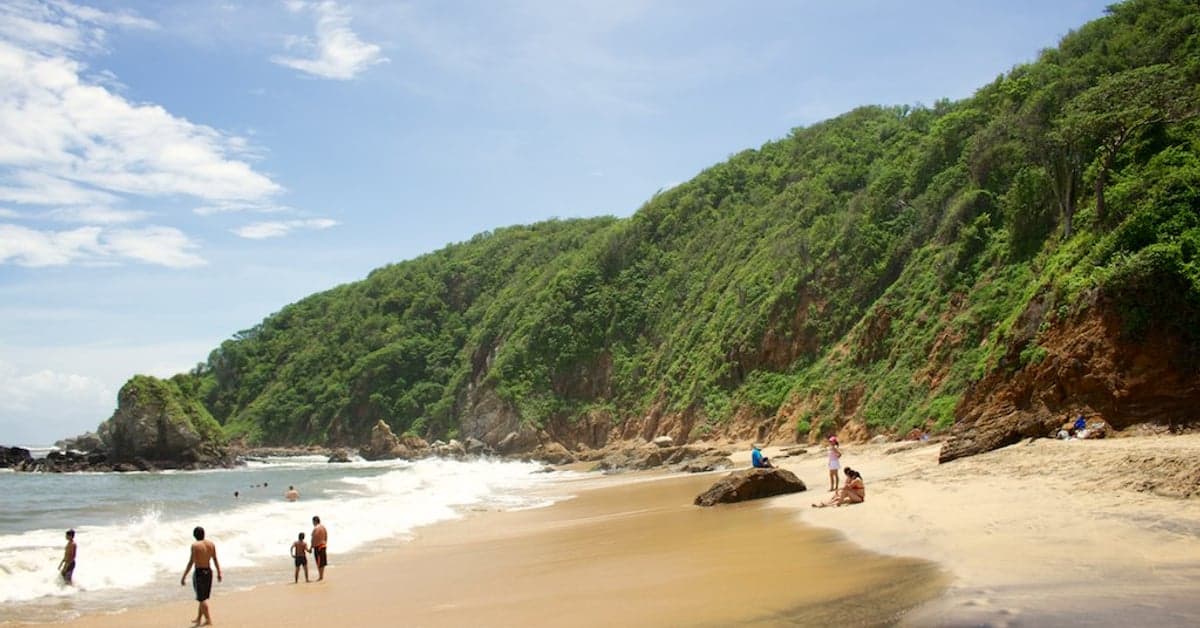
Oaxaca's Pacific coast — Puerto Escondido, Mazunte, San Agustinillo, Zipolite: US$35–55. Hostel dorms start around US$12 and simple private rooms around US$20–30. This is the cheapest genuinely good coast in the country.
Mazatlán and Progreso: US$40–60. Both are priced for Mexican families and long-stay Canadians rather than week-long package tourists, and it shows in the restaurant bill more than in the room rate.
La Paz and mainland Baja California Sur: US$50–75. Cheap in town, but the best beaches carry a bus fare and, in one case, a reservation and a fee.
Bacalar: US$45–70. Dorm beds run near US$20 in season. The lagoon is the expense — a shared panga starts around 250 pesos, a sailboat trip runs roughly 500–600 pesos, and a half-day private charter is 1,200–2,500 pesos.
Cancún, Playa del Carmen and Tulum: US$90–150 for the same standard of trip. Mexico is not expensive. That corridor is.
Six Beach Towns Where the Numbers Work
Puerto Escondido, Oaxaca
Puerto Escondido has been the best-value beach town in Mexico for two decades, which is exactly why it is no longer a secret. Playa Zicatela — the "Mexican Pipeline" — is a beach for watching, not swimming; the shorebreak is genuinely dangerous and drowns people most years. The swimmable options are Playa Carrizalillo, a small cove reached by a long staircase, and Playa Manzanillo next to it. Puerto Angelito and Playa Bacocho round out the list.
Access improved sharply in February 2024, when the 104-kilometre Barranca Larga–Ventanilla highway opened and cut the drive from Oaxaca City from six-plus hours of mountain switchbacks to about two and a half. That matters for budgets: an overnight bus from Oaxaca City is often cheaper than a flight into Puerto Escondido's small airport, and now it is not a punishment.
Mazunte and Zipolite, Oaxaca
Roughly ninety minutes east along the coast, Mazunte is a Pueblo Mágico where bungalows start near US$30 and the whole town is walkable in twenty minutes. Zipolite, one beach over, is the one place in Mexico where nudity on the sand is openly accepted rather than tolerated — we cover the etiquette and the legal reality in our honest guide to Mexico's nude beaches.
The honest warning for both: the Oaxacan coast has strong undertow and very few lifeguards. Zipolite's name is popularly glossed as "beach of the dead" and the rip currents earn it. Swim at Mazunte's protected west end or at San Agustinillo, not off the middle of Zipolite.
Mazatlán, Sinaloa
Mazatlán gives you a working Mexican city with a restored 19th-century Centro Histórico attached to a long seafront malecón — quoted at anywhere from 7 to 21 kilometres depending on which sections you count. Seafood is cheap, the historic centre has a real theatre and plaza life rather than a souvenir strip, and hotel rates sit well below the Caribbean for comparable rooms.
The caveat is worth stating plainly rather than burying. Sinaloa carries one of the most severe warning levels in the US State Department's Mexico travel advisory, and that level is set by conditions across the state, not by the malecón. Read the state-by-state text rather than the headline, and treat intercity night driving differently from a week in the old town.
La Paz, Baja California Sur
La Paz is the counter-argument to Los Cabos, two hours north and a different price bracket. The town itself is inexpensive — most in-city taxi rides land between 50 and 100 pesos — and the PlayaBus that loops the beach road costs around 130 pesos round trip.
Balandra, about 25 kilometres from downtown, is the beach people come for, and it is now rationed. CONANP caps entry at around 450 visitors per time slot across two windows, roughly 8am–noon and 1pm–5pm, and non-local adults need a digital bracelet bought in advance at about 125 pesos. Book it the day before; turning up without one means turning around.
Progreso, Yucatán
Progreso is the cheapest beach day in Mexico if you are already in Mérida. It sits about 36 kilometres north, Autoprogreso runs second-class buses every 15–20 minutes from the centre, and the fare is somewhere between 17 and 23 pesos each way depending on the service. The beach is public with no entry fee, the malecón has playgrounds and food stalls, and the last buses back leave around 9:30–10pm — confirm at the station rather than assuming.
Check the cruise schedule before you go. Progreso's pier takes large ships, and a ship day changes the town completely.
Bacalar, Quintana Roo
Bacalar is a freshwater lagoon, not the sea, which is the point: no sargassum, ever. It sits in the same state as Cancún but roughly four hours south, and prices drop with every hour. Skip the beach clubs charging around 500 pesos for entry with 250 pesos of that as drink credit — the public balnearios along the shore road cost a fraction of it, and a shared boat trip from the town dock is the thing you actually came for.
Buses, Colectivos and the Maya Train
At Cancún airport, the ADO bus into downtown runs about 140–145 pesos and leaves from directly outside the terminals. A private transfer costs many times that for the same 30 minutes. This single decision is usually the largest saving available on arrival day.
Along the Riviera Maya, colectivos — shared vans running fixed routes — cost about 50 pesos from Playa del Carmen to Tulum and take an hour with stops. Carry small bills; drivers rarely break a 500.
The Tren Maya is comfortable but is not the budget option. Cancún to Tulum runs roughly 450 pesos in tourist class and about 720 in premier, against an ADO coach on the same corridor for less. Take the train because you want the train, not to save money.
For domestic flights, read the fare rules before you compare prices. Volaris and VivaAerobus base fares include only an under-seat personal item; the overhead carry-on is a paid add-on, commonly around US$30–45 at booking and more at the gate. An 800-peso fare with two bags attached is not an 800-peso fare.
The Fees Nobody Warns You About
Quintana Roo charges foreign visitors a state tourist tax, Visitax, held at 285 pesos for 2026 — roughly US$17 — with the state confirming no increase this year. Pay it at the official visitax.gob.mx portal; the numerous lookalike sites add a markup for the same QR code. Enforcement at Cancún airport departures has tightened, so treat it as mandatory rather than optional.
Site fees changed in Tulum in July 2026. Under a federal decree dated 20 July, Parque del Jaguar is free for Mexican nationals and about 100 pesos for foreign visitors, with the Tulum archaeological zone charged separately at roughly 80 pesos for nationals and 265 pesos for foreigners. Marine parks elsewhere are run by CONANP and charge per person per day, not per activity.
ATM commissions are the quiet leak. Reported per-withdrawal charges in 2026 range from about 22 pesos at Inbursa to roughly 64 pesos at Banorte, with Santander near 35 and Banamex around 30. Always decline the machine's offer to convert to your home currency — that conversion is where the real loss is. Withdraw large amounts rarely, and use bank-branch machines rather than the standalone units in convenience stores.
Every Beach Is Public, and That Is a Budget Tool
Article 27 of the Mexican constitution puts beaches and the federal maritime-terrestrial zone — ZOFEMAT, the 20-metre strip measured inland from the high-tide line — in national public ownership. Hotels can hold concessions over that strip. They cannot own it and cannot lawfully bar you from walking it. Regulations dating from 1991 oblige municipalities and SEMARNAT to maintain public access points at least every 500 metres wherever development exists, and federal legislators have since reaffirmed free access with penalties for blocking it.
In practice, guards on the Tulum beach road and in the Cancún hotel zone will still tell you a stretch is private. It is not. Find the marked public access, walk in below the high-tide line, and bring your own towel. The corollary is that a beach club "minimum consumption" buys you a lounger and a bathroom, not the sand.
Doing the Riviera Maya on a Budget Anyway
Sometimes the flight deal is to Cancún and that settles it. Stay in Tulum Pueblo or in Puerto Morelos rather than on the beach road, where the same room costs three times as much and you still need a taxi. Use the colectivos. Eat away from the pedestrian strips — our guide to beachside street food in Mexico is a better spending plan than any resort meal package.
Cenotes at 100–300 pesos are consistently better value than beach clubs, and they are unaffected by seaweed. If you would rather move the whole trip somewhere quieter for the same money, our list of the best beaches in Mexico beyond Cancún is the place to start.
When to Go, and the Sargassum Problem
On the Caribbean side the cheap months and the seaweed months are the same months. Sargassum landings peak roughly May through August, with June and July heaviest, and the University of South Florida recorded record-high May levels across most monitored regions in 2026. December to March is clean, and priced accordingly.
September and October are the honest compromise: the weed recedes, rates stay low, and it is peak hurricane season — so book the refundable rate and buy the insurance, or accept the risk knowingly.
The Pacific and the Sea of Cortez get no sargassum at all. For a budget trip in June or July, that fact alone should push you toward Oaxaca or Baja rather than Quintana Roo.
What to Skip
All-inclusive day passes, typically US$80–120, almost never pay for themselves unless you drink seriously and stay past sunset. Airport taxis at Cancún when the ADO exists. Timeshare presentations dressed up as a free breakfast or a discounted tour — the ninety minutes is never ninety minutes. Currency exchange inside airport terminals, where the spread is worst. And resort transfers priced per person when a colectivo runs the same road.
If you are weighing an all-inclusive against booking the pieces yourself, our breakdown of Mexico beach resorts, luxury versus budget runs the actual numbers on both.
Final Thoughts
Mexico is not an expensive beach destination that occasionally has deals. It is a cheap beach destination with one very expensive corridor attached, and most travellers only ever see the corridor. Fly into Puerto Escondido, Mazatlán or La Paz instead of Cancún and the daily spend roughly halves without downgrading anything that matters — the water, the food, or the amount of sand you get to yourself.
If the trip has to be Quintana Roo, the savings come from three habits rather than one big trick: sleep inland, ride the colectivo, and remember that the beach itself was never something you had to pay for.
Frequently Asked Questions
How much does a beach vacation in Mexico cost per day?
On Oaxaca's Pacific coast, budget roughly US$35–55 a day for a private guesthouse room, local food and public transport. Mazatlán, Progreso and Bacalar run US$40–70, and La Paz US$50–75. The same trip in Cancún, Playa del Carmen or Tulum costs US$90–150 because that corridor is priced in dollars rather than pesos.
What is the cheapest beach town in Mexico?
Puerto Escondido and its neighbours on the Oaxacan coast — Mazunte, San Agustinillo and Zipolite — are consistently the cheapest good beach towns in the country. Hostel dorms start near US$12 and small guesthouses near US$20–30. Progreso in Yucatán is cheaper still as a day trip from Mérida, at 17–23 pesos each way on the Autoprogreso bus, but has less to hold you for a week.
Do you have to pay to get on the beach in Mexico?
No. Article 27 of the Mexican constitution places all beaches and the 20-metre federal maritime-terrestrial zone (ZOFEMAT) in public ownership, and access must be free. Hotels may hold concessions over that strip but cannot own it or lawfully exclude you. Regulations require public access points at least every 500 metres where development exists — find the marked access rather than arguing with a guard.
How much is Visitax in Quintana Roo in 2026?
Visitax is set at 285 pesos, about US$17, for 2026, and the state has confirmed no increase this year. It applies to foreign visitors to Quintana Roo — Cancún, Playa del Carmen, Tulum and Bacalar — and Mexican nationals are exempt. Pay only at visitax.gob.mx; third-party sites sell the same QR code at a markup. Enforcement at Cancún airport departures has tightened.
What is the cheapest way to get from Cancún airport to your hotel?
The ADO bus, at roughly 140–145 pesos to downtown Cancún, leaving from outside the terminals. A private transfer or taxi costs many times that for the same half hour. If you are heading down the coast, ADO also runs direct to Playa del Carmen and Tulum, and colectivos take over from there at about 50 pesos between towns.
When is the cheapest time to visit Mexico's beaches?
May through October on the Caribbean side, which is also sargassum season — landings peak from May to August with June and July heaviest. September and October are the best value compromise as the seaweed recedes, though it is peak hurricane season, so book refundable rates. The Pacific coast has no sargassum at all and stays inexpensive year-round outside Christmas and Semana Santa.
Is it cheaper to fly into Cancún or somewhere on the Pacific coast?
Cancún usually has the cheaper airfare because of the volume of routes into it, but the trip that follows costs two to three times more per day. Puerto Escondido, Huatulco, Mazatlán and La Paz have thinner flight schedules and higher fares, yet the daily spend on the ground is roughly half. On a week-long trip the ground costs almost always outweigh the fare difference.