The Best Beaches in Georgia (Country): Black Sea Coast
Table of Contents
Prices in this guide are approximate and change often. Check with the hotel, airline or operator before you book.
Georgia's Black Sea Coast: Europe's Overlooked Beach Destination
When travelers think of Georgia, they picture mountain villages in the Caucasus, wine regions in Kakheti, and the cobblestone streets of Tbilisi. The Black Sea coast rarely makes the list, which is a mistake. Georgia's western coastline stretches roughly 310 kilometers along the Black Sea, with a mix of pebbly beaches, subtropical vegetation, and a faded Soviet-era resort culture that has been slowly modernizing since independence.
The beaches here are not the white-sand, turquoise-water type. The water is dark blue-green, the sand ranges from gray to black volcanic, and the pebble beaches require water shoes. What the Georgian coast offers instead is extraordinary value, genuine warmth from locals, excellent food and wine at laughable prices, and the novelty of a beach destination that almost no Western tourists have visited. A week on the Georgian coast, including flights from Europe, costs less than three nights at a mid-range Mediterranean resort.
Batumi: The Main Resort City
Batumi Boulevard Beach
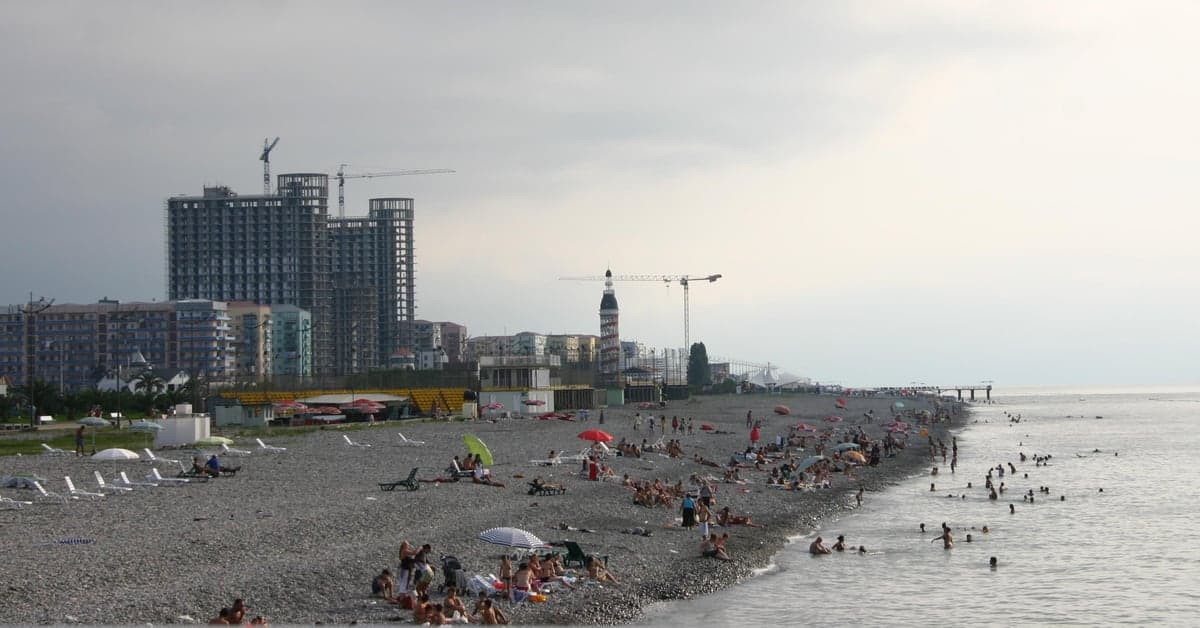
Batumi is the capital of the Adjara region and Georgia's primary Black Sea resort city. The main beach runs along Batumi Boulevard, a 7-kilometer seafront promenade that has been extensively modernized with fountains, sculptures, cycling paths, and botanical gardens. The beach itself is pebbled (not sand), with free public access along its entire length. Sunbed rental costs 5-10 GEL ($2-4 USD) per day.
The water is clean enough for swimming from June through September, with temperatures reaching 24-26 degrees Celsius in July and August. The beach gets crowded during Georgian and Turkish holiday periods, but the long stretch means you can always find space if you walk past the central section. Behind the beach, Batumi's old town has excellent restaurants, wine bars, and a nightlife scene that has grown significantly in recent years.
Batumi's Architecture
Batumi's skyline is an unlikely mix of Belle Epoque buildings, Soviet-era blocks, and modern glass towers including the Alphabet Tower and the Radisson Blu hotel. The city has invested heavily in becoming a regional tourism hub, and while the results are uneven, the ambition is visible. Casino tourism from Turkey brings revenue and a certain energy to the waterfront strip. The contrast between the faded Soviet-era buildings and the gleaming modern towers gives Batumi a distinctive visual character that no other Black Sea city can match.
North of Batumi
Kvariati Beach
Kvariati is a small beach settlement about 15 kilometers south of Batumi, near the Turkish border. The beach is pebbly and less crowded than Batumi's main stretch. The water is notably clear, and the depth increases quickly offshore, making it popular with snorkelers. Guesthouses in Kvariati charge 40-80 GEL ($15-30 USD) per night with breakfast included. Several restaurants serve fresh Black Sea fish and traditional Georgian dishes at local prices.
Gonio Beach
Gonio sits between Batumi and Kvariati, adjacent to the ancient Gonio-Apsaros Fortress, a Roman-era fortification dating to the 1st century AD. The beach is long and pebbly with a gentle entry into the water. The area has seen new apartment and hotel development aimed at Georgian domestic tourists, keeping prices low: a double room in a modern guesthouse costs 60-120 GEL ($22-45 USD) per night in summer.
Kobuleti
The Beach
Kobuleti is a quieter resort town about 25 kilometers north of Batumi, with a 10-kilometer beach of dark pebbles and a wide promenade. The town was a major Soviet-era resort destination and retains some of that architectural character, including large sanatorium buildings now converted to hotels. The beach is less polished than Batumi's but significantly less crowded, and the surrounding pine forests give the area a pleasant, shaded atmosphere.
The water quality at Kobuleti is good, and the gradual depth is suitable for families. Beach facilities include simple restaurants serving khachapuri (cheese bread), kebabs, and watermelon at prices that rarely exceed 15 GEL ($6 USD) for a full meal. The Kobuleti Protected Areas nearby include a managed wetland with hiking trails through subtropical forest.
Ureki: The Magnetic Sand Beach
What Makes Ureki Unique
Ureki, about 50 kilometers north of Batumi, has something no other beach on this list offers: black magnetic sand. The dark sand contains high concentrations of magnetite, and Georgian medical tradition holds that lying on the sand has therapeutic benefits for joint and muscle conditions. Whether the medical claims hold up to rigorous scrutiny is debatable, but the experience of walking on warm black sand with a magnet-like texture is genuinely unusual.
The beach itself is wide and flat, with calm water suitable for children. Ureki is popular with Georgian families and has a bustling summer atmosphere. Accommodation is dominated by family-run guesthouses charging 30-60 GEL ($11-22 USD) per night. The town is small and somewhat chaotic in peak season, with vendors selling everything from inflatables to churchkhela (the grape-and-walnut candy you see all over Georgia).
Anaklia and Ganmukhuri
Anaklia
Anaklia sits near the mouth of the Enguri River, close to the border with the breakaway region of Abkhazia. The beach is a mix of sand and fine gravel, and the setting includes river delta marshland and views across to the restricted Abkhazian coast. The Georgian government has invested in developing Anaklia as a modern resort, with a new bridge, music festival venue, and plans for a deep-water port that have been on-again, off-again for years.
For now, Anaklia is a fascinating, half-realized beach destination with good swimming, minimal crowds outside of festival weekends, and the geopolitical curiosity of being steps from a frozen conflict zone. The annual Anaklia music festival brings electronic music acts from across Europe.
Ganmukhuri
Adjacent to Anaklia, Ganmukhuri has a pine forest backing a quiet beach with dark sand. The area is being marketed for eco-tourism, with forest paths and a calmer atmosphere than the developing Anaklia strip. Accommodation here is limited to a few guesthouses and one or two small hotels. The pine forest trails make for pleasant morning runs or walks before heading to the beach, and the dark sand absorbs heat, staying warm well into the evening hours during summer.
Together, Anaklia and Ganmukhuri represent the future of Georgian coastal tourism: newer, purposefully designed, and attempting to attract visitors who might otherwise default to Turkey or Greece. The infrastructure is still catching up to the ambition, but the beaches themselves are genuinely pleasant, and the prices are lower than anywhere else along the coast.
Practical Information
Getting There
Batumi International Airport receives flights from Istanbul, Dubai, Tel Aviv, and several European cities during summer. Budget airlines (Wizz Air, FlyDubai) operate seasonal routes with fares as low as 30-80 EUR one way. From Tbilisi, the train to Batumi takes 5 hours and costs 25-35 GEL ($9-13 USD), running along a scenic inland route. Marshrutka minibuses are faster at 4 hours but less comfortable.
Best Time to Visit
June through September is swimming season, with July and August being peak months. Water temperature reaches 24-26 degrees Celsius in summer. May and October are shoulder months with pleasant weather but cool water. Winter is mild but rainy along the coast. Batumi receives more rainfall than Tbilisi throughout the year due to its subtropical climate. For more unique European beach destinations, see our guide to northern Spain's beaches.
Budget
Georgia is extraordinarily affordable. A daily budget of 80-120 GEL ($30-45 USD) covers a comfortable guesthouse room, three meals at restaurants (including wine), local transport, and beach sunbed rental. Hotel rooms with sea views start at 100-200 GEL per night. A full Georgian supra (feast) with multiple courses and wine costs 30-50 GEL ($11-19 USD) per person at most restaurants. Check the official Georgian tourism site for current travel requirements.
Frequently Asked Questions
Are Georgia's beaches sandy or pebbly?
Most Georgian Black Sea beaches are pebbly, particularly in and around Batumi. Ureki has black magnetic sand, and Anaklia has a mix of sand and fine gravel. Water shoes are recommended for the pebble beaches, as the stones can be uncomfortable underfoot. The pebbly beaches have the advantage of clearer water, as pebbles do not cloud the water the way sand does.
Is Georgia's Black Sea coast safe for tourists?
Crime against tourists on the coast from Batumi to Anaklia is low, and visitors are generally made welcome. Check current travel advice before you go, because large political protests have taken place in Tbilisi since late 2024. The region near Abkhazia (north of Anaklia) should be approached with awareness, as it borders a frozen conflict zone. Do not attempt to cross into Abkhazia from Georgia without proper authorization. Standard travel precautions apply for petty theft in tourist areas.
How cheap is the Georgian coast compared to Mediterranean destinations?
Georgia's coast is roughly 60-70% cheaper than comparable Mediterranean destinations. A restaurant meal with wine costs $5-10 versus $20-40 in Greece or Croatia. Guesthouses charge $11-30 per night versus $60-150 for similar Mediterranean accommodation. Budget flights from Europe start at 30-80 EUR one way. The overall daily spend is $30-45 compared to $80-150 for a similar experience in Southern Europe.
What is the water temperature in the Black Sea?
Black Sea water temperatures along the Georgian coast reach 24-26 degrees Celsius (75-79 Fahrenheit) in July and August, dropping to 20-22 degrees in June and September. The water is comfortable for swimming from mid-June through mid-September. Outside this window, temperatures drop to 8-15 degrees and swimming is only for the cold-tolerant.
Can you combine a Tbilisi trip with beach time in Batumi?
Absolutely. The overnight train from Tbilisi to Batumi takes 5 hours and costs $9-13. Many travelers spend 3-4 days in Tbilisi, then take the train west for 3-4 days on the coast. Budget airlines also fly between the two cities in under an hour for as little as $15-25 one way. A combined Tbilisi-Batumi trip of 7-10 days is an ideal introduction to Georgia.
What is the black magnetic sand at Ureki beach?
Ureki's sand has a high concentration of magnetite, a naturally magnetic iron oxide mineral. The sand appears dark gray to black and has a slightly different texture than normal beach sand. Georgian folk medicine claims therapeutic benefits from lying on the sand, particularly for arthritis and rheumatism. Scientific evidence for these claims is limited, but the beach experience is genuinely unique.
What food should you eat on the Georgian coast?
Georgian coastal cuisine includes Adjarian khachapuri (boat-shaped cheese bread with an egg, the national dish of the Adjara region), Black Sea fish grilled or fried, lobio (spiced bean stew), and pkhali (walnut-vegetable pastes). Batumi's restaurants also serve excellent khinkali (dumplings) and grilled meats. Wine is exceptional and cheap: a bottle of quality Georgian natural wine costs 15-30 GEL ($6-11 USD) in a restaurant.