The Best Beaches for Collecting Shells and Sea Glass
Table of Contents
Prices in this guide are approximate and change often. Check with the hotel, airline or operator before you book.
Where Beachcombing Produces Actual Finds
Shell collecting and sea glass hunting require specific beach conditions that most popular tourist beaches don't deliver. The best shelling beaches sit near shallow continental shelves with rich mollusk populations, while the best sea glass beaches are near historical dumping sites where decades of wave action have polished broken glass into smooth, frosted gems. This guide covers both, with practical advice on when to go, what to look for, and what you're allowed to take home.
Top Shelling Beaches
Sanibel Island, Florida
Sanibel is the best shelling destination in North America, and it's not close. The island's east-west orientation (most barrier islands run north-south) acts like a scoop for shells carried by Gulf of Mexico currents. Over 250 species of shells wash up on Sanibel's beaches, including junonia (the collector's prize — a cream-and-brown spotted shell found maybe once per 10,000 shells), lightning whelks, horse conchs, and fighting conchs.
The Sanibel Stoop — the bent-over posture of shell hunters scanning the tide line — is so common it's become an official local term. Best conditions: after a westerly wind, during low tide, especially following a storm. Bowman's Beach on the island's west end consistently produces the most shells because fewer people reach it (parking is $5, plus a 10-minute walk through mangroves). Blind Pass Beach, where Sanibel meets Captiva Island, collects shells in the current between the two islands.
The Bailey-Matthews National Shell Museum on Sanibel (admission $24 adults, $15 children) has a living gallery with over 40 aquarium habitats and runs guided beach walks ($15 per person) where marine biologists help identify finds. Important rule: Sanibel prohibits taking live shells — any shell with an animal still inside must be returned to the water. Fines start at $500.
Outer Banks, North Carolina
The Outer Banks' 130-mile barrier island chain catches shells from the convergence of the Gulf Stream (warm, Caribbean species) and the Labrador Current (cold, northern species). Cape Hatteras National Seashore, particularly the stretch near Ocracoke Inlet, produces lettered olive shells, baby's ear shells, scotch bonnets (North Carolina's state shell), and shark teeth.
The best shelling happens after nor'easter storms from October through March, when wave action churns the seabed and deposits material on shore. Early morning, just after high tide turns, is prime time. Ocracoke Island is harder to reach (40-minute ferry from Hatteras Village, free) but rewards the effort with less competition from other collectors. Accommodation on Ocracoke averages $100-180 per night for vacation rentals.
Shell Beach, Western Australia
Shell Beach in Shark Bay, Western Australia, is one of only two beaches in the world made entirely of shells — 110 kilometers of coastline covered in billions of tiny cockle shells (Fragum erugatum) piled up to 10 meters deep. The shells have been accumulating for thousands of years in the hypersaline water of L'Haridon Bight, where few predators survive.
The visual effect is surreal: a blindingly white beach stretching to the horizon, composed entirely of thumb-nail-sized shells. Swimming is possible in the warm, ultra-saline water (you float higher than normal). Shell Beach is part of the Shark Bay World Heritage Area, 45 kilometers from Denham. The nearby Monkey Mia reserve is famous for wild dolphins that swim to shore daily. Accommodation in Denham starts at AUD 120-180 ($80-120) per night.
Jeffreys Bay, South Africa
Known primarily as a surf destination, Jeffreys Bay's Shell Museum Beach (Supertubes area) deposits impressive shells along a 2-kilometer stretch. Pansy shells (sand dollars), cowries, whelks, and spiral turret shells are common finds. The beach faces the Indian Ocean's Agulhas Current, which carries warm-water species south from Mozambique.
Top Sea Glass Beaches
Fort Bragg, California (Glass Beach)
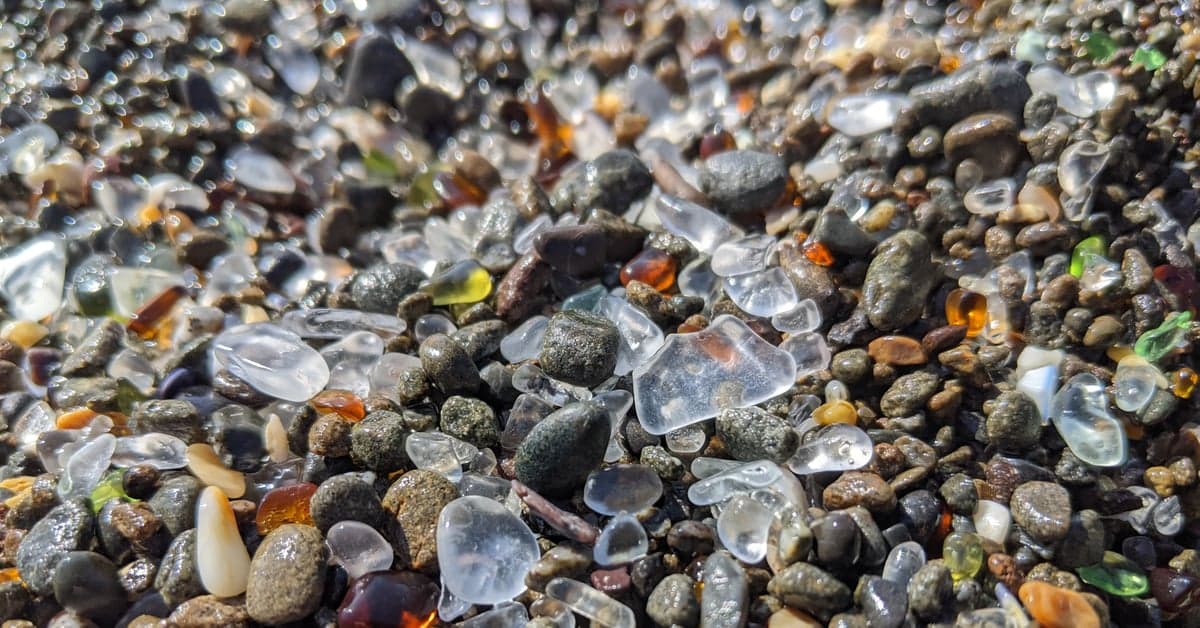
Glass Beach in Fort Bragg exists because the city used the coastal bluff as a dump from 1906 to 1967. After the dump closed, decades of wave action broke down the glass bottles, pottery, and car parts, tumbling the fragments into smooth, colorful pebbles. The beach is now part of MacKerricher State Park (free admission, parking $8).
The glass is primarily green (from beer and wine bottles), white/clear (from household glass), and brown (from medicine and whiskey bottles). Rare colors — cobalt blue, red, purple, and orange — command high prices among collectors (rare pieces sell for $5-50+ on Etsy). The volume of glass has decreased substantially since the beach became famous; what once covered the beach now requires careful searching along the high-tide line and in rocky crevices.
Fort Bragg is 175 miles north of San Francisco via Highway 1. The Beachcomber Motel, a 5-minute walk from Glass Beach, charges $120-200 per night. Silver's at the Wharf restaurant serves fish and chips for $18 and clam chowder for $9.
Seaham Beach, County Durham, England
Seaham claims the title of the world's best sea glass beach, thanks to the Londonderry Bottleworks that operated nearby from 1852 to 1921, dumping glass waste directly into the North Sea. The resulting sea glass washes up in extraordinary variety — multi-colored pieces, swirls, and rare end-of-day glass (mixed colors created when workers cleaned vats at shift's end) that collectors prize highly.
The best hunting happens at low tide along the base of the limestone cliffs south of Seaham Harbour. Winter storms (October-March) produce the freshest deposits. The Seaham area has several B&Bs from £50-80 per night, and the town's fish and chip shops serve cod and chips for £8-10. Browse more coastal destinations for your beachcombing trip.
Bermuda Sea Glass Beaches
Several Bermuda beaches produce quality sea glass, particularly Black Bay Beach (near the Royal Naval Dockyard) and Alexandra Battery Beach Park near St. George's. Bermuda's 400 years of maritime and colonial history — including centuries of bottle disposal into the ocean — feed these beaches with glass in colors ranging from common green and white to rare lavender (from early 20th-century manganese-containing glass that turns purple in UV light).
When and How to Find the Best Pieces
Timing
The best beachcombing conditions are: low tide (the receding water reveals the widest beach area), after storms (wave energy churns the seabed and deposits new material), early morning (before other collectors have scoured the tide line), and during spring tides (the moon's gravitational pull creates the lowest low tides and highest high tides, exposing the most beach).
Full moon and new moon periods produce the most extreme tides. Check tide tables at tide-forecast.com or NOAA's tide prediction page before planning a beachcombing trip.
Technique
Walk the high-tide wrack line — the line of seaweed and debris deposited at the highest point of the last tide. This is where shells and sea glass accumulate. Move slowly and scan a 3-4 foot area ahead of you. Train your eye to notice color and shape differences in the beach material. A mesh bag or bucket with a damp towel protects delicate finds.
Legal Considerations
National parks and marine sanctuaries often prohibit removing natural materials. In the US, collecting seashells for personal use is legal on most public beaches but regulated in national parks (check individual park rules). Live shells — those still containing an animal — are protected in many jurisdictions. Coral collection is prohibited almost everywhere. Sea glass, as man-made debris, is legal to collect in most locations.
International transport: when flying home, declare shells in your customs form if traveling internationally. Some countries (Australia, New Zealand, the US) have strict biosecurity rules that may require cleaning or confiscation of organic material. Read beachcombing tips from fellow travelers on TripAdvisor for destination-specific advice.
Frequently Asked Questions
What is the best beach in the world for shell collecting?
Sanibel Island, Florida is widely considered the best shelling beach in North America, with over 250 species washing ashore. Its east-west orientation acts as a natural shell trap. Bowman's Beach and Blind Pass Beach consistently produce the most finds, especially after westerly winds and storms.
When is the best time to find shells on the beach?
Low tide, early morning, after storms, and during spring tides (around full and new moons) create the best conditions. The combination of a storm followed by a morning low tide is the ideal scenario. Check tide tables before planning a dedicated shelling trip.
Where is the best place to find sea glass?
Fort Bragg, California (Glass Beach) and Seaham Beach, County Durham, England are the two most famous sea glass beaches. Fort Bragg's glass comes from a former dump site; Seaham's from a Victorian bottleworks. Both produce green, white, and brown glass commonly, with rare colors like cobalt blue and red worth $5-50+ per piece.
Is it legal to collect shells from the beach?
On most public beaches in the US and internationally, collecting empty seashells for personal use is legal. However, national parks, marine sanctuaries, and protected areas often prohibit removal of natural materials. Live shells (with animals inside) are protected in many jurisdictions. Always check local regulations before collecting.
Can I bring seashells through airport security and customs?
Yes, seashells can go in checked or carry-on luggage. For international travel, declare shells on your customs form. Australia, New Zealand, and the US have strict biosecurity rules — shells may need to be clean and free of organic material. Coral collection and transport is prohibited in most countries.
What are the rarest seashells to find?
On Sanibel Island, the junonia (spotted cream-and-brown shell) appears roughly once per 10,000 shells and is the most sought-after find. Scotch bonnets (North Carolina's state shell) are uncommon on the Outer Banks. For sea glass, red, orange, and true cobalt blue pieces are the rarest, produced from limited glass sources.
What equipment do I need for beachcombing?
Minimal gear is needed: a mesh bag or bucket, a damp towel to protect fragile finds, and comfortable shoes for walking wet sand. For sea glass, a small scoop or garden trowel helps search rocky crevices. A field guide to shells (or the iNaturalist app) helps with identification. Polarized sunglasses reduce glare and help spot shells in shallow water.