
Beach Packing List: What to Actually Bring for 6 Types of Beach Trips
Table of Contents
Pack to the trip, not the destination
A three-day surf trip to Bali and a ten-day family vacation to the same stretch of Kuta Beach need almost nothing in common. The surfer lives in board shorts and zinc, uses one towel, and needs a fin key. The family of four needs a UV shelter, four sets of rash guards, snacks that survive heat, and a first-aid kit that accounts for scraped knees on lava rock. The destination sets the climate. The trip type sets the bag.
Below is what actually goes in the duffel for six distinct beach trips, why each item earns its spot, and what veterans leave behind.
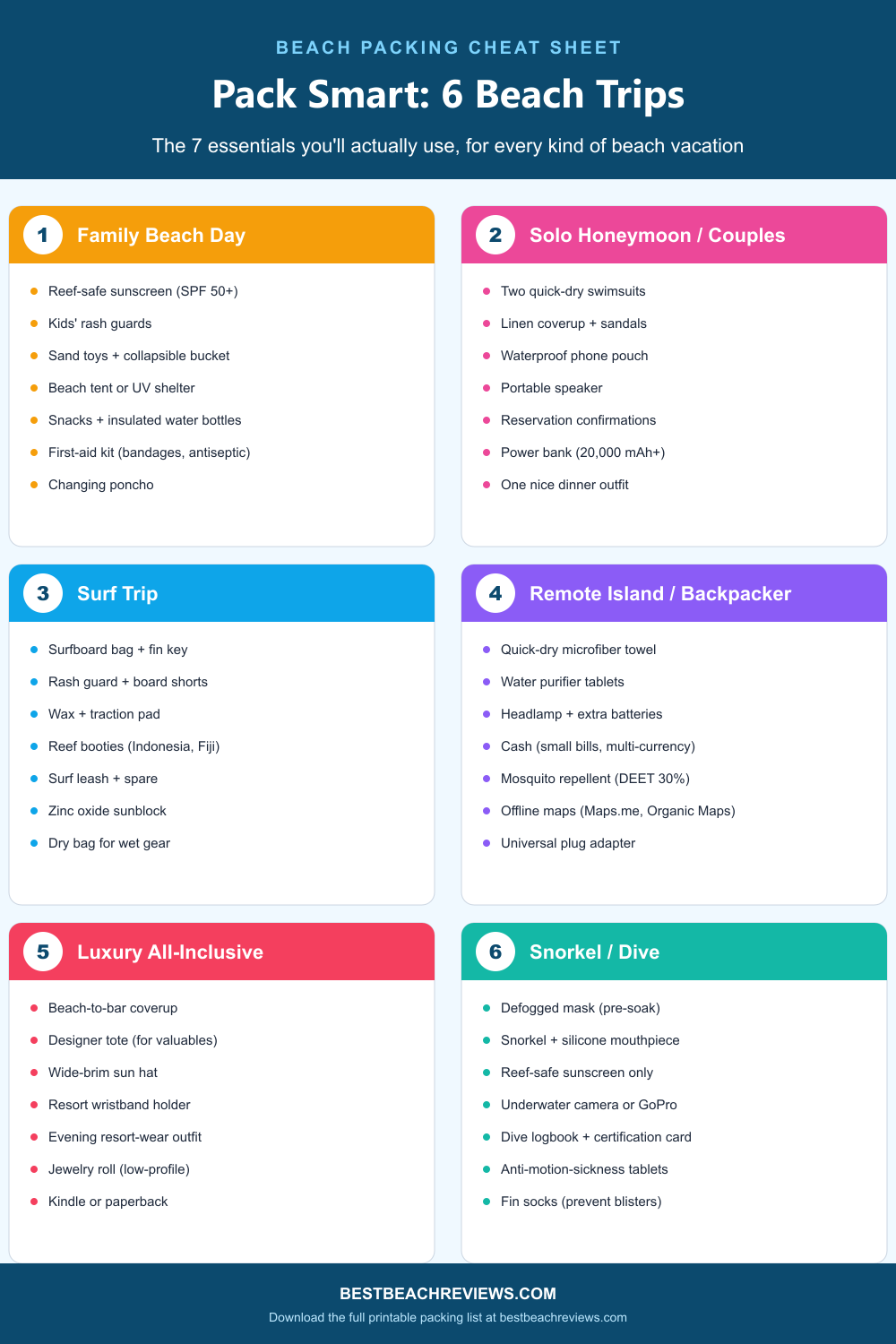
1. Family Beach Day
The math on a family beach day is cruel. Every item you forget costs thirty minutes and roughly $18 at the resort gift shop. Pack once, use all week.
- Reef-safe sunscreen SPF 50+ — Sun Bum Original or Thinkbaby run about $15 a bottle. Mineral zinc formulas are mandatory in Hawaii, Mexico's Yucatan, and Palau.
- Kids' UPF 50 rash guards — One per child, long-sleeve. They beat reapplying lotion every 80 minutes on a squirming four-year-old.
- Sand toys and a collapsible silicone bucket — The collapsible version (around $12) flattens into a suitcase. Rigid plastic buckets are a packing disaster.
- Pop-up beach tent or UV shelter — A Neso Grande or Coleman pop-up gives 50+ UPF shade. Toddlers nap. Adults don't cook.
- Insulated water bottles and real snacks — Hydro Flask keeps water cold for six hours in direct sun. Pack almonds, apples, and cheese sticks, not anything chocolate.
- Compact first-aid kit — Band-aids, tweezers for sea-urchin spines, hydrocortisone, kids' Tylenol, Neosporin. Sand cuts happen hourly.
- Changing poncho — A hooded microfiber poncho lets kids (and adults) change at the beach without a meltdown or a wet car seat.
2. Honeymoon or Couples Trip
The goal here is looking put-together without checking a second bag. Two of everything you actually use, one of everything nice.
- Two quick-dry swimsuits each — You will always want a dry one while the other drips on the balcony railing. Non-negotiable.
- Linen coverup and leather sandals — A linen shirt or slip dress takes you from pool to lunch without a wardrobe change.
- Waterproof phone pouch — JOTO and Mpow pouches cost $8 and save a $1,200 phone. Float versions are worth the extra $4.
- Portable Bluetooth speaker — A JBL Clip 4 (IP67-rated) survives pool splashes. Your hotel room speaker is always worse than you hope.
- Printed reservation confirmations — For the snorkel charter, the couples massage, the restaurant that won't honor a bad data connection. Paper works when Wi-Fi doesn't.
- 20,000 mAh power bank — Anker 737 or similar. All-day excursions drain phones fast, especially with photos and offline maps running.
- One nice dinner outfit — Most boutique hotels have a no-swimwear dinner policy. A linen shirt and chinos, or a wrap dress, covers every venue short of a Michelin room.
3. Surf Trip
Surf packing is ruthless. Everything earns its weight, and your board bag counts as your checked luggage on most airlines.
- Padded board bag and fin key — Dakine Daylight or Pro Lite models protect against baggage handlers. Tape the fin key to the bag; surf shops overseas charge a premium.
- Rash guard and board shorts — A UPF long-sleeve prevents wax rash on your sternum after day two. Vissla and Patagonia make durable options.
- Surf wax and spare traction pad — Match wax to water temp (Mr. Zogs Sex Wax Warm for most tropical trips). A spare tail pad saves a wrecked session.
- Reef booties — Required in Indonesia, Fiji, and most Pacific reef breaks. 3mm split-toe booties protect against stonefish, urchins, and live coral.
- Two surf leashes — Leashes snap. Replacing one in Nias or G-Land is hard. A 6- or 7-foot leash runs about $25.
- Zinc oxide sunblock — Vertra or Headhunter sticks don't run into your eyes on a four-hour paddle session.
- 10L roll-top dry bag — Sea to Summit or Earth Pak. Keeps phone, passport, and keys dry on boat transfers.
4. Remote Island or Backpacker Trip
Infrastructure gets thinner the farther you go. The Gili Islands have no cars. Siargao had no ATM during a 2022 outage. Pack the self-sufficiency kit.
- Microfiber towel — A Rainleaf or PackTowl dries in 20 minutes and folds to paperback size. Hostels rarely supply towels.
- Water purifier tablets or filter — Aquatabs cost pennies per liter. A Grayl GeoPress ($100) filters viruses and sediment in 15 seconds.
- Headlamp with extra batteries — Power cuts are routine on remote islands. Black Diamond Spot runs about $40 and frees your hands for finding the bungalow path.
- Cash in small bills, multiple currencies — US dollars under $20 get taken everywhere. Bring small-denomination local currency on arrival. Card readers are optional on most outer islands.
- DEET 30% mosquito repellent — Picaridin works for sensitive skin. Dengue and malaria are real risks in parts of Southeast Asia and the South Pacific.
- Offline maps — Download Maps.me or Organic Maps before leaving Wi-Fi. Google Maps coverage degrades fast past the ferry pier.
- Universal plug adapter — A multi-port adapter with USB-C handles most of Southeast Asia, where outlets shift between Type A, C, and G within the same guesthouse.
5. Luxury All-Inclusive
At a high-end resort, the hotel supplies the towels, the umbrellas, the water, the sunscreen, and sometimes the flip-flops. You pack for the version of yourself who wants to look good at dinner.
- Beach-to-bar coverup — A kaftan or linen wrap lets you walk from lounger to lobby bar without changing.
- Designer tote for valuables — A Longchamp Le Pliage folds flat and holds passport, phone, and Kindle for day excursions.
- Wide-brim sun hat — Packable straw (Lack of Color, Madewell). Your face thanks you at the rehearsal dinner five months later.
- Wristband holder — A silicone sleeve keeps the all-inclusive bracelet from irritating your skin and looks less gimmicky in photos.
- Evening resort-wear outfit — At least one collared shirt or midi dress. Sandals and Smart Casual is the standard dress code at Sandals, Excellence, and most Four Seasons properties.
- Jewelry roll — A soft-sided Cuyana or Mark & Graham roll keeps earrings separate and untangled.
- Kindle or paperback — Resort Wi-Fi is slow. A Kindle Paperwhite holds a year of reading and survives poolside splashes.
6. Snorkel or Dive Trip
Equipment you trust matters more than equipment you own. That said, a few items are worth the suitcase space.
- Pre-soaked, defogged mask — Scrub the inside with toothpaste before the trip to strip manufacturing film. A clear mask on dive one is the single biggest quality-of-life upgrade.
- Snorkel with silicone mouthpiece — Rental mouthpieces are chewed, hard plastic. A personal silicone snorkel costs $25 and saves your jaw.
- Reef-safe sunscreen only — Oxybenzone and octinoxate bleach coral. Hawaii, Mexico, and Bonaire enforce this by law.
- GoPro Hero or equivalent — A Hero 12 with a red filter handles 10m+ visibility. Include a floating hand strap; the ocean floor keeps the ones you drop.
- Dive logbook and certification card — PADI or SSI operators require your C-card for anything beyond a discover-scuba. A plastic sleeve keeps it readable after boat spray.
- Anti-motion-sickness tablets — Bonine (meclizine) works without the drowsiness of Dramamine. Take it 30 minutes before the boat leaves the dock.
- Fin socks — Neoprene socks prevent blisters on rental fins. Two long dive days without them will end the trip early.
The universal 5 essentials
If you strip every list above to the bone, these five items go on every beach trip, every time.
- Reef-safe sunscreen — SPF 30+ mineral-based. Legal requirement in a growing list of destinations.
- Reusable water bottle — A 32oz insulated bottle saves you $5 and one plastic bottle per day.
- Sandals you can afford to lose — Havaianas at $22 beat leather sandals that warp in saltwater.
- Small first-aid kit — Band-aids, antiseptic wipes, tweezers, ibuprofen, antihistamine. Fits in a ziplock.
- A book or Kindle — Beach downtime is the point. Don't spend it doomscrolling.
What not to pack
The wrong items add weight, cost luggage fees, and cause stress when they get lost or stolen. Leave these at home.
- Full-size toiletries — Any hotel above two stars provides shampoo, conditioner, and soap. Bring travel-size only for the first night and resupply if needed.
- Single-use water shoes — The kind that fall apart after one beach day. Invest in real reef booties or skip them.
- Full-size electronics — Laptops, DSLRs with three lenses, iPads. A phone and a GoPro cover 95% of beach-trip photography without the anxiety.
- Anything sentimental or expensive you'd stress about losing — Engagement rings, inherited watches, designer sunglasses you'd cry over. Hotel safes fail. Tides take things.
- Cotton towels — They weigh four times a microfiber towel, take six hours to dry in humid air, and smell like mildew by day three.
Lay everything out on the bed the night before. Anything that doesn't map to a specific activity on the itinerary goes back in the closet. The best beach bag is the one you don't notice carrying.
Frequently Asked Questions
What should I pack for a week at the beach?
For a week-long beach trip, plan on two swimsuits, one coverup, two pairs of sandals (one dressy, one disposable), reef-safe sunscreen SPF 50+, a microfiber towel, a 20,000 mAh power bank, and one dinner outfit. Almost every hotel above two stars supplies bath towels, shampoo, and conditioner, so skip full-size toiletries. Add activity-specific gear only for the actual activities on your itinerary.
What is the most important thing to pack for the beach?
Reef-safe mineral sunscreen (SPF 30+, zinc or titanium dioxide) is the single item no beach trip should skip. Oxybenzone and octinoxate are now banned in Hawaii, parts of Mexico, Palau, and Bonaire, so standard chemical sunscreens can be confiscated or fined. A single $15 bottle of Sun Bum or Thinksport covers most trips.
Do I need to bring beach towels to a resort?
No. Any resort charging more than about $150 a night provides beach towels at the pool and often at the beach entrance, usually in exchange for a room key or wristband. Bringing your own bath towel from home wastes 2-3 pounds of luggage weight. Budget guesthouses and hostels are the exception, where a microfiber travel towel is essential.
What beach gear should I leave at home?
Leave full-size toiletries, cotton towels, cheap single-use water shoes, bulky electronics like laptops and DSLR kits, and any jewelry or accessories you would stress about losing. Hotel safes get broken into, sand destroys camera lenses, and the ocean takes exactly what you tell it not to.
How do you pack a carry-on for a beach vacation?
Roll two quick-dry swimsuits, one linen coverup, one dinner outfit, two t-shirts, one pair of shorts, underwear, and one pair of sandals into packing cubes. Wear your bulkiest shoes and jacket onto the plane. Keep a 3-1-1 liquids bag for travel-size sunscreen, toothpaste, and any prescription medications, and pack electronics plus a power bank in the personal item.
How do you pack for the beach without forgetting anything?
Build a reusable checklist organized by category (swimwear, sun protection, electronics, documents, activity-specific gear) and print it before every trip. Lay every item out on the bed the night before, then cross it off the list as it goes into the bag. A second pass the morning of the flight catches the phone charger and the reef-safe sunscreen almost everyone forgets.

