Beach Flag Warning Colors: What Each Flag Means in the US, UK and Australia
Table of Contents
Prices in this guide are approximate and change often. Check with the hotel, airline or operator before you book.
Why Beach Flags Exist (and Why They Disagree)
Beach flags are the quickest safety information you get on any lifeguarded shoreline, and the same color does not always mean the same thing. A single red flag in Florida means "high hazard"; a single red flag on a lifeguarded beach in Cornwall or on Australia's Gold Coast means "do not go in the water at all." The International Life Saving Federation (ILS) recommends a common set of beach safety flags, and the international standard ISO 20712-2 specifies colors, shapes and meanings, but national lifesaving bodies still run their own systems. In the US that is the United States Lifesaving Association (USLA) flag program; in the UK it is the RNLI; in Australia, Surf Life Saving Australia.
The practical rule: before you get in, read the sign that explains the flags at that beach (most lifeguarded beaches post one at the access point) or ask the lifeguard.
The US Hazard Flags (USLA and Florida)
Most US lifeguard agencies use the USLA system, and Florida has written a version of it into state law: section 380.276 of the Florida Statutes created a uniform beach warning flag program, run by the state's Department of Environmental Protection, that requires public beaches flying warning flags to use only the state's flags, with signs explaining each one.
| Flag | Meaning (US) |
|---|---|
| Double red | Water closed to the public |
| Red | High hazard: high surf and/or strong currents |
| Yellow | Medium hazard: moderate surf and/or currents |
| Green | Low hazard: calm conditions, exercise caution |
| Purple | Dangerous marine life (for example jellyfish or stingrays) |
Double Red: Water Closed
Two red flags, usually one above the other on the same pole, mean the water is closed. On the Florida Panhandle it is enforced: Walton County's tourism office warns that entering the Gulf during double red flag conditions can result in a $500 fine and criminal charges. Other jurisdictions have their own ordinances, so treat double red as a legal closure everywhere.
Single Red: High Hazard
In the US system a single red flag means high surf, strong currents, or both. The water is not formally closed, but these are the conditions in which rip currents (the cause of most surf-beach rescues) are strongest, and anyone who is not an experienced surf swimmer should stay out. On an Outer Banks or Jersey Shore red-flag morning, that means watching from the sand.
Yellow: Medium Hazard
Yellow means moderate surf or currents. Swim near a lifeguard, avoid floats and inflatables, and keep children within arm's reach. It is one of the most common flags on a typical summer day.
Green: Low Hazard
Green means calm conditions, but the USLA wording is "exercise caution," not "safe." Rip currents can form on calm, sunny days. Note that Australia and the UK do not use a green hazard flag at all.
Purple: Dangerous Marine Life
Purple warns of marine life that can hurt you, such as jellyfish, Portuguese man o' war or stingrays. It is flown alongside a hazard flag rather than instead of one, so purple with yellow means moderate surf plus marine life.
Zone Flags: Where to Swim and Where to Surf
Red and Yellow: Swim Between the Flags
A pair of flags split horizontally, red on top and yellow below, marks the lifeguarded swimming area. This is the signature flag of Surf Life Saving Australia and New Zealand, and the RNLI uses red and yellow flags the same way in the UK: swim, bodyboard and use inflatables only between them, where lifeguards are watching. Outside the flags you are not being supervised.
Black and White Chequered: Craft Zone
Black and white quartered (chequered) flags mark the area set aside for surfboards, stand-up paddleboards, kayaks and other non-powered craft. Swimmers and bodyboarders should stay out of it. This is the standard on RNLI beaches in the UK and on Australian patrolled beaches.
Orange Windsock: No Inflatables
On RNLI beaches an orange windsock shows the wind direction and strength. When it is flying, do not use inflatables, because an offshore wind can carry them (and a child on them) out to sea quickly.
Black Ball: No Surfing (California)
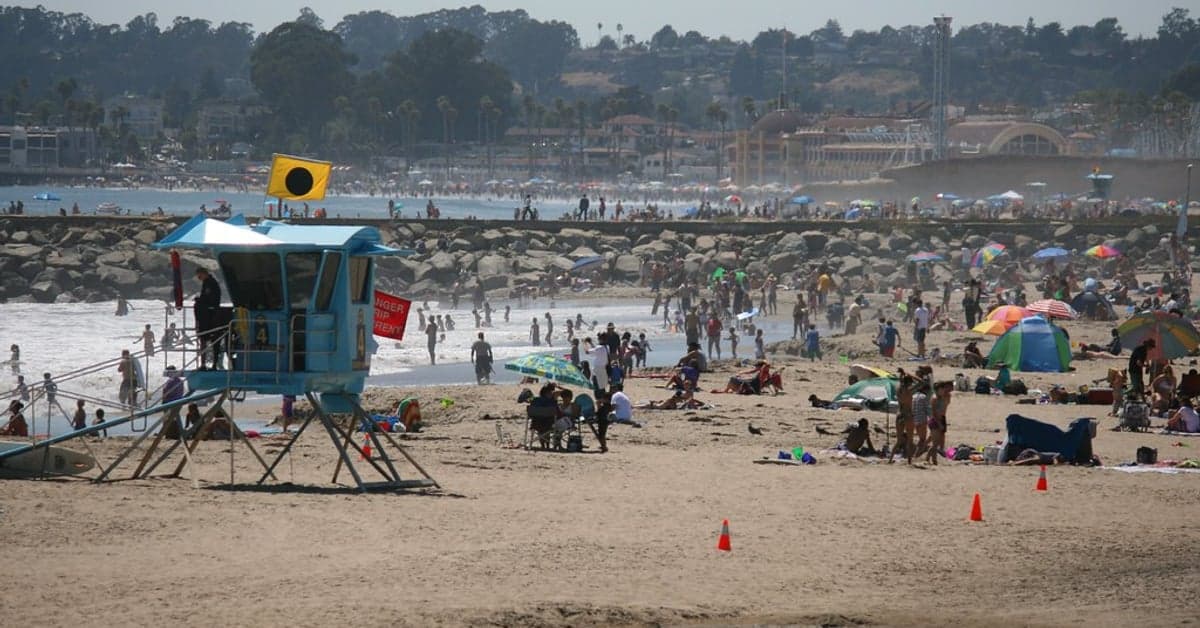
A yellow flag with a solid black circle means surfboards and other hard craft are banned in that section of water, which is reserved for swimmers. You will see "black ball" flags at Southern California beaches such as Huntington Beach and Newport Beach, usually on busy summer days.
Country-by-Country Differences
United States: USLA colors as in the table above, with Florida's version set by state law. California adds black ball surfing restrictions. Hawaii relies heavily on posted warning signs at lifeguard towers, and high surf advisories and warnings come from the National Weather Service office in Honolulu.
Australia and New Zealand: The system is built around the red and yellow patrolled zone. A red flag means the beach is closed to swimming. A yellow flag means caution: potential hazards in the water. There is no green flag. On unpatrolled beaches there are no flags at all.
United Kingdom: RNLI lifeguards use red and yellow flags for the swimming zone, black and white chequered flags for the craft zone, a red flag for danger (never go in the water when it is flying) and the orange windsock for wind.
Spain, France and the Mediterranean: Green, yellow and red hazard flags are standard, but the details, including how jellyfish are signalled, vary by region and town; some beaches use a purple flag or a sign with a jellyfish pictogram at the lifeguard post. Do not confuse any of these with the Blue Flag, which is an eco-label awarded to beaches for water quality and management and says nothing about today's conditions.
Brazil: The state fire departments (Corpo de Bombeiros) run lifeguard services in Rio de Janeiro, São Paulo and most coastal states. In Recife, in Pernambuco state, shark warning signs line the city beaches after a series of attacks recorded since the early 1990s; take them literally.
What No Flag Means
No flag usually means no lifeguard on duty. It does not mean the water is safe. Small municipal beaches, rural coastline and any beach outside its posted lifeguard hours are unpatrolled. The difference is large: the National Weather Service, citing the USLA, puts the chance of drowning at a beach with lifeguards at 1 in 18 million.
Before You Swim: A Practical Checklist
- Find the flags and the sign that explains them. Walk to the lifeguard tower first. If there is no tower, look for posted signage.
- Ask the lifeguard. Thirty seconds of conversation will tell you about rip locations, sandbar gaps and marine life that no flag can communicate.
- Scan for rip currents. The National Weather Service lists the signs: a gap in the line of breaking waves, a channel of choppy or darker water heading out, and foam or sandy water moving seaward. Our guide to reading ocean currents and waves covers them in detail.
- Be honest about your swimming. Ocean swimming is not pool swimming. If you have not swum in surf recently, treat yellow as red.
- Do not swim alone at an unfamiliar beach. Someone on the sand who is watching you can call for help if you get into trouble.
When Flags Are Missing or Out of Date
Flags reflect conditions when they were raised. After overnight storms, poles blow down and lifeguards may not arrive for hours. Many small village beaches in Greece, southern Italy and Croatia have no flag system at all. The morning after a storm, rip currents can be stronger than usual even under a clear sky. Trust what you see: if the surf is bigger than it was yesterday, yesterday's flag no longer applies.
Flag systems reduce risk; they do not remove it. Read them, respect them, and treat them as the start of your judgement, not the end. For more on rip currents and sun protection, see our beach safety guide.
Frequently Asked Questions
What does a double red flag mean at the beach?
In the US system, two red flags mean the water is closed to the public. Some jurisdictions enforce it: Walton County, Florida warns that entering the Gulf during double red flag conditions can result in a $500 fine and criminal charges.
What does a single red flag mean?
It depends on the country. In the US (USLA and Florida), a single red flag means high hazard: high surf and/or strong currents. On RNLI beaches in the UK and on Australian patrolled beaches, a red flag means do not go in the water at all.
Is a purple flag at the beach dangerous?
A purple flag warns of dangerous marine life, such as jellyfish, Portuguese man o' war or stingrays. It is flown alongside a hazard flag, so purple with yellow means moderate surf plus marine life.
What do the red and yellow flags on Australian and UK beaches mean?
A pair of flags, red on top and yellow below, marks the lifeguarded swimming area. Swim between them. Black and white chequered flags mark the separate zone for surfboards, kayaks and other craft, where swimmers should not go.
What does a black ball flag mean in California?
A yellow flag with a solid black circle means surfboards and other hard craft are banned in that section of water, which is reserved for swimmers. It is common on busy summer days at Southern California beaches such as Huntington Beach and Newport Beach.
Does no flag on the beach mean it is safe to swim?
No. No flag usually means no lifeguard is on duty, not that conditions are safe. The National Weather Service, citing the USLA, puts the chance of drowning at a lifeguarded beach at 1 in 18 million, so swim near a lifeguard whenever you can.
Is the Blue Flag a warning flag?
No. The Blue Flag is an eco-label awarded to beaches for water quality, safety services and environmental management. It says nothing about today's surf or marine life. Jellyfish warnings in Spain and elsewhere in the Mediterranean vary by region, so check the sign at the lifeguard post.