The Best Beach Destinations Accessible by Train in Europe
Table of Contents
Prices in this guide are approximate and change often. Check with the hotel, airline or operator before you book.
Why Take the Train to the Beach
European rail networks connect major cities to coastal destinations that budget airlines can't reach without airport transfers, shuttle buses, and the general airport experience. A train pulls into a station in the town center, often within walking distance of the beach. No baggage fees, no liquids restrictions, no two-hour pre-departure security lines. You watch the scenery shift from urban to rural to coastal through a window with legroom. And the carbon footprint of a train journey is roughly 90% lower than an equivalent flight.
The destinations below are all reachable by direct or single-change train journeys from major European cities. Travel times are competitive with flying when you factor in airport transfers on both ends and the time spent in terminals. For most of these routes, booking 2-4 weeks in advance on Trainline, SNCF, Renfe, or Trenitalia secures significantly discounted fares.
France
Nice and the Cote d'Azur
The TGV from Paris Gare de Lyon to Nice takes 5 hours 30 minutes, depositing you at Nice-Ville station, a 15-minute walk from the Promenade des Anglais and the beach. Advance fares start at EUR 35; standard fares run EUR 80-$120. From Nice, regional TER trains run along the coast to Villefranche-sur-Mer (10 minutes), Monaco (25 minutes), Menton (35 minutes), Antibes (25 minutes), and Cannes (35 minutes) for EUR 3-$10 each way.
The Cote d'Azur beaches are mostly pebble rather than sand (a detail that surprises first-time visitors), but the water is clear Mediterranean blue and warm from June through September (22-26°C). Villefranche-sur-Mer has one of the prettiest small beaches on the coast — a sandy crescent in a sheltered bay with colorful buildings rising behind it. Antibes' Plage de la Gravette is sandy and sheltered within the old port walls. The coastal train line itself is scenic, running along clifftops with ocean views.
Biarritz and the Basque Coast
The TGV from Paris Montparnasse to Biarritz takes 4 hours 20 minutes. Advance fares start at EUR 29. Biarritz station is a 10-minute bus ride or taxi from the Grande Plage, the town's main beach — a wide sandy crescent backed by Belle Epoque architecture and the Casino Municipal. Biarritz is France's surf capital, with consistent Atlantic waves from spring through fall. The Cote des Basques, a longer beach south of the town center, is the best surf break and also offers a dramatic cliff-backed setting.
From Biarritz, trains and buses connect to Saint-Jean-de-Luz (25 minutes), a quieter Basque fishing town with a sheltered sandy beach that's calmer and better for swimming with children. The Basque coast combines French sophistication with a distinct Basque identity — the food alone (pintxos, seafood, Basque cider) justifies the trip. San Sebastian in Spain is only 50 minutes away by bus, making cross-border day trips easy.
Spain
Barcelona and the Costa Brava
Barcelona's Barceloneta Beach is a 15-minute metro ride from Sants station, where high-speed AVE trains arrive from Madrid (2.5 hours, from EUR 25), Seville (5.5 hours, from EUR 35), and other Spanish cities. Barceloneta is a wide city beach with decent sand, warm water (June-September, 23-26°C), and the full energy of a major Mediterranean city steps away.
For better beaches, take a Rodalies commuter train north from Barcelona. Sitges (35 minutes, EUR 5) is a lively town with a long sandy beach and a vibrant cultural scene. Calella de Palafrugell on the Costa Brava requires a train to Girona (38 minutes by AVE from Barcelona) then a bus, but the reward is a string of cove beaches with turquoise water, pine-shaded paths between them, and a character that feels distinctly Catalan rather than generically tourist.
San Sebastian
San Sebastian (Donostia in Basque) is reachable by Renfe train from Madrid (5.5 hours, from EUR 30) or by Euskotren from Bilbao (2.5 hours, EUR 7). La Concha Beach, a perfect scallop-shaped bay with fine golden sand and calm water, is consistently rated among the best urban beaches in Europe. The old town (Parte Vieja) backing the beach is one of the world's great food destinations — pintxo bars line every street, and the city has more Michelin stars per capita than almost anywhere else.
La Concha is best from June through September when the Bay of Biscay warms to 20-23°C. Spring and autumn bring cooler water but pleasant air temperatures and smaller crowds. Surfers head to Zurriola Beach on the opposite side of Monte Urgull, where consistent Atlantic swells provide reliable waves year-round.
Italy
Cinque Terre
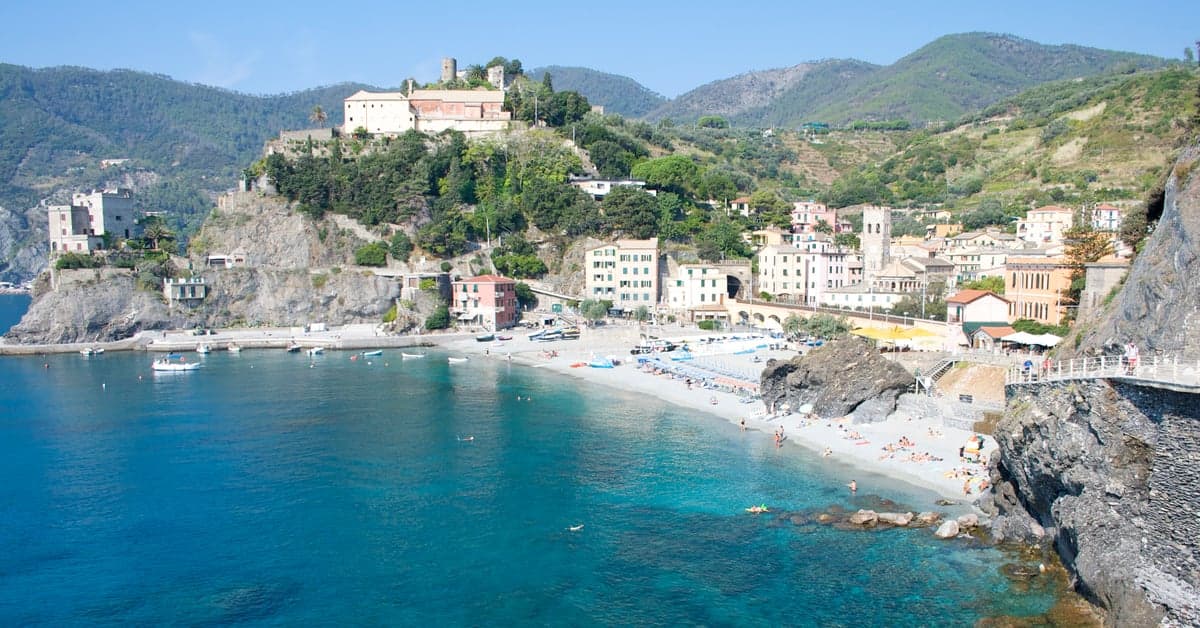
The five villages of Cinque Terre (Monterosso al Mare, Vernazza, Corniglia, Manarola, Riomaggiore) cling to the Ligurian coastline between Genoa and La Spezia. Regional trains from La Spezia reach the first village (Riomaggiore) in 8 minutes and run between all five villages every 15-30 minutes for a few euros per ride. Fares go up in high season, and the Cinque Terre Card covers unlimited rides. La Spezia connects to Milan (3 hours), Florence (2.5 hours), and Rome (3.5 hours) via high-speed Trenitalia and Italo trains.
Monterosso has the only proper sandy beach in Cinque Terre — a wide stretch with paid sections (loungers and umbrellas for EUR 25-$40/day) and a free public section. The other villages have rocky swimming areas and small pebble beaches. Vernazza's tiny harbor beach is picturesque but crowded. The real draw of Cinque Terre is the combination of coastal scenery, village character, and the hiking trails connecting the villages — not beach sunbathing per se.
Puglia's Adriatic Coast
Trenitalia trains from Rome reach Bari in 4 hours (from EUR 20). From Bari, regional trains connect to Polignano a Mare (30 minutes), where the old town perches on a cliff above a sheltered cove beach — Lama Monachile — that's one of the most photographed beaches in Italy. The cove is small and heavily visited in July and August; June and September offer the same swimming with fewer people.
Further south, trains reach Lecce (1.5 hours from Bari), the gateway to the Salento peninsula's Ionian and Adriatic beaches. Renting a car from Lecce opens access to beaches like Punta Prosciutto (shallow turquoise water, Caribbean-like sand) and Porto Selvaggio (a rocky beach within a nature reserve), but some coastal towns like Gallipoli and Otranto are reachable by bus from Lecce. Browse our Europe beach destination guides for more Italian coastal options.
Portugal
Cascais and the Lisbon Coast
Cascais sits at the end of the Lisbon-Cascais commuter train line — 35 minutes and EUR 2.30 from Lisbon's Cais do Sodre station. The train runs along the Tagus estuary and then the coast, with views of the water for most of the journey. Cascais itself has several small sandy beaches within the town, but the standout is Praia do Guincho, a wide, windswept beach 5 km west of Cascais (reachable by local bus) that's famous for surfing and kitesurfing.
The commuter train makes Cascais work as a day trip from Lisbon or a quieter base for exploring the capital. Hotels in Cascais are 30-50% cheaper than equivalent options in central Lisbon. The seafood restaurants along the Cascais waterfront are excellent, particularly Casa da Guia and the casual fish restaurants near the fish market.
Lagos, Algarve
The train from Lisbon to Lagos takes approximately 4 hours with a change at Tunes (from EUR 22). Lagos station is a 10-minute walk from the town center and the beaches. Praia Dona Ana, reached by a 15-minute walk or short taxi from town, is a series of golden sand coves set between sculpted sandstone cliffs — one of the most dramatic beach settings in Europe. Praia do Camilo, nearby, is a tiny cove accessed by 200 wooden steps, with clear water and towering cliff walls.
Greece
Pelion Peninsula (from Athens via Volos)
Greece's limited rail network makes train-to-beach travel less straightforward than in Western Europe, but one route works well: the train from Athens to Volos (3.5-4 hours, from EUR 15), gateway to the Pelion Peninsula. The Pelion is a mountainous finger of land jutting into the Aegean between the Pagasetic Gulf and the open sea. The east coast beaches — Mylopotamos, Fakistra, Papa Nero — have turquoise water, white pebble sand, and mountain backdrops that rival anything in the Greek islands.
From Volos, local buses and the historic narrow-gauge Pelion Railway (a restored steam train operating seasonally) connect to villages on the peninsula. Renting a car in Volos makes beach access easier, but the bus to popular beaches like Agios Ioannis runs regularly during summer. The Pelion is less visited by international tourists than the islands, keeping prices lower and authenticity higher. The Trainline app books most European rail journeys in a single interface with e-tickets.
Practical Tips
Booking Strategies
European rail fares follow airline-style dynamic pricing: book early for the cheapest fares. SNCF (France), Renfe (Spain), and Trenitalia (Italy) release tickets 3-4 months before travel. The first tickets sold are often 60-70% cheaper than last-minute prices. Interrail/Eurail passes can offer value for multi-country itineraries, but for single-destination trips, point-to-point advance tickets are usually cheaper.
What to Pack for Train-to-Beach Travel
The beauty of train travel is that luggage is unconstrained by airline baggage limits. Bring a full-size suitcase, a beach bag, snorkel gear — whatever you want. Overhead racks and end-of-car luggage areas accommodate large bags. Bring food and drinks for the journey (most European stations have excellent bakeries and delis). First-class upgrades on many routes cost EUR 15-$30 more than second class and provide wider seats, power outlets, and quieter carriages.
Frequently Asked Questions
What is the best train-accessible beach in Europe?
San Sebastian's La Concha Beach is arguably the best urban beach in Europe and is directly accessible by train from Madrid (5.5 hours) and Bilbao (2.5 hours). For dramatic scenery, Lagos in Portugal's Algarve (4 hours from Lisbon) offers cliff-backed coves. For the combination of beach and culture, Barcelona's Barceloneta is a metro ride from the main train station.
How much cheaper is train travel than flying to European beaches?
Advance train fares are often comparable to or cheaper than budget airline tickets when you factor in airport transfers, baggage fees, and seat selection charges. Paris to Nice starts at EUR 35 by TGV vs. EUR 30-80 by budget airline plus EUR 15-20 for airport transfers on each end. The train also saves 3-4 hours of airport time.
When should I book European train tickets for the best prices?
Book 2-4 months in advance for the best fares. SNCF (France), Renfe (Spain), and Trenitalia (Italy) release tickets 3-4 months before travel. Early-bird fares are often 60-70% cheaper than last-minute prices. Use the Trainline app for cross-border bookings in a single interface.
Is a Eurail pass worth it for a beach trip?
For a single-destination beach trip, point-to-point advance tickets are usually cheaper than a Eurail pass. Passes offer better value for multi-country itineraries covering 3+ countries with frequent train travel. Calculate the cost of individual tickets for your planned routes before committing to a pass.
Can I bring beach gear on European trains?
Yes. European trains have no baggage weight or size limits like airlines. Overhead racks and end-of-car luggage areas accommodate full-size suitcases, beach bags, surfboards (on many regional trains), and other gear. This is one of the main advantages of train travel for beach vacations.
What is the fastest train-to-beach route from a major European city?
Lisbon to Cascais takes just 35 minutes by commuter train for EUR 2.30 and drops you within walking distance of several beaches. Barcelona to Sitges is 35 minutes. Nice's beaches are a 15-minute walk from the TGV station. Bari to Polignano a Mare is 30 minutes by regional train.
Are European beach trains crowded in summer?
Popular routes (Lisbon-Cascais, Barcelona-Sitges, Nice coastal trains) can be crowded on summer weekends and holidays. Travel midweek or buy reserved seats on high-speed trains. Regional and commuter trains are usually first-come, first-served — board early for the best seats. Coastal routes in shoulder season (May, June, September) are significantly less crowded.