How to Build a Sand Castle Like a Pro
Table of Contents
The Science Behind Great Sand Castles
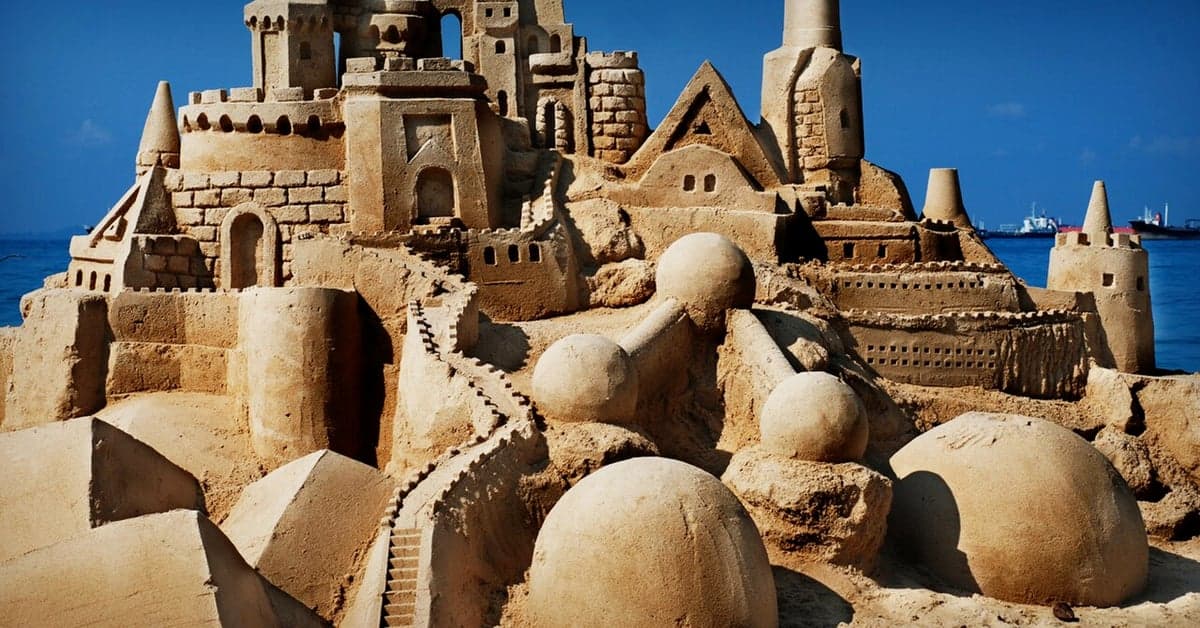
Competition sand sculptors build pieces several metres tall that hold fine detail for days or weeks. The Guinness World Record for the tallest sandcastle is 21.16 m (69 ft 5 in), built by Skulpturparken Blokhus in Blokhus, Denmark, on July 2, 2021. None of that depends on special sand or secret additives. It depends on water and compaction. Sand grains are irregular, and when a small amount of water sits between them, surface tension forms tiny liquid bridges that hold the grains together. Too little water and the sand crumbles. Too much and it flows.
The amount of water that gives the strongest sand is smaller than most people expect. A 2012 study in Scientific Reports by physicists at the University of Amsterdam found that sand is strongest at about 1% water by volume; beyond that, the liquid bridges merge into larger, weaker pockets. You will not measure 1% on a beach. In practice, builders start with sand wet enough to pour, then shake and press it so the excess water drains away. What stays behind is close to that optimum, which is exactly what the pancake method below does.
Grain shape matters too. Angular grains with a mix of sizes lock together better than uniform, rounded grains, because the small grains fill the gaps between the large ones. If a wet handful squeezed in your fist holds a firm shape when you open your hand, the sand will build. If it slumps or falls apart, move to a different part of the beach or add more compaction.
Essential Tools
What the Pros Use
You don't need specialty equipment to build a castle far better than the average beach pile. Here's a kit that fits in a bucket: one 5-gallon bucket (for hauling water and packing sand), one standard beach pail (for shaping towers), a small garden trowel or flat-edge spatula or putty knife (for carving walls), a plastic knife or palette knife (for detail work), a melon baller (for clean, round windows and arches), a drinking straw (for blowing loose sand out of carved details), and a spray bottle (for keeping the surface damp while you work).
Skip the plastic castle molds that come with children's beach toy sets. They produce weak, generic shapes because they don't compact the sand densely enough. Hand-packing and carving, described below, produce stronger, more detailed results with basic tools.
The One Tool That Changes Everything
A spray bottle filled with water is the single most useful sand castle tool. Keeping the surface lightly misted while you carve stops it drying and crumbling. Sculptors working on large pieces use pump-action garden sprayers; for a beach castle, a standard 16-ounce spray bottle is enough. Mist, don't soak: a fine spray keeps the moisture balance without washing away your work.
Building the Foundation
Choosing Your Location
Find the line of dried seaweed and debris on the beach (the wrack line). That marks roughly where the last high tide reached. A castle built above it will survive the next tide; one built below it will not. The firm, damp sand just below the wrack line is easier to pack, so if you want to build there, check a NOAA tide prediction for your beach and start soon after high tide. Most Atlantic and Pacific beaches get two high tides a day, roughly 12 hours and 25 minutes apart (parts of the Gulf of Mexico get only one), so starting on a falling tide gives you the most time before the water comes back.
Flat ground matters. Use a trowel or your hands to level an area about 4 feet across, and clear shells, pebbles and debris that could weaken the base. If you're building on a slope, the downhill side carries more stress, so put the simplest, sturdiest elements there.
The Pancake Stacking Method
This is the technique that separates impressive castles from beach piles. Instead of filling a bucket with dry sand and flipping it over (which creates a weak structure), you build by stacking "pancakes" of densely packed wet sand.
Scoop two handfuls of very wet sand, wet enough that water drips through your fingers. Cup the sand between your hands and jiggle it gently to settle the grains and drain excess water. Place this pancake on your foundation and press down firmly. Repeat, stacking pancakes on top of each other and jiggling each one before adding the next. The jiggling is the important part: vibration packs the grains closer together, the same principle engineers use to compact soil. Make each pancake slightly smaller than the one below to create a natural taper.
With this method you can build a solid tower 3 to 4 feet tall without any internal support. It will be rough-shaped, a lumpy cone of compacted sand. That's fine. You carve the details after the structure is built. Think of this phase as making the raw block, the way a stone sculptor starts with a block of marble.
Bottomless Forms for Taller Blocks
Competition teams build their tall starting blocks with bottomless forms: open-ended cylinders or boxes made from plastic buckets with the bottom cut out, PVC pipe or plywood. Set the form on the ground, fill it in layers of wet sand, and compact each layer by jiggling or tamping before adding the next. When the form is full, lift it straight up. The packed sand keeps the form's shape and gives you a uniform block to carve. Stack a second, smaller form on top to go higher.
Carving the Castle
Top Down, Always
The most important rule of sand castle carving: always work from the top down. Sand that falls from upper levels won't damage work below. Sand that falls from lower levels collapses everything above. Start with the highest point of your castle, the top of the tallest tower, and carve downward. Finish the top completely before moving to the next level down.
Shaping Towers
Use the flat edge of a trowel or spatula to carve flat walls on your packed-sand tower. Hold the tool vertically against the sand and draw it straight down in one smooth motion. Rotate the tower 90 degrees and repeat on each side. For round towers, use the curved side of the trowel or make smooth vertical passes at many angles. Mist the surface before each carving pass.
For a classic castle tower, carve the body into a cylinder, then cut a flat top. Use a plastic knife to carve crenellations (the notched battlements at the top) by cutting small rectangular notches at regular intervals. Make each notch roughly twice as wide as the teeth between them. Three to five crenellations per face look proportional on a typical hand-built tower. If you want a conical roof, pack a small cone of wet sand onto the flat top rather than trying to carve one out of the cylinder.
Windows, Doors, and Arches
Windows are carved by pressing the tip of a plastic knife or popsicle stick horizontally into the wall to the depth you want (usually 1 to 2 cm), outlining the window shape and carefully removing the sand plug. Arrow-slit windows (tall, narrow rectangles) are the easiest and most castle-appropriate design. Arched windows need a steady hand: carve the rectangle first, then round the top.
Doors are carved the same way, wider and taller, with an arched top. For a freestanding arch, build two pillars a few inches apart, pack a bridge of wet sand across the top, let it set for a minute, then remove the sand underneath from both sides in thin layers until the openings meet. Mist heavily first, and use a straw to blow loose sand out of the opening rather than scooping.
Staircases and Pathways
Spiral staircases wrapping around a tower are one of the most impressive features you can add. Starting near the base, carve a horizontal groove into the tower wall about 1 cm deep and 2 cm wide. Angle it upward as you work around the tower, keeping the depth and width consistent. The staircase is an illusion, a carved groove rather than individual steps, but from a few feet away it reads as a winding stairway.
Advanced Techniques
Drip Castles for Decoration
Drip castles, the stalactite-like shapes made by dripping very wet sand, work well as decoration on a carved castle. Mix sand and water to a runny batter and let it drip from your fingertips onto the tops of towers, along walls, or around the base. The drips harden into spires, bumps and textures that break up smooth carved surfaces. This is also the easiest technique for small children.
Use drip technique for decorating the tops of towers (it looks like weathered stone), suggesting ivy or vegetation on walls, building small turrets at corners, and adding texture to any surface that looks too smooth.
Building Walls and Connecting Structures
Walls between towers are built the same way as the towers themselves: pancake-stack the wet sand into a long ridge, then carve it flat. For a wall between two existing towers, pack the sand against both towers at once so the joins are solid. Carve the wall flat on top and add crenellations. For extra realism, score horizontal and vertical lines into the wall face with a popsicle stick to suggest individual stone blocks.
Moats and Water Features
A moat looks good and gives you a convenient source of building sand: dig it first and pile the excavated sand into the centre as your building material. A moat 8 to 12 inches wide and 4 to 6 inches deep is plenty to hold water visibly. If you're close enough to the waterline, dig a channel from the moat toward the sea and let the rising tide fill it, or dig near the water and let groundwater seep in from below. Slope the moat walls outward slightly; vertical walls in wet sand collapse.
Dig Safely and Leave the Beach Clear
Keep every hole shallow. Sand walls can collapse without warning, and people, mostly children and teenagers, are buried and killed in collapsed beach holes in the US every year. A 2007 letter in the New England Journal of Medicine documented 52 such collapses, 31 of them fatal. The National Park Service at Cape Hatteras advises never digging deeper than knee height on the person standing in the hole, filling any hole before you leave, and filling abandoned holes you come across. Some beach towns restrict or ban digging deep holes outright, so check local rules before you start.
On beaches where sea turtles nest (in Florida, roughly March through October), fill in holes and knock down sand castles before you leave. The Florida Fish and Wildlife Conservation Commission asks beachgoers to fill holes that could trap turtles, and both nesting females and hatchlings heading for the water can be blocked by large castles and moats. Our beach safety guide covers the other hazards worth knowing before a long day on the sand.
Making It Last
A well-compacted sand castle above the high-tide line can stand for a day or more in dry, calm weather. The key to longevity is the density of the initial packing: loosely piled sand collapses quickly, while vibration-compacted sand resists wind and passing feet. Rain and strong wind are what take most castles down, and wind also dries the surface, so mist exposed detail every 10 to 15 minutes on breezy days.
If you want to share your creation, photograph it within the first hour while the carving is fresh. Low-angle light (early morning or late afternoon) throws shadows that bring out carved details. Shoot from your castle's best side at the same height as the structure; crouching or lying on the sand gives the most dramatic perspective.
Where to Watch the Pros
Watching a sculpting contest is the fastest way to pick up technique, and many include free lessons. Two long-running US events:
- Cannon Beach Sandcastle Contest, Oregon: held every June since 1964 and run by the Cannon Beach Chamber of Commerce, with divisions from young children to masters. The 2026 contest was on June 20.
- AIA Sandcastle Competition, Galveston, Texas: teams of architects, designers and engineers organised by AIA Houston build on East Beach using only sand and water. The 2026 event ran September 19 to 20; check the organiser's site for the current year's date, which has moved between seasons.
Sand castles are temporary by nature, and that's part of their appeal. Build something, photograph it, flatten it and fill your holes when you leave, and build another one tomorrow. For families planning a beach trip around activities like this, see our beach destinations by age guide.
Frequently Asked Questions
What is the best sand to water ratio for building sand castles?
Less water than most people think. A 2012 University of Amsterdam study in Scientific Reports found sand is strongest at about 1% water by volume. On the beach, start with sand wet enough to pour, then jiggle and press it so the excess drains away; what remains is close to that optimum and holds its shape firmly.
What tools do I need to build a good sand castle?
A 5-gallon bucket for hauling water, a small garden trowel, flat spatula or putty knife for carving walls, a plastic knife for detail work, a melon baller for windows, a drinking straw for blowing away loose sand, and a spray bottle for keeping the surface moist. Skip plastic castle molds, as they produce weaker structures than hand-packing.
What is the pancake stacking method?
Scoop very wet sand, cup it between your hands, jiggle to settle the grains and drain excess water, then stack these compacted 'pancakes' on top of each other. Each pancake should be slightly smaller than the one below. The jiggling compacts the sand into a dense, strong structure that can reach 3 to 4 feet tall without internal support.
Why should I carve from the top down?
Sand that falls from upper levels won't damage finished work below. Sand that falls from lower levels collapses everything above. Always complete the highest elements of your castle first, then work downward level by level.
How long will a sand castle last?
A well-compacted sand castle built above the high-tide line can last a day or more in dry, calm weather. Rain and strong wind destroy castles quickly. Photograph your creation within the first hour when carved details are sharpest, and on sea turtle nesting beaches knock it down before you leave.
What type of beach sand is best for building?
Angular grains in a mix of sizes lock together best, because small grains fill the gaps between larger ones. Uniform, rounded grains are harder to build with. Test your sand by squeezing a wet handful: if it holds a firm shape when you open your hand, it will build well.
How deep can I safely dig a moat or hole?
Keep it shallow. The National Park Service advises never digging deeper than knee height on the person standing in the hole, because sand walls can collapse without warning and bury someone. A moat 4 to 6 inches deep is enough to hold water. Fill every hole before you leave the beach.
Where should I build my sand castle on the beach?
Above the wrack line (the line of dried seaweed left by the last high tide) if you want it to survive the next tide. If you build on the firmer damp sand below it, check a NOAA tide prediction and start soon after high tide. Level an area about 4 feet across, remove shells and debris, and stay close enough to the water that hauling buckets is manageable.