A Guide to Beach Wheelchair Access Around the World
Table of Contents
Prices in this guide are approximate and change often. Check with the hotel, airline or operator before you book.
The Problem with Beaches and Wheelchairs
Sand is the enemy of wheels. Standard wheelchairs sink, tip, and get stuck. Power chairs are heavier and sink faster. The gap between the parking lot and the water -- sometimes just 50 yards -- might as well be a mile if you can't roll across it. For the roughly 75 million wheelchair users worldwide, most beaches are functionally off-limits without specialized equipment and infrastructure that the majority of coastal towns have never bothered to install.
That's changing, slowly. A growing number of destinations now offer beach wheelchair programs, accessible boardwalks, and mobi-mat pathways that connect parking areas to the shoreline. Some places have been doing this for decades. Others just started. The quality and availability vary wildly, and advance research is non-negotiable -- showing up and hoping for the best is a recipe for frustration.
Beach Wheelchair Programs by Destination
San Diego, California
San Diego operates one of the most comprehensive beach wheelchair programs in the United States. The city's Parks and Recreation department provides free beach wheelchairs at six locations: Mission Beach, La Jolla Shores, Ocean Beach, Coronado, South Mission Beach, and Oceanside (technically a separate city but part of the same county program). The chairs have wide balloon tires that roll over sand without sinking and recline to allow the user to sit at water's edge.
Reservations are recommended, especially in summer, and can be made by calling the specific lifeguard station. The chairs are first-come, first-served and available during lifeguard hours (typically 9 AM to dusk). La Jolla Shores has the best overall setup: a flat, firm sand entry, a mobi-mat pathway from the parking lot, and consistently calm water.
Miami Beach, Florida
Miami Beach provides free beach wheelchair loans through its Parks Department at several locations along the beach. South Pointe Park, Lummus Park (the main South Beach strip), and North Shore Open Space Park all have chairs available. The program runs year-round. Call 305-673-7730 to check availability and reserve.
Additionally, several private organizations rent motorized beach wheelchairs in the Miami area. Beach Mobility (beachmobility.com) rents powered sand chairs for $150/day delivered to your beach location. The chairs can handle soft sand and shallow water. It's not cheap, but the independence is worth it for multi-day beach trips.
Gold Coast, Australia
The Gold Coast City Council provides free beach wheelchairs and beach matting at Surfers Paradise, Burleigh Heads, and Coolangatta. Australia's approach to beach accessibility is generally ahead of most countries, driven by the country's deep cultural connection to beach life and strong disability advocacy organizations. The Surf Life Saving clubs, which operate lifeguard services on most Australian beaches, often manage the wheelchair lending programs.
At Surfers Paradise, a permanent mobi-mat pathway runs from the esplanade to the water's edge. Beach wheelchairs are available daily from 8 AM to 5 PM at the lifeguard tower. No reservation required, but weekends and school holidays see high demand.
Barcelona, Spain
Barcelona operates the Banys Accessibles (Accessible Bathing) program from June through September at nine beaches: Barceloneta, Nova Icaria, Bogatell, Mar Bella, Nova Mar Bella, Llevant, Somorrostro, Sant Sebastià, and Forum. The program provides free amphibious wheelchairs, trained assistants who help users into the water, accessible changing rooms, and reserved parking near beach access points.
The assistants -- called Servei de Suport al Bany -- are on duty from 10 AM to 7 PM and will physically accompany wheelchair users into the water if requested. This level of hands-on support is uncommon globally and makes Barcelona one of the most wheelchair-friendly beach cities in the world. The service is free but requires advance registration through the city council's website (ajuntament.barcelona.cat).
Mobi-Mat Boardwalks
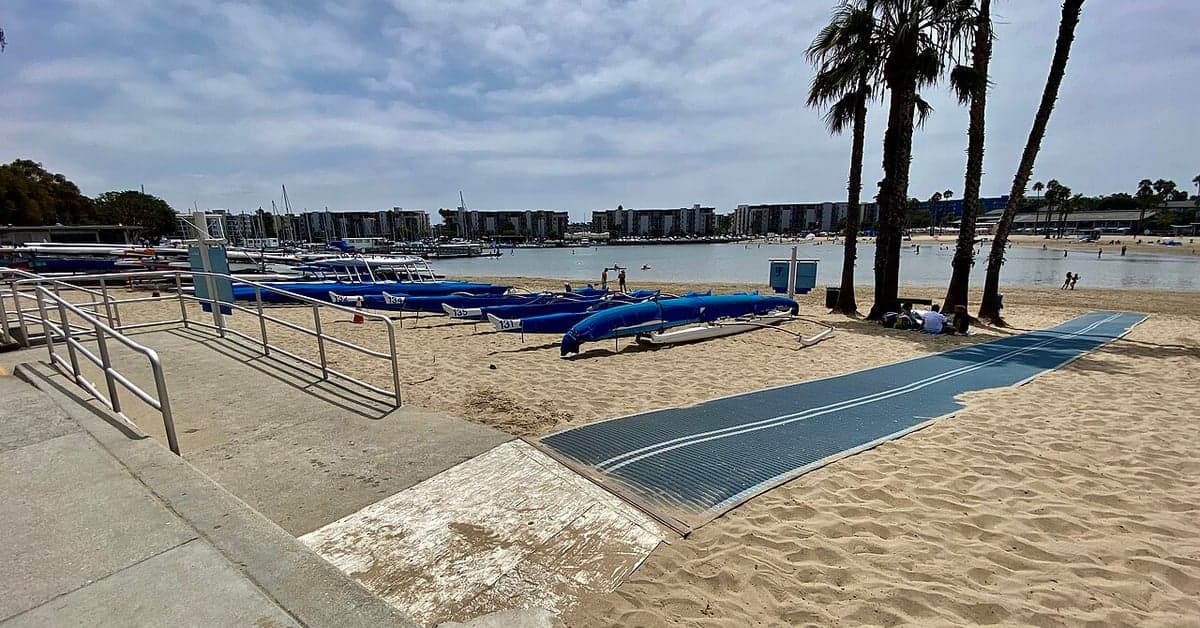
Mobi-mats are the single most impactful piece of accessibility infrastructure for beaches. These are rolled-out non-slip mats, typically made from recycled polyester, that create a firm surface over sand. A wheelchair that would sink immediately on loose sand can roll smoothly over a mobi-mat. The mats are lightweight, removable (so they can be stored during storms), and relatively inexpensive for municipalities to install -- about $15-25 per linear foot.
The challenge is that most beaches that have mobi-mats only run them from the parking lot or boardwalk to a single point near the water. Once you reach the end of the mat, you're stuck. Better installations extend the mat to the tidal zone and provide a flat platform area where a beach wheelchair can park at the water's edge.
Where to Find Mobi-Mats
- Most beaches in the Florida Panhandle (Destin, Panama City Beach, Pensacola) have seasonal mobi-mat installations
- Many New Jersey shore towns install them from Memorial Day through Labor Day
- Australia's major metropolitan beaches (Sydney's Bondi and Manly, Melbourne's St Kilda) have permanent installations
- Portugal's Praia Acessível program has mobi-mats at over 200 beaches nationwide
- The UK's Accessible Beaches initiative has added mats at Brighton, Bournemouth, and several Cornish beaches
Floating Beach Wheelchairs
Beach wheelchairs come in two categories: sand chairs and floating chairs. Sand chairs have oversized balloon tires that roll over sand but aren't designed for water. Floating chairs are buoyant enough to enter the water and float with the user seated. The best floating beach chairs -- like the Hippocampe, manufactured in France -- can handle both sand and water, with wide tires for the beach and a buoyant frame for the ocean.
A Hippocampe chair costs roughly $3,000-4,500 to purchase, which is why most individuals don't own one. Municipal programs and nonprofit organizations are the primary sources. Some accessible resorts keep floating chairs on-site for guest use. If water access is important to you, confirm that the specific beach or resort you're visiting has floating chairs -- not just sand chairs -- before booking.
Accessible Resorts
Sandals Royal Barbados
Sandals Royal Barbados has invested significantly in accessibility since its 2017 opening. The resort offers roll-in showers, lowered counters, and beach wheelchair access on Maxwell Beach. The beach has a mobi-mat pathway and Sandals provides complimentary beach wheelchairs. The resort's swim-up suites on the ground floor allow wheelchair users to access the pool directly from their room.
The limitation: Sandals is an adults-only, couples-only brand. If you're traveling solo or with family, this isn't an option.
Beaches Turks and Caicos
Beaches Turks and Caicos, the family-oriented sister brand of Sandals, sits on Grace Bay -- repeatedly ranked among the world's best beaches. The resort offers beach wheelchairs, accessible rooms with roll-in showers, and an autism-friendly program developed with the International Board of Credentialing and Continuing Education Standards. Kids' club activities are inclusive by design.
Rates are high -- $600-1,000+/night all-inclusive depending on season -- but the accessibility infrastructure is genuinely comprehensive rather than an afterthought. Call the resort's accessibility coordinator directly (not the general reservation line) to discuss specific needs before booking.
European Blue Flag Accessibility Standards
The Blue Flag program, operated by the Foundation for Environmental Education, certifies beaches that meet environmental and accessibility criteria. While Blue Flag is primarily known for water quality, its accessibility requirements have grown more stringent over recent years. A Blue Flag beach must provide accessible toilet facilities, safe access routes, and information about the accessibility features available.
In practice, enforcement varies by country. Spain, Portugal, and Greece tend to take the accessibility requirements seriously. Other Blue Flag countries treat them as boxes to check with minimal investment. A Blue Flag is a starting point for research, not a guarantee of a good experience. Cross-reference with disability travel forums and recent user reviews.
Standout Blue Flag Beaches for Accessibility
- Praia da Rocha, Portugal: Amphibious chairs, ramp access, accessible boardwalk along the full beach length
- Benidorm Poniente, Spain: Year-round accessible bathing service with trained assistants
- Elafonissi, Crete, Greece: Wooden boardwalk across the sand, though the famous pink-sand area remains difficult to access
- Jesolo, Italy: One of the first Italian beaches to install full accessible infrastructure, including an accessible sailing program
Organizations That Help
Access Surf Hawaii
Access Surf is a Honolulu-based nonprofit that provides adaptive surfing and ocean access programs for people with physical and cognitive disabilities. They run monthly surf days at White Plains Beach on Oahu's south shore, where volunteers help participants into adaptive surfboards and push them into waves. The program is free. Equipment is provided. No experience necessary.
Access Surf also hosts the annual Stance ISA World Adaptive Surfing Championship in partnership with the International Surfing Association. The organization has been instrumental in getting adaptive surfing included in Paralympic discussions.
Other Key Organizations
- Disabled Surfers Association of Australia: Runs Let's Go Surfing days at beaches across Australia, completely free, with trained volunteers
- Beach Access North East (UK): Provides beach wheelchair loans at beaches in Northumberland and Tyne and Wear
- Wheel the World: A travel company that books fully accessible trips including beach destinations, with verified accessibility information for each property
- Travelin' Mads (Madeline Delp): Not an organization but a wheelchair-using travel blogger whose beach reviews include specific, honest accessibility details that corporate travel sites omit
Adaptive Surfing
Adaptive surfing has grown from a niche activity to a globally recognized sport with its own competitive circuit. Surfers with limb differences, spinal cord injuries, visual impairments, and other disabilities compete in categories matched to their level of function. The equipment ranges from standard surfboards with added handles to prone boards, tandem boards, and wave skis.
Finding an adaptive surf program is easier than you'd expect. The International Surfing Association lists affiliated programs by country. In the US, major programs operate in California (Life Rolls On in Santa Monica), Hawaii (Access Surf), Virginia Beach (ECSC Adaptive Surf), and Florida (Amp Surf). Most are free or donation-based, run by volunteers, and welcome first-timers.
Planning Tips
Before You Book
- Call the specific beach or resort -- don't rely on website claims. Ask exactly what equipment is available, what hours it's available, and whether reservation is required
- Google Earth satellite view can show you the distance from parking to water and whether the terrain looks navigable
- Check tide tables: low tide at many beaches exposes firm, flat sand that's easier to navigate than the soft dry sand above the high-tide line
- Facebook groups like "Wheelchair Travel" and "Accessible Travel Club" have members who've been to most major beach destinations and will share unfiltered feedback
What to Bring
- A tire pressure gauge if you're using a beach wheelchair with balloon tires -- underinflated tires sink more
- A compact beach umbrella that clamps to a chair frame, since many beach wheelchair locations have no shade
- Quick-dry clothing that works in and out of the water, reducing the need for accessible changing facilities that may not exist
- A waterproof bag for phones and medication -- salt water and sand destroy electronics and degrade pill coatings
The Honest Reality
Beach accessibility is improving, but it's still far behind where it should be. Most beaches on Earth have zero wheelchair infrastructure. Even at beaches with programs, equipment is limited, hours are restricted, and staff may be undertrained. The best experiences come from doing thorough research, calling ahead, arriving early, and having a backup plan. The worst experiences come from assuming that a beach marked "accessible" on a tourism website has actually been visited by someone who uses a wheelchair.
Frequently Asked Questions
Which beaches have free wheelchair access?
San Diego provides free beach wheelchairs at six locations including La Jolla Shores and Mission Beach. Miami Beach offers free wheelchair loans at South Pointe Park and Lummus Park. Gold Coast, Australia provides free wheelchairs and matting at Surfers Paradise. Barcelona offers free amphibious wheelchairs with trained assistants at nine beaches from June through September.
What is a beach wheelchair and where can I rent one?
Beach wheelchairs have wide balloon tires that roll over sand without sinking. Floating models like the Hippocampe ($3,000-4,500 to buy) can also enter the water. Municipal programs at major beach cities loan them for free during lifeguard hours. Private rentals like Beach Mobility in Miami charge about $150/day for motorized sand chairs delivered to your location.
What is a mobi-mat at the beach?
Mobi-mats are rolled-out non-slip mats made from recycled polyester that create a firm surface over sand, allowing wheelchairs to roll smoothly. They cost municipalities about $15-25 per linear foot. Most beaches with mobi-mats run them from the parking area to near the waterline. They are common in Florida, New Jersey shore towns, and Australia's metropolitan beaches.
What is the most wheelchair accessible beach in the world?
Barcelona stands out with its Banys Accessibles program, which provides free amphibious wheelchairs and trained assistants who physically accompany wheelchair users into the water at nine beaches. The service runs from June through September, 10 AM to 7 PM, and is free with advance registration through the city council website.
Are there accessible beach resorts for wheelchair users?
Sandals Royal Barbados offers roll-in showers, beach wheelchair access on Maxwell Beach, and swim-up suites accessible from ground-floor rooms. Beaches Turks and Caicos on Grace Bay has beach wheelchairs, accessible rooms, and an autism-friendly program. Call the resort's accessibility coordinator directly to discuss specific needs before booking.
Can wheelchair users go surfing?
Yes. Adaptive surfing programs operate worldwide. Access Surf Hawaii runs free monthly surf days at White Plains Beach on Oahu with volunteers and adaptive equipment. The Disabled Surfers Association of Australia runs free Let's Go Surfing days at beaches across Australia. Life Rolls On operates in Santa Monica, California.