Table of Contents
Prices in this guide are approximate and change often. Check with the hotel, airline or operator before you book.
Why the Peloponnese Instead of the Islands
The Greek islands dominate beach vacation planning — Santorini, Mykonos, Crete, and the rest absorb most international tourism and most of the attention. The Peloponnese, the large peninsula connected to mainland Greece by the narrow Corinth isthmus (now cut by the Corinth Canal), has beaches that rival the best island shores without the ferry logistics, the inflated island prices, or the crowds that pack popular island beaches from June through September.
The Peloponnese is driveable from Athens (the Corinth Canal crossing is less than 90 minutes from the city center), has a road network that connects its coastal towns, and offers a combination of beaches, ancient ruins (Olympia, Mycenae, Epidaurus, Ancient Corinth), mountain villages, and Mani tower houses that no single Greek island can match for variety. You can swim at a turquoise beach in the morning, visit a 3,000-year-old theater in the afternoon, and eat grilled octopus in a fishing village at sunset.
West Coast Beaches
Voidokilia Beach, Messinia
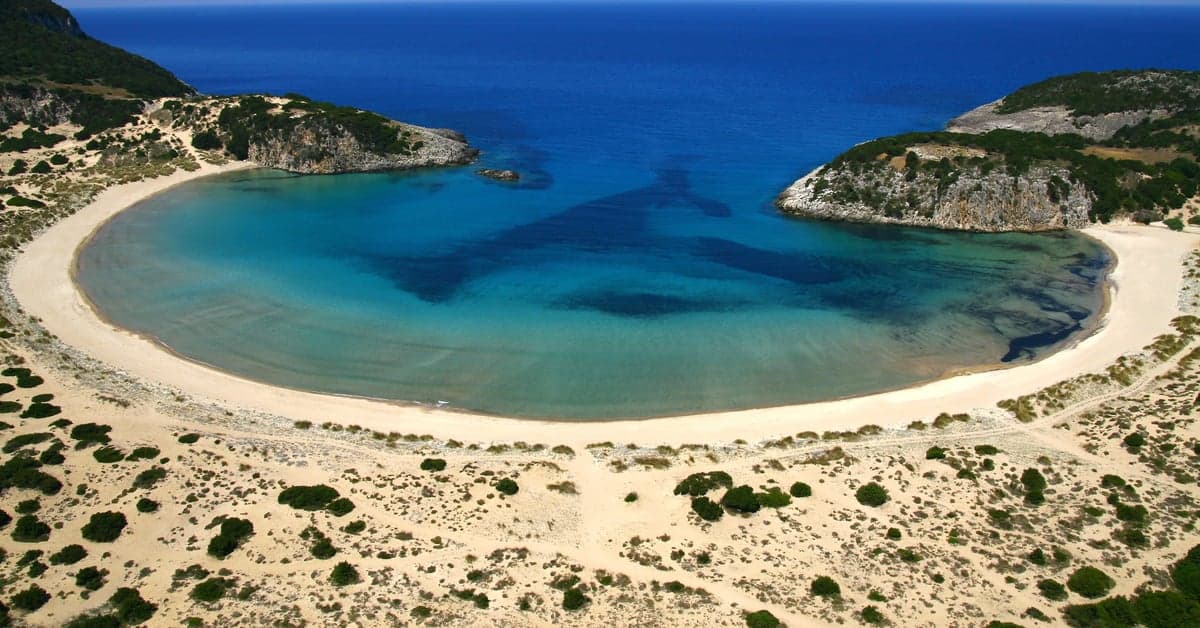
Voidokilia is the most photographed beach in the Peloponnese and arguably the most perfectly shaped beach in Greece. Seen from the Paleokastro fortress above, it forms an almost exact semicircle of white sand enclosing a shallow turquoise lagoon. The sand is fine and soft, the water is warm (22-26°C in summer), and the swimming is safe for all abilities thanks to the gradual sandy entry and sheltered bay.
Access is via a dirt road from the village of Petrochori (about 10 minutes), ending at a small parking area. The walk to the beach takes 5-10 minutes across the dunes. A climb up the hill behind the beach (20 minutes) reaches the Paleokastro ruins and gives the iconic aerial view. The beach has no facilities — no loungers, no bars, no showers — which is exactly why it stays beautiful. Bring everything you need including water and shade (there's no natural shade on the beach).
The lagoon behind Voidokilia (Gialova Lagoon) is a Natura 2000 protected wetland that's home to flamingos, herons, and other wading birds. The combination of the perfect beach, the ancient fortress, and the bird-filled lagoon makes Voidokilia one of the most complete beach experiences in Greece.
Foneas Beach, Mani
Foneas sits on the west coast of the Mani Peninsula, the middle finger of the Peloponnese that juts into the Mediterranean. The beach is a pebble-and-sand cove enclosed by rock formations that create small natural pools and excellent snorkeling. The water clarity here is exceptional — visibility regularly exceeds 15 meters, and the underwater rock formations host octopus, moray eels, and schools of damselfish.
The Mani region is one of Greece's most atmospheric areas: abandoned stone tower houses (built by feuding families in centuries past) dot the hillsides, and the villages of Kardamyli, Stoupa, and Areopoli retain a character that tourist-heavy destinations have lost. Patrick Leigh Fermor, the celebrated British travel writer, lived in Kardamyli for decades — his house is now a cultural center. Foneas Beach is a short drive south of Kardamyli, and the coastal road between Kalamata and Areopoli passes dozens of swimmable coves.
Kalogria Beach, Achaia
Kalogria is a 9-kilometer stretch of golden sand on the northwest Peloponnese coast, backed by the Strofylia pine forest — one of the largest remaining stone pine forests in Europe. The beach is mostly undeveloped, with a few beach bars and tavernas at the northern end near the village. The southern sections are empty enough that you can walk for an hour without seeing another person, even in August.
The water is shallow and warm, with a gentle sandy bottom that makes it safe for children. The Strofylia forest behind the beach provides natural shade (rare for Greek beaches) and is worth exploring on foot — marked trails wind through the pines and wetlands, and the Kotychi Lagoon at the forest's edge attracts migratory birds. Kalogria is reached by car from Patras (about 45 minutes), the main city of the western Peloponnese.
South Coast Beaches
Simos Beach, Elafonisos
Elafonisos is technically an island, but it's connected to the southern Peloponnese coast by a 5-minute car ferry from Pounta (boats run every 15-30 minutes, EUR 4 per person, EUR 10 for a car). Simos Beach, on the island's south side, is a double beach — two long stretches of white sand separated by a narrow peninsula, with shallow, crystal-clear water that rivals the Caribbean. The sand is so white and the water so blue that first-time visitors are genuinely startled.
Simos has organized beach areas with loungers and umbrellas (EUR 8-$12 for a set) and large free sections where you can set up your own spot. A few canteens sell food and drinks. The beach gets busy in July and August — Greek families from Athens make this a primary summer destination — but the two-beach layout and sheer size (over 1 km total) absorb the crowds. June and September offer the same water quality with half the people.
Mavrovouni Beach, Laconia
Mavrovouni stretches south of the town of Gythio along the eastern Mani coast. The beach is a long, wide strip of sand and fine pebble with warm, clean water. It's notable as a nesting site for loggerhead sea turtles (Caretta caretta) — the southern end of the beach is protected during nesting season (May through September), with marked nest areas and volunteer monitors.
The town of Gythio at the north end of the beach is a charming port town with a waterfront promenade, good fish tavernas, and the small island of Marathonisi (connected by a causeway) where Paris and Helen supposedly spent their first night after fleeing Sparta. The combination of turtle conservation, Mani tower house architecture, and Spartan history makes this stretch of coast rich beyond just the beach itself.
East Coast Beaches
Plaka Beach, Leonidio
Plaka Beach sits at the mouth of a dramatic gorge below the town of Leonidio on the eastern Peloponnese coast. Red limestone cliffs rise vertically behind the beach, and the Dafnon River flows through the gorge to reach the sea. The beach is a mix of sand and pebble with clear blue water. The setting is dramatic — you swim with 300-meter cliffs above you — and the beach is rarely crowded because Leonidio is off the main tourist circuit.
Leonidio has become known as a world-class rock climbing destination, with hundreds of sport climbing routes on the limestone walls above town. Even if you don't climb, the gorge itself is spectacular and can be explored on foot along a marked trail. The town has a handful of tavernas, rooms for rent, and a quiet evening atmosphere centered around the plateia (main square). Plaka Beach is a 5-minute drive from town. For more Greek beach options, explore our European beach destination guides.
Tolo Beach, Argolida
Tolo is a small resort town on the eastern coast, easily reached from Nafplio (12 km away). The beach is a long, sandy, gently curving bay with calm water, sun loungers, and a promenade lined with tavernas, ice cream shops, and small hotels. It's a family-oriented beach — safe swimming, shallow water, and the kind of unpretentious Greek seaside atmosphere that the islands are losing to boutique hotel development.
The real value of Tolo is its proximity to the Argolida's ancient sites. Nafplio (the most beautiful town in the Peloponnese, built around a Venetian fortress), Epidaurus (the ancient theater with perfect acoustics), Mycenae (the Lion Gate and the tomb of Agamemnon), and Tiryns (massive Mycenaean walls) are all within 30 minutes by car. A week based in Tolo combines daily beach time with serious archaeological exploration.
Practical Information
Getting Around
A rental car is essential for exploring the Peloponnese coast. Public buses connect major towns but don't serve most beaches directly. Rental cars at Athens airport start at EUR 30-$50/day in summer. The Corinth Canal crossing from Athens takes about 90 minutes. Main road quality is good; secondary roads to remote beaches can be narrow and winding. Gas stations are plentiful but may close by 8 PM in rural areas — fill up during the day.
When to Visit
June and September are the sweet spots — warm enough for comfortable swimming (22-25°C water temperature), less crowded than July-August, and lower accommodation prices. July and August bring the hottest weather (35°C+), the highest prices, and the most domestic tourists, particularly at popular beaches like Simos and Voidokilia. May and October offer pleasant weather for sightseeing but the water is cooler (18-21°C). The Greek National Tourism Organization provides regional guides and updated travel information.
Where to Stay
Nafplio is the best base for the eastern Peloponnese, with the widest range of hotels, restaurants, and atmosphere. Kardamyli on the western Mani coast is ideal for Mani beaches and hiking. Stoupa, also on the Mani, is a relaxed beach town. For Voidokilia, base yourself in Costa Navarino (luxury) or the town of Pylos (mid-range). Accommodation across the Peloponnese runs EUR 50-$150/night for mid-range hotels and EUR 200-$500 for luxury options — significantly cheaper than equivalent quality on Santorini or Mykonos.
Frequently Asked Questions
How do I get to the Peloponnese from Athens?
Drive across the Corinth Canal, about 90 minutes from Athens city center. The main highway (Olympia Odos/E94) connects Athens to Corinth, where you can head south into the Peloponnese. Rental cars at Athens airport start at EUR 30-50/day. Buses from Athens connect to major Peloponnese towns but don't serve most beaches directly.
What is the best beach in the Peloponnese?
Voidokilia is the most visually stunning — a perfect semicircle of white sand seen from an ancient fortress above. Simos Beach on Elafonisos has the whitest sand and most Caribbean-like water. For snorkeling, Foneas in the Mani offers the best underwater scenery. Kalogria is the best for families who want a long, shallow, pine-shaded beach.
Is the Peloponnese cheaper than the Greek islands?
Yes, significantly. Mid-range accommodation in the Peloponnese runs EUR 50-150/night vs EUR 100-300+ for equivalent quality on Santorini or Mykonos. Restaurant meals, car rental, and activities are all cheaper than on the popular islands. The Peloponnese also avoids the ferry costs and logistics required for island travel.
When is the best time to visit Peloponnese beaches?
June and September offer the best balance: warm water (22-25°C), pleasant air temperatures, fewer crowds, and lower prices than peak summer. July and August are hottest (35°C+) and most crowded, particularly at Simos and Voidokilia. May and October are pleasant for sightseeing but the water is cooler (18-21°C).
Can I see sea turtles at Peloponnese beaches?
Yes. Loggerhead sea turtles (Caretta caretta) nest at Mavrovouni Beach near Gythio from May through September. The southern end of the beach is protected during nesting season with marked nest areas and volunteer monitors. Respectful observation is possible — maintain distance from nests and nesting females, and avoid the beach at night during nesting season.
Do I need a car to visit Peloponnese beaches?
A rental car is essential. Public buses connect major towns but don't serve most beaches directly, and schedules are infrequent. The road network is good on main routes, though secondary roads to remote beaches can be narrow. Renting a car gives you the freedom to explore multiple beaches, ancient sites, and mountain villages in a single trip.
How does Voidokilia compare to Greek island beaches?
Voidokilia's near-perfect semicircular shape, white sand, shallow turquoise water, and undeveloped backdrop rival any beach in the Greek islands. Unlike popular island beaches, it has no facilities (no loungers, bars, or crowds in the same way). The combination of the beach, the Paleokastro fortress above, and the flamingo lagoon behind creates a richer experience than most island alternatives.