Table of Contents
Prices in this guide are approximate and change often. Check with the hotel, airline or operator before you book.
Tasmania's Coast: Where the Southern Ocean Meets Wilderness
Tasmania sits 240 kilometers south of the Australian mainland, surrounded by the Southern Ocean, the Tasman Sea, and Bass Strait. The island's coastline stretches 3,200 kilometers and includes some of the most pristine beaches in the Southern Hemisphere — white sand, orange lichen-covered granite, turquoise water that stays cold (12-18°C depending on season), and a near-total absence of development on many stretches.
What makes Tasmanian beaches different from the mainland is the wildness. Many require hiking to reach. Others sit below sea cliffs accessible only by boat. The water is dramatically colder than Queensland or even Sydney (bring a wetsuit for anything beyond a quick dip), but the trade-off is beaches where you might be the only person for kilometers, backed by temperate rainforest or granite mountains rather than apartment blocks.
East Coast
Wineglass Bay, Freycinet National Park
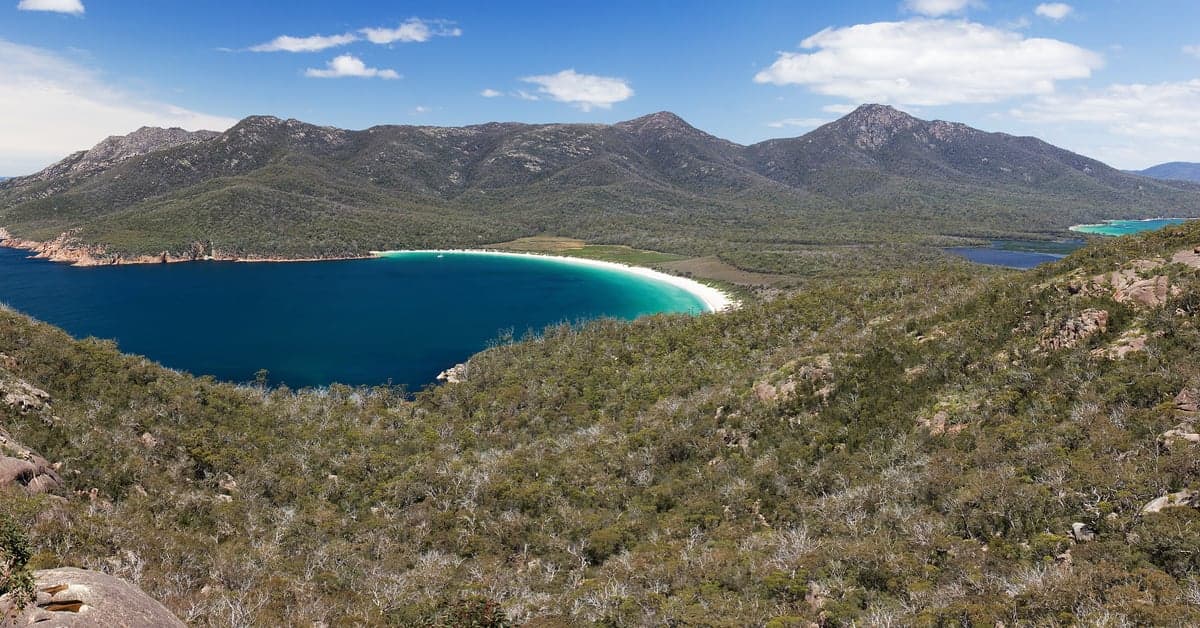
Wineglass Bay is Tasmania's most famous beach and regularly appears on world top-10 lists. The bay forms a perfect crescent of white quartz sand between two granite headlands, backed by dry eucalyptus forest. The classic view from the Wineglass Bay Lookout (1.5-hour return hike from the car park, moderate difficulty) shows the symmetrical curve of sand and the vivid blue water below.
To reach the beach itself, continue from the lookout down a steep path (30 minutes, adding 2.5 hours return total from the car park). The beach is 1.2 kilometers long and often empty on weekdays outside summer holidays. Swimming is possible — the bay is sheltered from ocean swell — but the water temperature even in February (Tasmania's warmest month) sits around 16-18°C. The sand is fine and white, made of crushed quartz from the Hazards granite range. See Surfline for current guidance.
Freycinet National Park charges AUD 24 ($16) per vehicle for a day pass or AUD 80 ($53) for a holiday pass covering all Tasmanian parks. Freycinet Lodge, inside the park, offers rooms from AUD 250-500 per night. The town of Coles Bay, at the park entrance, has a general store, a bakery, and a few restaurants — Freycinet Marine Farm sells fresh oysters for AUD 15-20 ($10-13) per dozen directly from the water.
Bay of Fires
The Bay of Fires covers 50 kilometers of coastline in northeast Tasmania, named not for the sand color but for the Aboriginal fires early European explorers saw along the shore. The beaches here are white sand framed by granite boulders covered in bright orange lichen (Caloplaca) — the contrast of white sand, orange rock, and blue-green water is Tasmania's most photographed coastal scenery.
Binalong Bay, at the southern end, is the easiest access point and has a small town with a cafe and a few holiday rentals. The Gardens, at the northern end, requires a 4WD or a 2-hour walk along the beach. The Bay of Fires Walk is a guided hut-to-hut walk along the coast that includes the Bay of Fires Lodge — a permanent camp with hot showers and gourmet meals perched on a clifftop with views along the entire bay.
Friendly Beaches
Friendly Beaches, 15 kilometers north of Coles Bay, is a 5-kilometer arc of white sand backed by coastal scrub and lagoons. The beach gets far fewer visitors than Wineglass Bay despite being easier to access (2-minute walk from the car park). The surf here is more exposed — 1-2 meter swells are common, making it popular with Tasmanian surfers. A free campground behind the dunes (no facilities, bush camping only) operates year-round.
South Coast
Cloudy Bay, Bruny Island
Bruny Island sits off Tasmania's southeast coast, reached by a 20-minute car ferry from Kettering (AUD 39 / $26 per vehicle return, runs every 30-60 minutes). South Bruny's Cloudy Bay is a 3-kilometer surf beach facing the Southern Ocean, backed by a lagoon system frequented by black swans and white-bellied sea eagles.
The beach is exposed and powerful — swimming is risky due to rip currents and the cold water (12-15°C), but walking the empty sand with waves crashing and Bruny's forests rising behind is a peak Tasmanian experience. The Neck, a narrow isthmus connecting North and South Bruny, has a viewing platform where short-tailed shearwaters (mutton birds) return to their burrows at dusk in enormous numbers from September through April.
Bruny Island also has the more sheltered Adventure Bay, where Captain Cook landed in 1777 and Captain Bligh (before the Bounty mutiny) planted apple trees. Get Shucked oyster bar at the ferry terminal serves oysters for AUD 20-25 ($13-17) per dozen with a glass of local wine.
Recherche Bay
Recherche Bay, at Tasmania's southernmost road-accessible point, is where French explorer Bruni d'Entrecasteaux sheltered his ships in 1792-93, and where French scientists made some of the earliest detailed records of Tasmanian Aboriginal culture. The bay has several beaches, the best being Cockle Creek Beach at the road's end — a wide sand beach at the start of the South Coast Track.
The South Coast Track (85 kilometers, 6-8 days) begins at Cockle Creek and traverses Tasmania's wildest coastline through Southwest National Park. Day walkers can access the first beach on the track — the 1-kilometer sandy Whale Bay — via a 90-minute return walk from the trailhead. No facilities, no phone signal, and the nearest town (Dover) is 50 minutes' drive north.
West Coast
Ocean Beach, Strahan
Ocean Beach, near the west coast town of Strahan, runs 33 kilometers unbroken — the longest beach in Tasmania. The beach faces the Roaring Forties (westerly winds that circle the globe between 40° and 50° south latitude), producing massive surf and wild conditions. Swimming is genuinely dangerous here — rip currents and cold water make it off-limits for casual swimmers.
The beach is worth visiting for the raw power of the ocean and the sense of exposure. On a windy day, sand stings your skin and the waves boom continuously. Hells Gates, the narrow entrance to Macquarie Harbour at the beach's northern end, sees tidal currents exceeding 8 knots. Gordon River cruises from Strahan (AUD 125-250 / $83-167) travel through Hells Gates into the harbor and up the tannin-stained Gordon River through ancient rainforest. See NOAA tide and current data for current guidance.
North Coast
Boat Harbour Beach
Boat Harbour Beach, on Tasmania's north coast, has the warmest and calmest water on the island. The beach faces Bass Strait rather than the open Southern Ocean, which means less swell and water temperatures reaching 18-20°C in summer. The 500-meter crescent of white sand is enclosed by rocky headlands, creating a natural pool effect on calm days.
The water color here is remarkable — pale turquoise fading to deep blue, more reminiscent of the Whitsundays than what you'd expect at 41° south latitude. The small settlement behind the beach has a handful of holiday houses and a general store. Penguin (the town, 20 minutes east) has the closest accommodation and a fairy penguin colony that parades up the beach at dusk. Explore more Australian beach destinations for your trip planning.
Practical Information
Getting to Tasmania
Flights from Melbourne to Hobart take 1 hour 15 minutes (AUD 100-250 / $67-167 one-way on Jetstar, Virgin Australia, or Qantas). The Spirit of Tasmania ferry crosses Bass Strait from Melbourne to Devonport (north coast) in 11 hours overnight (from AUD 200 / $133 per person plus AUD 100 / $67 per vehicle in a twin cabin).
Getting Around
A rental car is essential — public transport barely exists outside Hobart and Launceston. Rentals from Hobart airport start at AUD 40-70 per day. Drive times: Hobart to Freycinet (Wineglass Bay) is 2.5 hours. Hobart to Bay of Fires is 3.5 hours. Hobart to Strahan (west coast) is 4.5 hours. Road conditions are good on main highways but some beach access roads are unsealed. Compare Tasmania hotel prices on Expedia for your beach trip.
When to Visit
December through March delivers the warmest weather (18-25°C) and longest days (sunrise 5:30 AM, sunset 9 PM in midsummer). Sea temperatures peak at 16-20°C in February — a wetsuit is recommended for extended swimming. Winter (June-August) brings dramatic weather, fewer visitors, and daytime temperatures of 8-13°C — good for coastal walks but not beach days.
Frequently Asked Questions
What is the best beach in Tasmania?
Wineglass Bay in Freycinet National Park is the most famous and frequently ranked among the world's best beaches. The Bay of Fires offers the most unique scenery (orange lichen on granite). Boat Harbour Beach has the warmest, calmest water for swimming. All three are worth visiting on a Tasmanian trip.
Is the water warm enough to swim in Tasmania?
Sea temperatures range from 12°C in winter to 18-20°C in summer (February peak) on the sheltered north coast. The south and west coasts stay colder at 12-16°C. A wetsuit is recommended for extended swimming anywhere in Tasmania. Quick dips in sheltered bays like Wineglass Bay are manageable without a wetsuit in January-February.
How do I get to Wineglass Bay?
Drive 2.5 hours from Hobart or 2 hours from Launceston to Freycinet National Park (AUD 24 vehicle day pass). From the car park, hike 1.5 hours return to the lookout, or 2.5 hours return to the beach itself. The path is well-marked but the descent to the beach is steep. Bring water, sunscreen, and snacks.
When is the best time to visit Tasmania's beaches?
December through March offers the warmest weather (18-25°C), longest days, and warmest sea temperatures. January and February are peak season with higher accommodation prices. December and March provide excellent conditions with fewer visitors. Avoid June-August for beach trips unless you're interested in dramatic coastal walks in winter weather.
Do I need a car in Tasmania?
Yes, a rental car is essential. Public transport exists in Hobart and Launceston but doesn't serve beach destinations. Rentals from Hobart airport start at AUD 40-70 per day. Main highways are well-maintained, though some beach access roads are unsealed gravel. An SUV is recommended for reaching remote beaches like The Gardens at Bay of Fires.
How do I get to the Bay of Fires?
Drive 3.5 hours from Hobart or 1.5 hours from Launceston to Binalong Bay, the southern access point. A sealed road continues north along the coast to The Gardens, where it becomes a rough 4WD track. The Bay of Fires Walk (4 days, AUD 2,650 per person) is a guided option covering the entire 50-kilometer coastline.
Are there dangerous animals at Tasmanian beaches?
The main risks are rip currents (especially west and south coast beaches) and cold water temperatures causing hypothermia. Shark encounters are extremely rare but great whites are present in Tasmanian waters. No deadly jellyfish or crocodiles exist in Tasmania (unlike tropical Australia). Snakes are present in coastal scrub but rarely seen on beaches.