Table of Contents
Australia's Coldest State Has Some of Its Best Beaches
Tasmania sits at 42 degrees south, exposed to the Roaring Forties winds that sweep across the Southern Ocean from Patagonia. The water is cold. The beaches are extraordinary. The east coast holds bays with orange-granite headlands and water so clear it could be the Caribbean—if the Caribbean were 18°C. The west coast is wild, empty, and beaten by swells that have crossed 10,000 km of open ocean. The whole island has a population of about 570,000, and most of them live in Hobart. The beaches, even in summer, are often empty.
This is a beach destination for people who value landscape over lounging. The sand here is among the whitest in the world—composed of pure quartz rather than coral or shell. The wildlife is constant: wallabies on the dunes at dusk, sea eagles circling overhead, wombats wadding across the access tracks. You won't find beach clubs or cocktail bars. You will find some of the most visually striking coastline on the planet.
East Coast Beaches
Wineglass Bay, Freycinet National Park
The beach that put Tasmania on the travel map. A perfect crescent of white quartz sand framed by pink granite peaks, with water that shifts between deep blue and pale aqua. Getting here requires a 45-minute hike from the Freycinet car park, over a saddle and down through dry eucalypt forest. The walk filters out casual visitors, though in January and February you'll still find 50-100 people on the sand. For more solitude, continue south along the beach and around the rocks to Hazards Beach, adding another hour each way. Park entry for Freycinet is 40 AUD per vehicle per day (or free with a Parks Pass, 96 AUD for 8 weeks).
Bay of Fires
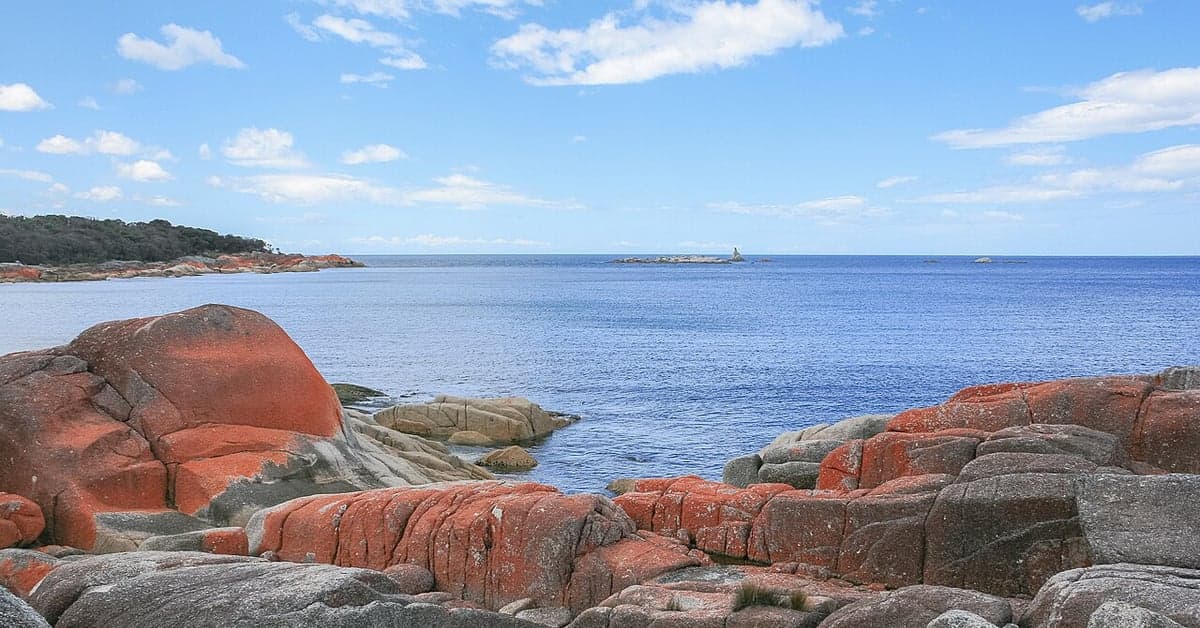
Not a single beach but a 50 km stretch of coastline from Binalong Bay to Eddystone Point. The defining feature: massive granite boulders covered in bright orange lichen (Caloplaca), sitting on white sand beside clear blue-green water. The colour contrast is extraordinary—white, orange, blue, green. The southern end around Binalong Bay and The Gardens is accessible by car and has a few accommodation options. The northern section requires the Bay of Fires Walk, a four-day guided hike (around 2,695 AUD per person, all inclusive) or self-guided camping. Swim at Cosy Corner or Sloop Reef for the best combination of sheltered water and lichen-covered rocks.
Friendly Beaches
A long, broad beach just north of Freycinet, accessible by a short drive from the Coles Bay road. The sand is fine and white, the beach stretches for kilometres in both directions, and on most days you'll have it largely to yourself. The surf can be moderate—this is an ocean-facing beach—but the southern end near the rocks is more sheltered. Camping is available at the Friendly Beaches campground (18 AUD per unpowered site) within Freycinet National Park. Sunrises here are exceptional.
Bicheno
The small town of Bicheno sits on the central east coast and has several beaches within walking distance. The main beach (Redbill Beach) is a good swimming spot, but the highlight is the Bicheno Blowhole and the short coastal walk to Diamond Island, which you can reach on foot at low tide. Little penguins nest around the rocks here—the nightly penguin viewing tours (adults 25 AUD) are one of Tasmania's best wildlife encounters. For food, the Lobster Shack on the foreshore sells fresh crayfish straight off the boats.
South Coast Beaches
Fortescue Bay, Tasman National Park
A sheltered bay reached by a 30-minute drive on a gravel road from the town of Port Arthur. The beach is a long arc of sand backed by tall eucalyptus forest. It's the starting point for walks to Cape Hauy (4-5 hours return), where dolerite sea cliffs drop 300 meters straight into the ocean, and Cape Pillar, one of the most dramatic coastal walks in Australia. The campground at Fortescue Bay (16-18 AUD per site) is basic but the setting is gorgeous. The water is cold—14-17°C even in summer—but the beach is perfect for walking and kayaking.
Cloudy Bay, Bruny Island
Bruny Island, reached by a 20-minute ferry from Kettering (free for walk-on passengers, 39 AUD per vehicle return), has some of Tasmania's wildest coastline. Cloudy Bay on South Bruny is a surf beach facing the Southern Ocean: big waves, strong rips, white sand stretching into distance, and nobody around. This is not a swimming beach for casual visitors, but it's magnificent for walking. The Adventure Bay side of the island is calmer and has safe swimming at a sheltered beach backed by a small township. Get Fish on the Bruny Island food trail serves the best fish and chips on the island for about 18-22 AUD.
North Coast Beaches
Boat Harbour Beach
A small cove on the northwest coast that looks like it belongs in Greece. White sand, turquoise water, rocky headlands on either side. It's tiny—maybe 200 meters long—and sheltered from the prevailing westerlies, making it one of the warmest swimming spots in Tasmania (water reaches 19-20°C in February). A general store at the top of the access road sells ice cream and basics. The nearest town of any size is Wynyard, 15 minutes west.
Greens Beach
At the mouth of the Tamar River on the north coast, Greens Beach is a wide sandy beach with calm water and views across to the Asbestos Range hills. It's popular with Launceston families (about an hour's drive) and has a holiday park, a small shop, and a surf lifesaving club. The beach is good for families—shallow water, no significant rip currents, and enough sand to spread out. Platypuses have been spotted in the creek that runs behind the dunes.
West Coast
Ocean Beach, Strahan
A 40 km stretch of beach facing the Southern Ocean. The sand is hard-packed and you can drive on sections of it, though a 4WD is recommended. The waves are huge, the wind is relentless, and swimming is genuinely dangerous—strong rips and cold water. But as a spectacle of raw coastline, Ocean Beach is hard to beat. Henty Dunes at the northern end are a massive sand dune system that you can sandboard down. Strahan, the small town at the southern end, has accommodation, restaurants, and is the departure point for Gordon River cruises.
Practical Tips
Water Temperature and Swimming
Tasmania's ocean water ranges from 12°C in winter to 19-20°C in late summer (February). A shorty wetsuit makes summer swimming comfortable; full wetsuits are needed outside December-March. The east coast is warmer than the west. Many locals swim without wetsuits in January and February, but if you're accustomed to tropical water, bring neoprene.
When to Visit
December through March is beach season. January and February are warmest, with air temperatures of 20-25°C. Tasmania's weather is changeable—pack layers even in summer. The shoulder months (November and April) can be beautiful, with fewer visitors and still-pleasant conditions for beach walks even if swimming is brisk.
Getting Around
A rental car is essential. Tasmania has no passenger rail and limited bus services. The drive from Hobart to the east coast beaches takes 2-3 hours. From Launceston, the Bay of Fires is about 2.5 hours. Fuel up before heading to remote beaches—service stations can be far apart on the west and south coasts. Car rentals from Hobart airport start at about 50-70 AUD per day.
National Park Passes
Most of the best beaches sit within national parks. A day pass costs 40 AUD per vehicle. If you're visiting multiple parks (and you should), the Holiday Pass at 96 AUD for 8 weeks is much better value. Buy it at the first park entrance or online from the Tasmania Parks and Wildlife Service website before you arrive.
Frequently Asked Questions
Is Tasmania good for beaches?
Yes, Tasmania has exceptional beaches, particularly on the east coast. Wineglass Bay and the Bay of Fires are regularly ranked among Australia's best. The sand is unusually white (pure quartz), the water is crystal clear, and most beaches are uncrowded even in peak summer. The tradeoff is cold water—19-20°C at best in February.
Can you swim at Wineglass Bay?
Yes, swimming is possible at Wineglass Bay in summer (December-March) when water temperatures reach 17-19°C. The bay is sheltered and usually calm. Most visitors find it refreshing rather than comfortable without a wetsuit. The 45-minute hike in from the car park means you'll be warm enough to appreciate the cold water by the time you arrive.
How cold is the water in Tasmania?
Ocean water temperatures range from about 12°C in winter (July-August) to 19-20°C in late summer (February). The east coast is slightly warmer than the west. A shorty wetsuit makes summer swimming very comfortable. Full wetsuits are recommended outside the December-March window.
How do you get to the Bay of Fires?
The southern end of the Bay of Fires at Binalong Bay is a 3.5-hour drive from Hobart or 2.5 hours from Launceston. The road is sealed all the way. The northern section around Eddystone Point requires a gravel road. No public transport reaches the Bay of Fires—a rental car is essential.
Do you need a car in Tasmania?
A rental car is essential for visiting Tasmania's beaches. The island has no passenger rail and very limited bus services that don't reach coastal areas. Car rentals from Hobart airport start at about 50-70 AUD per day. The east coast is 2-3 hours from Hobart, and fuel stations are sparse in remote areas.
When is the best time to visit Tasmania beaches?
January and February are peak beach months with the warmest air temperatures (20-25°C) and water temperatures (19-20°C). December and March are also good. Tasmania's weather changes quickly, so pack layers even in summer. The east coast is generally drier and sunnier than the west.
How much does it cost to enter Freycinet National Park?
A day pass for Freycinet National Park costs 40 AUD per vehicle (up to 8 passengers). The Holiday Pass at 96 AUD covers all Tasmanian national parks for 8 weeks and is better value if you plan to visit multiple parks. Passes can be purchased at park entrances or online from Tasmania Parks and Wildlife.