Table of Contents
Prices in this guide are approximate and change often. Check with the hotel, airline or operator before you book.
Northern France's Coastline: Dramatic, Historical, and Surprisingly Swimmable
Normandy and Brittany together form over 1,000 kilometers of coastline along the English Channel and Atlantic Ocean. These aren't the sunbaked Mediterranean beaches that dominate French tourism brochures. Instead, you get massive tidal ranges revealing kilometers of sand, granite cliffs dropping into emerald water, and a coastal culture centered on oysters, cider, and seafood platters rather than rosé and bouillabaisse.
The water is colder — 15-19°C in summer — but the beaches are less crowded, more dramatic, and significantly cheaper than the Côte d'Azur. A week on the Brittany coast costs roughly 40-50% less than an equivalent stay in Nice or Saint-Tropez.
Normandy's Best Beaches
Etretat
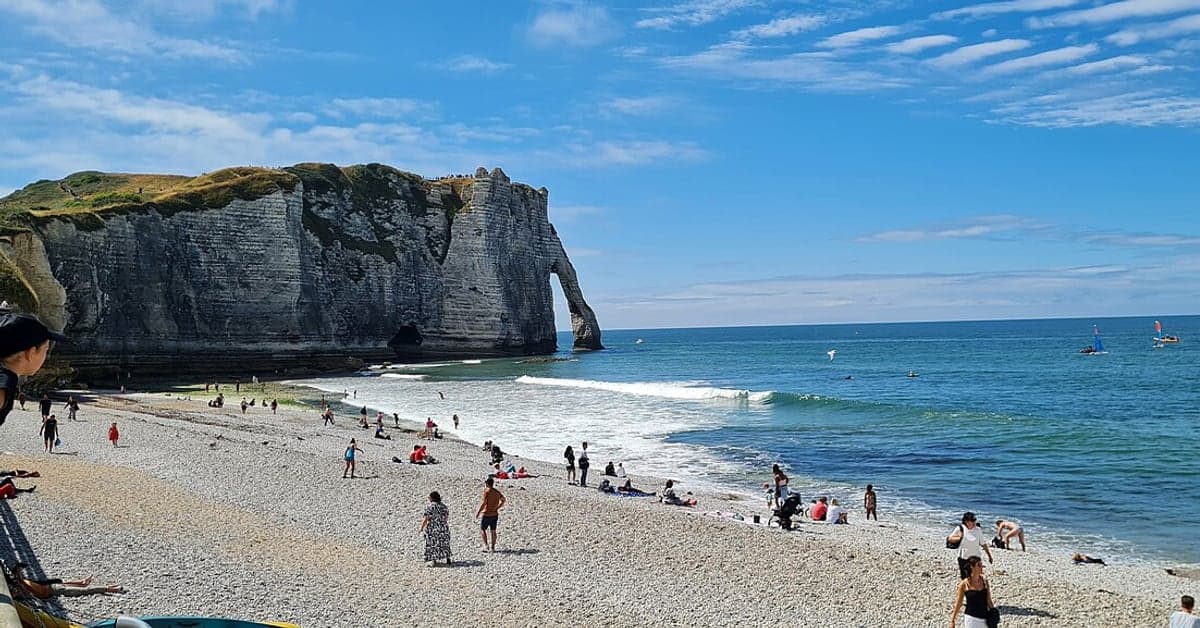
Etretat's chalk cliffs and natural arch — the Falaise d'Aval — are the most photographed coastal feature in northern France. Monet, Courbet, and Maupassant all worked here. The beach is pebble rather than sand, sloping steeply into clear green water. Swimming is possible but the drop-off is sharp; water shoes are recommended.
The cliff walk from the beach to the top of Falaise d'Aval takes 15 minutes and delivers panoramic views along the Alabaster Coast. The town behind the beach has restaurants serving moules-frites (mussels and fries) for €12-16 and galettes (savory buckwheat crepes) for €8-12. Hotel & Spa Les Pêcheurs, a 3-star property 200 meters from the beach, charges €90-160 per night.
D-Day Beaches: Omaha and Utah
Omaha Beach stretches 8 kilometers between Vierville-sur-Mer and Colleville-sur-Mer. Today it's a wide, flat beach popular with families and kite-fliers, but the American cemetery on the bluff above — 9,387 white crosses facing west toward home — keeps the history present. The beach is free, parking is free, and the water is calm in summer. Lifeguards patrol designated swimming zones in July and August.
Utah Beach, further west on the Cotentin Peninsula, has a museum (€8 admission) built around an actual Landing Craft that came ashore on June 6, 1944. The beach itself is excellent for swimming — wide, sandy, and sheltered by the peninsula from Atlantic swells.
Deauville and Trouville
Deauville is the glamorous option: a 2-kilometer boardwalk (Les Planches) lined with beach cabins painted in primary colors, each named after a film director. The sand is fine and expansive at low tide. Beach chair rental costs €8-15 per day from the concessionaire. Hotel Normandy Barrière, the grand dame property facing the beach, charges €250-500 per night; budget hotels a few streets back start at €80-130.
Trouville, across the river Touques, is Deauville's less polished twin — cheaper restaurants, a fish market on the quay where you can buy a dozen oysters for €8-12, and a beach that's equally wide with fewer parasols. Trouville's boardwalk is more local, less tourist-oriented.
Granville
Granville, on Normandy's western coast, has a haute ville (upper town) on a rocky headland and a series of sandy beaches below. Plage du Plat Gousset, the main beach, faces north with views across the bay to Mont Saint-Michel on clear days. The town has a working fishing port — Le Fief restaurant near the harbor serves the day's catch as a seafood platter (plateau de fruits de mer) for €28-45 depending on size. Christian Dior's childhood home, now a museum and garden on the cliffs, charges €8 admission.
Brittany's Best Beaches
Saint-Malo and the Emerald Coast
Saint-Malo's walled city (intra-muros) sits on a granite promontory, with beaches on three sides. Plage du Sillon, the main beach, runs 3 kilometers east from the city walls — at low tide, the sand extends 200 meters or more. The tidal range here exceeds 12 meters during spring tides, one of the largest in Europe.
Walk from the beach through the Porte Saint-Vincent gate into the walled city for crêperies (La Touline serves galettes for €7-11), ice cream (Sanchez on Rue de l'Orme au Chat), and seafood restaurants along Rue Jacques Cartier. Hotel de l'Univers inside the walls charges €100-180 per night; waterfront apartments on Airbnb start at €70-110.
The Emerald Coast (Côte d'Émeraude) stretches west from Saint-Malo toward Cap Fréhel. Plage de Saint-Cast, a 2-kilometer crescent of sand, is one of the finest — wide enough that it never feels crowded, with water that turns pale green on sunny days. Cap Fréhel's pink granite cliffs rise 70 meters above the sea and support a colony of guillemots and razorbills.
Pink Granite Coast (Côte de Granit Rose)
Between Perros-Guirec and Trébeurden, the coastline turns otherworldly. Massive boulders of pink-orange granite, shaped by erosion into improbable forms, line the beaches and headlands. The Sentier des Douaniers (customs officers' path) follows the coast for 8 kilometers between Perros-Guirec and Ploumanac'h, passing through the most concentrated formations.
Plage de Saint-Guirec in Ploumanac'h sits in a cove surrounded by house-sized pink boulders. The beach is small — maybe 100 meters wide — but the setting is singular. Parking fills by 10 AM in August; arrive early or walk in from the Sentier des Douaniers. Ti al Lannec, a cliffside hotel in Trébeurden with views of the islands, charges €120-220 per night and has a heated outdoor pool overlooking the sea.
Belle-Île-en-Mer
Brittany's largest island sits 15 kilometers off the Quiberon peninsula, reached by a 45-minute ferry from Quiberon (€17 one-way, €32 return with car). The island's Côte Sauvage (wild coast) faces the open Atlantic with cliffs, sea stacks, and beaches accessible only by steep paths.
Plage des Grands Sables is an unusual beach — a convex sandbar extending from the island's eastern tip, shaped like an arrow pointing into the sea. Swimming here is safe in calm conditions but currents can be strong. Plage de Donnant, on the wild coast, is a surfers' beach between two rock headlands, with waves averaging 1-2 meters. Board rental at the beach costs €15 per session.
Le Palais, the main harbor town, has restaurants serving bouillabaisse bretonne (a Breton take using local langoustine and monkfish) for €22-28. Hotel Vauban, overlooking the citadel, charges €80-150 per night. Search for coastal France hotel deals to find the best rates in Normandy and Brittany.
Quiberon Peninsula
The Quiberon peninsula hangs from Brittany's south coast like a finger pointing into the Bay of Biscay. The east side faces the sheltered Quiberon Bay with calm, warm water and sandy beaches — Grande Plage in the town of Quiberon is the most popular. The west side, the Côte Sauvage, is exposed Atlantic cliffline with powerful waves and no safe swimming.
La Belle Époque restaurant on the Quiberon waterfront serves grilled lobster for €35 and tuna tartare for €18. The town's thalassotherapy (seawater therapy) center, Institut de Thalassothérapie, offers half-day spa packages from €80.
Practical Tips for Northern French Beaches
Getting There
Paris to Deauville is 2 hours by car or 2.5 hours by train (from Gare Saint-Lazare, €25-35). Paris to Saint-Malo is 3 hours by TGV from Gare Montparnasse (€30-55). Paris to Rennes (Brittany's capital, with onward connections) is 1.5 hours by TGV (€25-45). Budget airlines fly to Rennes and Dinard from London Stansted for €25-60 one-way. Compare Normandy hotel deals on Expedia for your trip.
Best Time to Visit
July and August deliver the warmest weather (20-25°C air temperature) and the longest days. Sea temperatures peak at 17-19°C in August — cold by Mediterranean standards but swimmable for most people, especially with a brief adjustment period. June and September are quieter with slightly lower temperatures and significantly fewer crowds.
What to Eat
Normandy and Brittany are France's seafood heartland. Cancale, east of Saint-Malo, is the oyster capital — stands along the waterfront sell a half-dozen for €5-8 with lemon and bread. Crêpes and galettes are the default quick meal across Brittany, starting at €3 for a sweet crêpe and €6-11 for a savory galette complete (ham, cheese, egg). Norman cider replaces wine as the default drink with meals — a bowl (traditionally served in ceramic cups) costs €3-5.
Frequently Asked Questions
Is the water warm enough for swimming in Normandy and Brittany?
Sea temperatures reach 17-19°C in July and August — colder than the Mediterranean (23-26°C) but swimmable for most people after a brief adjustment. Many beaches have lifeguard-supervised swimming zones in summer. Wetsuits are recommended for surfing and extended water activities.
How do I get from Paris to the Normandy or Brittany coast?
By train: Paris to Deauville is 2.5 hours (€25-35 from Gare Saint-Lazare), Paris to Saint-Malo is 3 hours by TGV (€30-55 from Gare Montparnasse). By car: Deauville is 2 hours, Saint-Malo is 3.5-4 hours. Budget airlines connect London to Rennes and Dinard for €25-60.
What is the best beach in Brittany?
Plage de Saint-Guirec in Ploumanac'h, surrounded by pink granite boulders, is the most visually striking. For swimming and size, Plage du Sillon in Saint-Malo stretches 3 kilometers with fine sand. Plage des Grands Sables on Belle-Île offers a unique convex sandbar formation.
Can I visit the D-Day beaches as a day trip?
Yes. From Bayeux (the closest town), Omaha Beach is 20 minutes by car. Guided D-Day tours from Bayeux covering multiple beaches, the American cemetery, and Pointe du Hoc cost €80-120 per person for a full day. From Paris, plan a long day trip (3+ hours each way by car) or stay overnight in Bayeux.
How much does a beach vacation in Normandy or Brittany cost?
Significantly less than the Côte d'Azur. Hotel rooms average €80-180 per night in summer. Restaurant meals cost €12-25 for mains. Oysters from market stalls start at €5-8 per half-dozen. A week for two including accommodation, food, and transport costs roughly €1,200-2,500 depending on location and hotel quality.
When is the best time to visit Normandy and Brittany beaches?
July and August for the warmest weather (20-25°C) and best swimming conditions. June and September offer quieter beaches and pleasant temperatures (17-22°C) with some swimming still possible. May and October are good for coastal walks but too cold for most swimmers.
What food should I try on the Normandy and Brittany coast?
Oysters from Cancale (€5-8 per half-dozen), buckwheat galettes (€6-11 for a galette complete), moules-frites (mussels and fries, €12-16), plateau de fruits de mer (seafood platters, €28-45), and Norman/Breton cider (€3-5 per bowl). Cancale's waterfront oyster stands are a must-visit.