Outer Banks Beach Guide: Wild Horses, Shipwrecks, and Barrier Island Surf
Table of Contents
Prices in this guide are approximate and change often. Check with the hotel, airline or operator before you book.
A Chain of Sand Between the Atlantic and the Sound
The Outer Banks is a 200-mile ribbon of barrier islands off the North Carolina coast, connected by bridges and ferries and separated from the mainland by the Pamlico and Albemarle Sounds. The geography is extreme. These islands are narrow -- in some places just a few hundred yards wide -- and constantly shifting. Storms reshape the shoreline every season. Inlets open and close. Entire sections of Highway 12 wash out during hurricanes and get rebuilt.
That impermanence is part of the appeal. The Outer Banks beaches don't feel manicured or controlled. They feel wild. You can drive onto the sand in a 4x4 at certain access points, fish from the surf at dawn, and watch the Milky Way from beaches with zero light pollution. The towns range from family-oriented Nags Head to the quiet fishing villages of Hatteras Island to the car-free wilderness of the southern banks.
Nags Head and Kill Devil Hills
Nags Head is the commercial center of the northern Outer Banks. The beach runs unbroken for miles, backed by modest rental houses on stilts and the occasional pier. Jennette's Pier is the main landmark -- a 1,000-foot concrete pier that charges $14 for fishing ($9 for kids) and is free to walk for sightseers. The pier is run by the North Carolina Aquarium and has underwater cameras showing what's swimming below.
Kill Devil Hills sits just north of Nags Head and is where the Wright Brothers made their first powered flight in 1903. The Wright Brothers National Memorial ($10 admission) sits on a grassy hill a few blocks from the beach. The Outer Banks beaches in this stretch are wide and family-friendly, with lifeguards posted at major access points from Memorial Day through Labor Day.
Where to Eat in Nags Head
Owens' Restaurant on Beach Road has been serving seafood since 1946 -- the she-crab soup is a local institution. Kill Devil's Frozen Custard and Beach Treats does exactly what the name promises. For a proper fish taco, hit Tortugas' Lie on the Beach Road strip. Their blackened mahi tacos ($16) are the best on the northern banks.
Jockey's Ridge and Hang Gliding
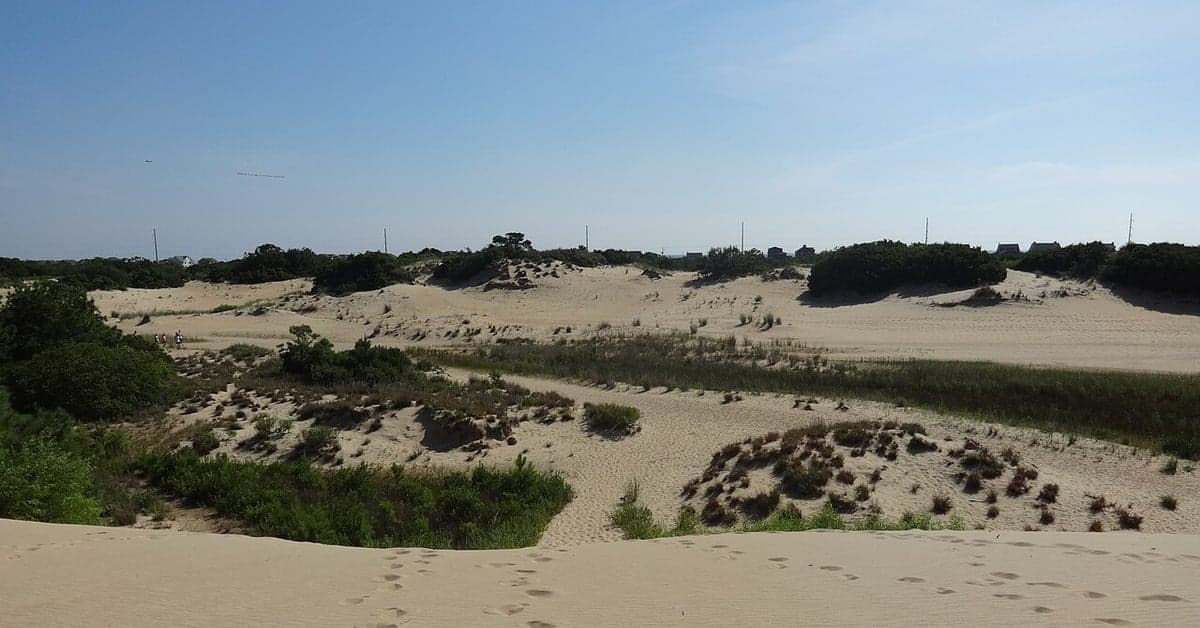
Jockey's Ridge State Park contains the tallest active sand dune system on the East Coast -- the main dune rises about 80 feet above sea level and shifts position with the prevailing winds. The park is free to enter. Walk to the top for a 360-degree view of the sound on one side and the Atlantic on the other.
Kitty Hawk Kites operates hang gliding lessons off the dunes starting at $109 for a beginner flight. The thermals off the sand are consistent enough that this has been a hang gliding destination since the 1970s. The connection to the Wright Brothers feels deliberate -- you're flying off the same dunes they studied for wind patterns.
Cape Hatteras National Seashore
South of Nags Head, the development thins out and the Cape Hatteras National Seashore begins. This is 70 miles of protected coastline -- no high-rises, no boardwalks, no commercial strips. Just sand, sea oats, and the occasional bathhouse at designated beach access points. The Outer Banks beaches here are some of the most unspoiled on the entire East Coast.
The surf is best along Hatteras Island. The sandbars shift constantly, creating new breaks that experienced surfers learn to read. The area around the "S-Turns" north of Rodanthe is a consistent spot. Water temperatures range from the low 50s in winter (wetsuit territory) to the upper 70s in summer. Surfline runs cameras at several Hatteras breaks.
Cape Hatteras Lighthouse
The black-and-white spiral-striped lighthouse is the tallest brick lighthouse in the United States at 198 feet. You can climb the 257 steps to the top from mid-April through Columbus Day ($8 adults, $4 seniors and kids). In 1999, the entire structure was moved 2,900 feet inland to save it from shoreline erosion -- an engineering feat that took 23 days.
Ocracoke Island
Ocracoke is accessible only by ferry (free from Hatteras, about an hour; paid from Cedar Island or Swan Quarter on the mainland, around $15 one-way per vehicle). The island is 16 miles long with one small village at the southern end. The rest is National Seashore -- empty Outer Banks beaches stretching in both directions with almost no one on them.
Ocracoke Village has a few hundred year-round residents and a tight cluster of restaurants, shops, and inns. The vibe is closer to a New England fishing village than a beach resort. Howard's Pub, with burgers, local seafood and a long draft list, is the island's social hub.
The Wild Horses of Corolla
At the northern end of the Outer Banks, past where the paved road ends in Corolla, a herd of about 100 wild Colonial Spanish Mustangs roams the beaches and dunes. These horses have been here for roughly 500 years, descended from Spanish explorers' stock. The only way to reach them is by 4x4 on the beach -- you need to air down your tires to about 20 PSI.
The Corolla Wild Horse Fund runs guided tours ($49 per person) in modified Hummers. Keep 50 feet of distance from the horses at all times -- it's a Currituck County ordinance, and the fine is enforced. Early morning tours have the best odds of spotting the herd near the waterline. The Outer Banks beaches north of Corolla feel genuinely remote, despite being only 90 miles from Norfolk, Virginia.
Surfing the Outer Banks
The Outer Banks is the best surfing destination on the East Coast south of New England's cold-water reef breaks. Hurricane season (August through October) brings the biggest and most consistent swells. The water is warm enough for board shorts in summer and a 3/2mm wetsuit handles the shoulder seasons.
Avalon Pier in Kill Devil Hills is a beginner-friendly break with a sandy bottom and a surf shop that rents boards ($30/day for a longboard, $25 for a shortboard). For more advanced surf, the jetties at Oregon Inlet produce fast, hollow waves when the swell direction is right. The Outer Banks beaches around Rodanthe and Buxton are the most consistent, with multiple sandbars creating rideable waves on most swells. See Surfline for current guidance.
Shipwrecks and the Graveyard of the Atlantic
More than 5,000 ships have wrecked along the Outer Banks since the 1500s. The shallow shoals, strong currents, and frequent storms earned this stretch the name "Graveyard of the Atlantic." The Graveyard of the Atlantic Museum in Hatteras village (free admission) displays artifacts from centuries of wrecks, including items from WWII U-boat attacks just offshore.
After big storms, shipwreck remnants occasionally surface on the beach. Wooden ribs from 19th-century schooners poke out of the sand near Nags Head, visible at low tide. The Outer Banks beaches carry history in a way that's rare for American coastlines.
Practical Information for Visiting
Getting There
Norfolk International Airport (ORF) is the closest major airport, about 80 miles north of Nags Head. Raleigh-Durham (RDU) is 200 miles west. There's no public transit to the Outer Banks -- a car is essential. Check flight options to Norfolk for the shortest drive.
Best Time to Visit
June through August is peak season with warm water (75-80°F) and the biggest crowds. May and September offer warm weather, smaller crowds, and lower rental prices -- a week-long beach house in Nags Head drops from $3,000+ in July to $1,500-2,000 in September. Hurricane season peaks August through October, which brings the best surf but occasional evacuations.
Beach Driving
You can drive on certain Outer Banks beaches with a permit. Permits for Cape Hatteras National Seashore cost $50 for a 10-day pass or $120 for an annual pass. You need a true 4WD vehicle (not AWD) and should air down tires to 15-20 PSI. Getting stuck in soft sand without proper equipment means a $200+ tow.
Where to Stay
Beach house rentals are the Outer Banks tradition. Most are booked Saturday-to-Saturday in summer. A 4-bedroom oceanfront house in Nags Head runs $2,500-4,000/week in peak season. Hatteras Island is cheaper -- similar houses go for $1,800-2,800/week. Ocracoke has smaller inns and cottages, with rooms from $120-200/night. Check accommodation options for the best rates.
Frequently Asked Questions
When is the best time to visit the Outer Banks?
June through August is peak season with water temperatures of 75-80°F. May and September offer lower prices -- beach house rentals drop from $3,000+ per week to $1,500-2,000. Hurricane season (August-October) brings the best surf but occasional storm evacuations.
Can you see wild horses on the Outer Banks?
Yes. About 100 wild Colonial Spanish Mustangs roam the beaches north of Corolla. You need a 4x4 to reach them since the paved road ends. The Corolla Wild Horse Fund runs guided tours for $49 per person. Keep at least 50 feet away -- the $500 fine is enforced.
How do you get to Ocracoke Island?
The free Hatteras-Ocracoke ferry runs daily and takes about an hour. Paid ferries from Cedar Island or Swan Quarter on the mainland cost around $15 one-way per vehicle and take 2-2.5 hours. Reservations are recommended in summer.
Is the Outer Banks good for surfing?
The Outer Banks is one of the best surf destinations on the East Coast. Hurricane season (August-October) brings the biggest swells. Hatteras Island around Rodanthe and Buxton has the most consistent breaks. Board rentals run $25-30 per day at local shops.
Can you drive on the beach at the Outer Banks?
Yes, with a permit. Cape Hatteras National Seashore beach driving permits cost $50 for 10 days or $120 annually. You need a true 4WD vehicle and should air down tires to 15-20 PSI. Getting stuck without proper equipment means a $200+ tow fee.
How tall is the Cape Hatteras Lighthouse?
Cape Hatteras Lighthouse is 198 feet tall -- the tallest brick lighthouse in the United States. You can climb 257 steps to the top from mid-April through Columbus Day for $8 (adults) or $4 (seniors and kids). In 1999 it was moved 2,900 feet inland to escape erosion.
What is the Graveyard of the Atlantic?
The Outer Banks has claimed more than 5,000 ships since the 1500s due to shallow shoals, strong currents, and storms. The Graveyard of the Atlantic Museum in Hatteras village (free admission) displays artifacts from centuries of shipwrecks, including WWII U-boat items.
How much does a beach house rental cost on the Outer Banks?
A 4-bedroom oceanfront house in Nags Head costs $2,500-4,000 per week in peak summer. Hatteras Island is cheaper at $1,800-2,800 per week. Ocracoke has inns and cottages from $120-200 per night. September offers the best value with 40-50% lower rates.