Tidal Pools: Where to Find Them and What Lives Inside
Table of Contents
Prices in this guide are approximate and change often. Check with the hotel, airline or operator before you book.
How Tidal Pools Form
Tidal pools exist because rock erodes unevenly. When ocean waves batter a rocky coastline over thousands of years, softer rock wears away faster than harder rock, creating basins, crevices, and shelves that trap water when the tide recedes. The geology matters: volcanic basalt, sandstone with differential hardness layers, and limestone with dissolution cavities all produce different pool shapes and sizes.
Each pool becomes a self-contained marine ecosystem for several hours of every tide cycle, cut off from the open sea until the water returns. The organisms living in them have adapted to extreme conditions: temperature swings of 20°F or more as the sun heats shallow water, salinity changes from rain dilution and evaporation, wave shock when the tide returns, and exposure to air and UV radiation during low tide. These are some of the toughest organisms in the ocean, compressed into a space you can observe from a kneeling position. The Smithsonian Ocean Portal has more background on intertidal life.
What Lives in Tidal Pools
The Zones
Tidal pool life organizes by vertical zones based on how long each area spends above water:
- Splash zone (highest): Only reached by spray and highest tides. Periwinkle snails, limpets, and cyanobacteria (the black "tar" staining on upper rocks). Tough, drought-resistant species.
- High intertidal: Submerged only during high tide. Barnacles dominate — acorn barnacles cement themselves to rock and filter-feed when submerged, seal shut when exposed. Hermit crabs scavenge here.
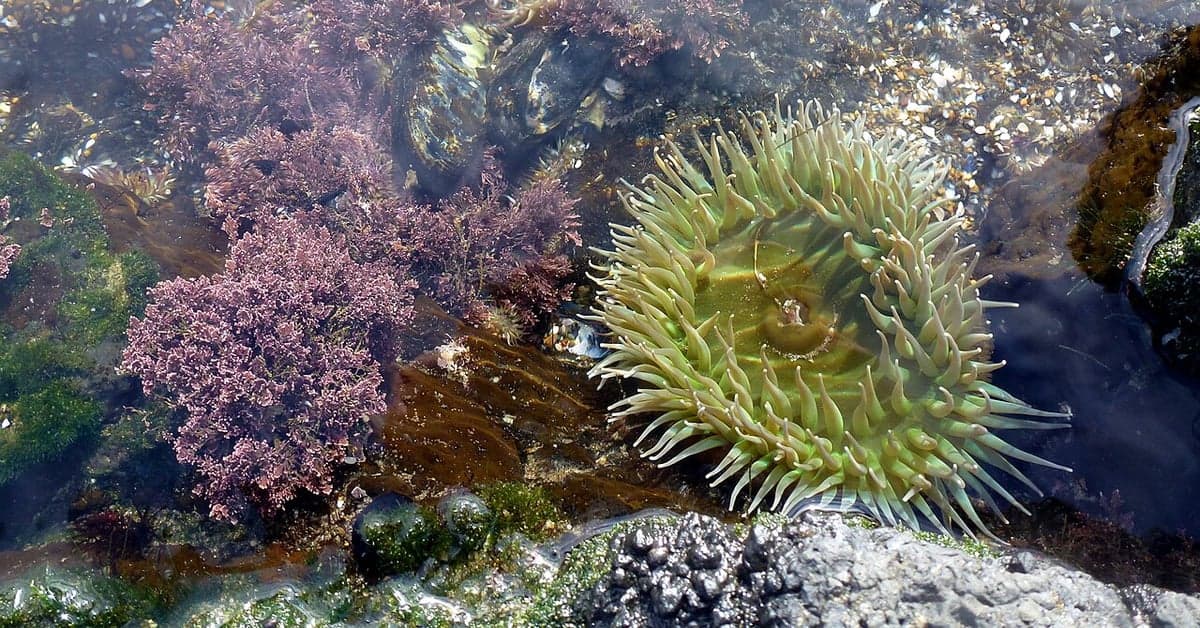
- Mid intertidal: The richest zone. Sea anemones (aggregating anemones and giant green anemones on the Pacific coast), mussels, sea lettuce, and turban snails. This is where the classic tide pool experience happens.
- Low intertidal: Exposed only during the lowest tides. Sea stars (ochre stars, sunflower stars), sea urchins, abalone, nudibranchs, small fish (sculpins, blennies, gobies), and sea cucumbers. The most diverse zone because it has the most stable conditions.
What to Look For
Sea anemones look like rubbery blobs when closed and flower-like when open and feeding. The tentacles of the common shore species feel sticky rather than painful to people, because their stinging cells are built for small prey, but touching them still interrupts feeding, so watch rather than poke. Giant green anemones, common along the Pacific coast from Alaska to Baja, get their color from symbiotic algae living in their tissues, the same relationship that powers coral reefs.
Hermit crabs occupy borrowed snail shells and upgrade to larger ones as they grow. You'll often see them scuttling between pools. Watch long enough and you may see two investigating each other's shells: behavioral ecologists have documented hermit crabs assessing, and sometimes trading, shells, rather than fighting at random.
Sea stars move using thousands of tube feet on their undersides, each operated by hydraulic pressure. You can often see the tube feet at work along the edge of a star moving through clear water; don't pull one off the rock to look, because the tube feet tear. A sea star eating a mussel is one of nature's strangest spectacles: it wraps its arms around the mussel, uses sustained force to pry the shell open a fraction of a millimeter, then extrudes its stomach out through its mouth and into the shell to digest the mussel externally.
Sea urchins wedge themselves into rock depressions that they've carved over time using their teeth (yes, teeth — a structure called Aristotle's lantern on their underside). Purple sea urchins along the California coast have created a major ecological problem: with the decline of their predator, the sunflower sea star (lost to a wasting disease since 2013), purple urchin populations have exploded and are consuming kelp forests at devastating rates.
Nudibranchs — sea slugs, basically — are the tidal pool's showpieces. They come in every color combination: neon orange, electric blue, purple with gold tips. Most are smaller than your thumbnail and easy to miss unless you look closely at rock surfaces and seaweed. The opalescent nudibranch, common in Pacific tide pools, is translucent white with orange-tipped cerata (finger-like projections) on its back.
Best Tidal Pool Destinations
Fitzgerald Marine Reserve, Moss Beach, California
About 25 miles south of San Francisco in Moss Beach, Fitzgerald Marine Reserve protects a reef shelf that extends well out from shore at low tide, creating one of the richest tidal pool systems on the Pacific coast. It lies within the Montara State Marine Reserve, a protected area under California's Marine Life Protection Act, so taking anything is prohibited. San Mateo County Parks posts the reserve's hours, tide pooling events and group tour bookings. There is no entrance fee.
Harbor seals haul out on the rocks at the northern end, and gray whales pass offshore during migration (December through April). The reef flat has distinct zones: a high mussel zone, a mid-level surfgrass zone, and a low coralline algae zone. A short walk from the parking area off Nevada Avenue leads down to the beach and reef.
Timing: on the Pacific coast of North America the lowest tides of the year (called "minus tides" because they drop below the mean lower low water mark) fall in the early morning in late spring and summer, and in the late afternoon or evening in winter. Check the tide table and plan around those windows.
Acadia National Park, Maine
The granite coast of Mount Desert Island creates deep pools along the shore at Wonderland, Ship Harbor, and the Schoodic Peninsula. The cold North Atlantic water (the park puts the average summer ocean temperature at 55-60°F) supports different species than the Pacific: rock crabs, periwinkles, dog whelks, rockweed, Irish moss, and occasional lobsters in deeper pools. The green sea urchin is the signature species — covered in short, green spines.
Bar Island, reached on foot across a gravel bar at low tide from downtown Bar Harbor, has tide pools along its shore, but the bar is only walkable for roughly an hour and a half either side of low tide. Check the NOAA tide table for Bar Harbor before crossing, and head back well before the window closes, or you will be stranded until the next low tide.
Park entrance fee: $35 per private vehicle for 7 days, and non-US residents aged 16 and over pay an additional $100 per person unless they hold an annual or America the Beautiful pass, according to the National Park Service. The park's tidepooling guidance recommends going from 1.5 hours before to 1.5 hours after low tide, staying on the rocks rather than wading into pools, and washing off sunscreen and bug spray first. Ranger-led tide pool programs run in summer.
Kalaloch Beach, Olympic National Park, Washington
Beach 4 at Kalaloch has a large reef exposed at low tide with excellent pools; the park advises aiming for tides lower than 1 foot. The Olympic coast is remote and wild, with no boardwalks or manicured paths. You scramble over driftwood logs the size of telephone poles to reach the reef. The pools here hold giant green anemones, ochre sea stars (orange or purple), gooseneck barnacles, and chitons (primitive mollusks with eight-plated shells).
The Olympic coast is also one of the best places to see ochre sea stars, which have partially recovered from the sea star wasting syndrome that killed billions along the Pacific coast starting in 2013. Healthy orange and purple stars are again a common sight in pools here.
Giant's Causeway, Northern Ireland
The roughly 40,000 interlocking basalt columns that make up the Giant's Causeway create uniquely geometric tide pools: hexagonal basins that look engineered rather than natural. The columns formed some 50 to 60 million years ago when basalt lava cooled and contracted, cracking into polygonal pillars. The pools hold beadlet anemones (red, with blue spots), common shore crabs, topshells, and blennies.
The site has been a UNESCO World Heritage Site since 1986 and is cared for by the National Trust. The Trust charges for its visitor centre experience, which includes parking, but you can walk to the stones themselves from the coastal path without a ticket. Low tide exposes the most pools at the Grand Causeway and Middle Causeway sections; the rocks nearest the sea are slippery and exposed to waves, so keep well back in rough weather.
Wembury and the South Devon Coast, England
Wembury Beach, east of Plymouth, is the star of the South Devon coast for rock pooling: slate reefs and wave-cut platforms exposed at low tide, home to cushion stars, snakelocks anemones, corkwing wrasse, and occasional cuttlefish. It has been a designated Marine Conservation Area since 1981, and Devon Wildlife Trust runs the Wembury Marine Centre on the beach, which holds guided "rockpool safaris" through its spring and summer season (check its What's On page for dates and booking).
Nearby Bantham Beach, at the mouth of the River Avon, has pools on its eastern rock ledges, and Thurlestone Beach features a natural rock arch with pools at its base. The South West Coast Path connects all of these, making for a solid day hike with multiple tidal pool stops.
How to Read Tide Charts
The NOAA Tides and Currents website provides free tide predictions for thousands of stations in the US. In the UK, the UK Hydrographic Office's Admiralty EasyTide gives official predictions for British and Irish ports. What to look for:
- Low tide time: You want to arrive 1-2 hours before the lowest point. This gives you time to explore as pools are still draining and reveals the lowest zones at peak low.
- Tide height: Lower is better. A predicted low of -0.5 feet means the water drops 0.5 feet below the chart datum (in the US, mean lower low water), exposing reef areas that are normally submerged. Anything below 0.0 feet is excellent; Olympic National Park suggests anything under 1 foot is worth a trip.
- Spring tides: Occur near full and new moons, when the gravitational pull of the sun and moon align. These produce the most extreme highs and lows — the best tide pooling happens during spring low tides.
- Neap tides: Occur near quarter moons. Less extreme tidal range, meaning fewer pools exposed.
Etiquette and Safety
Touching Rules
The safest rule is to look without touching, and many parks and reserves ask for exactly that. Where light touching is allowed, wash off sunscreen and insect repellent first, wet your hand, and use one finger. Never pry animals off rocks: a sea star gripping rock with thousands of tube feet is injured if you pull it free. Don't pick up sea urchins.
If you turn over a small rock to look underneath, put it back exactly as it was, the same way up. A rock left flipped exposes the animals on its underside to drying air and sunlight they can't survive.
Safety Basics
- Watch the water. Sneaker waves — unusually large waves that arrive without warning — kill people on rocky coasts every year. Never turn your back to the ocean on an exposed reef.
- Wear appropriate footwear. Reef-walking in bare feet or flip-flops invites sea urchin spines, barnacle cuts, and broken toes. Closed-toe water shoes with hard soles or old sneakers work fine. Algae-covered rock is extremely slippery, so keep one foot on the ground and don't jump from rock to rock.
- Know when the tide turns. If you've walked out to a low-tide reef, you need to walk back before the water rises. Set a phone alarm for the time of low tide and start working your way back toward shore soon after it sounds; the water returns faster than most people expect.
- Don't collect. Most tidal pool areas are protected. Taking shells, rocks, or organisms is illegal in marine reserves and national parks, and it depletes the ecosystem even where it's technically legal.
Frequently Asked Questions
What are tidal pools and where do you find them?
Tidal pools are shallow pockets of seawater trapped in rock formations when the tide recedes. They contain miniature ecosystems with anemones, hermit crabs, sea stars, small fish, and sometimes octopuses. The best tidal pools are on rocky coastlines -- the Pacific coast of the US (California, Oregon), New England, Hawaii, and the UK.
When is the best time to visit tidal pools?
Visit around low tide, ideally a minus tide (lower than the average low) for the most exposed marine life. Check a tide table before going: Acadia National Park recommends exploring from about 1.5 hours before to 1.5 hours after low tide. Arrive before the lowest point and leave as the tide starts rising.
Can you touch animals in tidal pools?
The safest rule is not to touch, and many parks and marine reserves ask visitors to look only. Sunscreen, insect repellent and skin oils can harm small animals, and pulling animals off rocks injures them. Never remove animals, shells or rocks: collecting is prohibited in marine reserves and national parks.
Where are the best tidal pools in California?
Crystal Cove State Park near Laguna Beach, Cabrillo National Monument in San Diego, and Fitzgerald Marine Reserve in Moss Beach (near Half Moon Bay) are among the best-known tide pool areas in California. Fitzgerald lies inside the Montara State Marine Reserve, and all three protect their tide pools, so look but don't take anything.
What animals live in tidal pools?
Common tidal pool inhabitants include sea anemones, hermit crabs, shore crabs, periwinkle snails, sea stars, chitons, mussels, barnacles, sea urchins, and small fish like blennies and sculpins. Octopuses, nudibranchs, and sea hares appear in deeper pools, especially on the Pacific coast.
Are tidal pools safe for kids?
Tide pools are a good introduction to marine life for kids, but they are not risk-free. Rocks covered in algae are very slippery, barnacles cut, and sneaker waves can knock people off exposed rocks. Keep small children within arm's reach, wear closed-toe shoes with grip, never turn your back on the sea, and go on a falling tide.