Fernando de Noronha: Brazil's Most Pristine Beach Archipelago
Table of Contents
Prices in this guide are approximate and change often. Check with the hotel, airline or operator before you book.
Fernando de Noronha: Why This Archipelago Costs More and Delivers More
Fernando de Noronha is a volcanic archipelago 354 kilometers off Brazil's northeast coast. Twenty-one islands make up the chain, but only the largest is inhabited — and even that one keeps visitor numbers down with a daily environmental fee and national park charges. The Brazilian government declared it a marine national park in 1988, and the preservation shows. The water visibility regularly exceeds 40 meters. Spinner dolphins travel in pods of 500 or more in the bay each morning. Sea turtles nest on almost every beach from December through June.
Getting to Fernando de Noronha requires a flight from Recife (1 hour) or Natal (1 hour 10 minutes). Round-trip tickets range from 800-1,600 reais ($160-320). Upon arrival, you'll pay a daily environmental preservation tax (Taxa de Preservação Ambiental) that starts at 97.16 reais ($19) per day and increases the longer you stay. The national park entrance fee is an additional 369 reais ($74) for non-Brazilians.
Baía do Sancho: The Best Beach in the World Debate
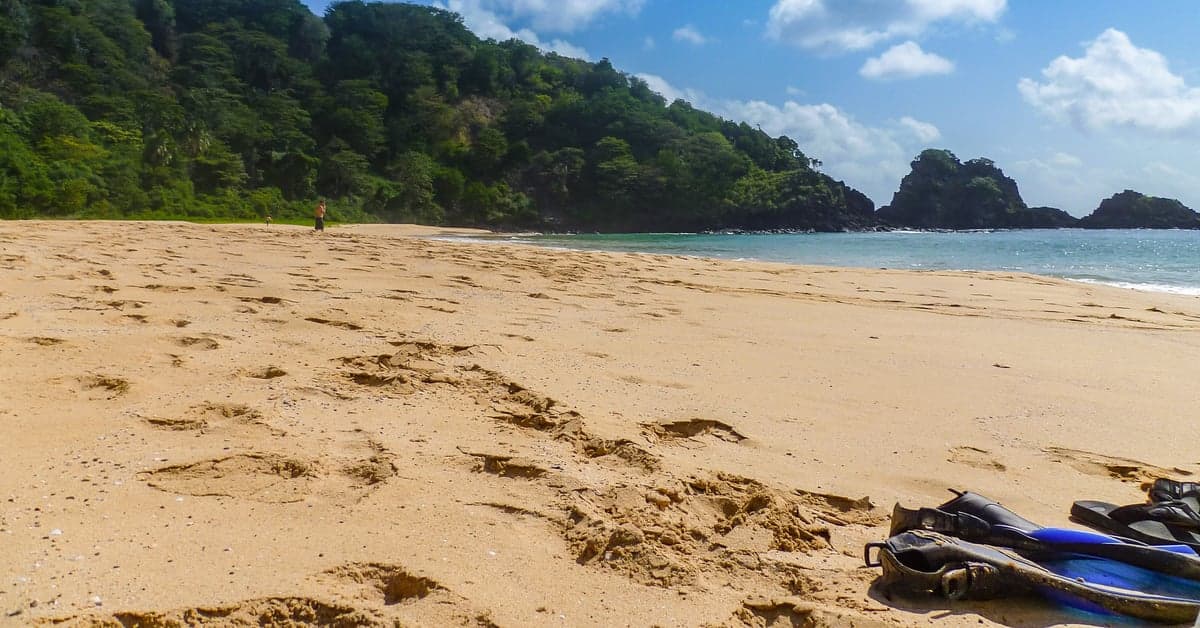
TripAdvisor has named Baía do Sancho the world's best beach multiple times, and the ranking holds up. The bay is a crescent of golden sand enclosed by volcanic cliffs draped in green vegetation. Access comes via a narrow crevice in the rock face — you descend two fixed metal ladders bolted to the cliff, squeezing through a gap barely wide enough for your shoulders. At the bottom, the beach opens up like an amphitheater.
The water is transparent turquoise. Sea turtles glide past at arm's length. During the rainy season (February through June), two thin waterfalls cascade over the cliffs directly onto the sand. Snorkeling from the beach is excellent — reef fish, octopus, and rays are common within 30 meters of shore.
Baía do Sancho is part of the national park, so you need the park pass to enter. The trailhead parking area fills by 9 AM in peak season. Go early or go late — the afternoon light on Fernando de Noronha beaches is magical when the cliffs cast golden shadows across the water.
Baía dos Porcos: The Postcard Shot
Baía dos Porcos is tiny — maybe 100 meters of sand — but the view is staggering. Two volcanic rock formations called Dois Irmãos (Two Brothers) rise from the water directly in front of the beach. At low tide, natural pools form among the rocks at the eastern end, with crystal-clear water and tropical fish trapped in shallow basins.
Access requires scrambling over large boulders from the Sancho trail — there's no proper path, just painted arrows on rocks. Wear shoes with grip. The "beach" disappears entirely at high tide, so check tide charts before making the trek. This is the archipelago at its most raw and photogenic.
Praia do Leão: Turtle Nesting Central
Praia do Leão faces the open Atlantic on the southeast side of the island. It's the primary sea turtle nesting beach — from December through June, hawksbill and green turtles come ashore at night to lay eggs. The Projeto TAMAR conservation group monitors the beach and occasionally offers guided nighttime visits during nesting season (book at the TAMAR visitors center in the village — 30 reais per person).
Even without turtles, Praia do Leão is striking. The sand is wide, the surf is rough, and a shark-shaped rock formation sits just offshore. Swimming is risky due to strong currents, but the beach is perfect for long walks and watching the waves.
Praia da Conceição and Praia do Meio
These two adjacent beaches on the north (leeward) coast are the most accessible and swimmable on the island. Conceição is a 900-meter stretch of sand with calm water, a few palm trees, and views of Morro do Pico, the island's tallest peak at 323 meters. Praia do Meio connects to Conceição at low tide and has natural rock pools.
The sunset from Forte de Nossa Senhora dos Remédios, a colonial-era fort on the hill above Conceição, is the island's best evening ritual. Bring a beer from the minimarket in Vila dos Remédios — the fort is free to enter and has panoramic views of the Fernando de Noronha coastline.
Praia do Atalaia: Snorkeling by Reservation
Atalaia is a natural tidal pool on the south coast where the national park allows only 100 visitors per day in controlled 30-minute windows. You reserve your slot through ICMBio (the park authority) — spaces fill up fast, so book as soon as you arrive. The pool is shallow (1-2 meters) and packed with marine life: reef sharks, rays, moray eels, parrotfish, and octopus, all in an area the size of a swimming pool.
No sunscreen is allowed in the water at Atalaia — only biodegradable options approved by the park. A guide accompanies each group. This is the single best snorkeling experience on Fernando de Noronha and one of the best in the South Atlantic.
Diving on Fernando de Noronha
The archipelago has 25 mapped dive sites with visibility of 30-50 meters. The water temperature stays at 26-28°C year-round. Highlights include the wreck of the Corveta Ipiranga (a deliberately sunk naval vessel at 62 meters), Pedras Secas with its swim-throughs and turtle cleaning stations, and Buraco da Raquel where nurse sharks rest in underwater caves.
Two dive operators work on the island: Águas Claras and Noronha Divers. A two-tank dive costs about 700-900 reais ($140-180). A full PADI Open Water certification runs around 2,500 reais ($500). The diving here justifies the cost — the density and variety of marine life in the warm, clear water is extraordinary. See PADI for current guidance.
For more dive-friendly destinations, browse our destination guides covering the best underwater experiences worldwide.
Where to Stay and Eat
Fernando de noronha has no large hotels or resorts — only pousadas (guesthouses) and private rentals. Budget options start around 400-600 reais ($80-120) per night, which is expensive by Brazilian standards but reflects the island's remoteness and visitor caps. Mid-range pousadas with breakfast run 700-1,200 reais ($140-240). The luxury end — Pousada Maravilha, Pousada Triboju — charges 2,000-4,000 reais per night.
The food scene is small but quality is high. Restaurante Mergulhão, built into the rocks above the harbor, serves grilled lobster for about 180 reais ($36) and fresh fish plates for 80-120 reais. Empório São Miguel does creative island cuisine with locally sourced ingredients. For cheap eats, the tapioca stands in the village square sell filled crepes for 15-25 reais.
Water and supplies are shipped to the island, so everything costs more. A beer at a bar runs 15-20 reais ($3-4). Supermarket prices are roughly double the mainland. Bring snacks and sunscreen from Recife or Natal.
Practical Information
How Long to Stay
Four to five days is ideal. This gives you time for the main beaches, a dive day, the Atalaia snorkeling reservation, and the boat tour (Passeio de Barco, about 200 reais) that enters the Baía dos Golfinhos where spinner dolphins congregate at dawn. Fewer than three days feels rushed.
Getting Around
Rent a buggy — the standard island transport. Rates run 250-350 reais ($50-70) per day. The island has one main road (BR-363) running 7 kilometers from the port to the airstrip. A public bus covers this route for 5 reais, but it doesn't reach most beaches. E-bikes are available for about 150 reais per day.
Best Months to Visit
August through December offers the best conditions: calm seas on the north coast, excellent visibility, and dry weather. The south-facing beaches (Leão, Sueste) get better waves and are more dramatic during the rainy season (February-June). The official Fernando de Noronha government site has current visitor information and fee schedules.
Fernando de noronha isn't cheap or easy to reach. That's precisely what keeps it pristine. The money you spend on fees goes directly to conservation, and the result is an ecosystem that functions the way tropical islands did before mass tourism arrived.
Frequently Asked Questions
How much does it cost to visit Fernando de Noronha?
The environmental tax starts at 97.16 reais ($19) per day and increases with length of stay. The national park pass costs 369 reais ($74) for non-Brazilians. Flights from Recife or Natal run 800-1,600 reais ($160-320) round trip. Budget pousadas start at 400-600 reais ($80-120) per night.
How do you get to Fernando de Noronha?
Fly from Recife (1 hour) or Natal (1 hour 10 minutes). Azul and GOL operate daily flights. Round-trip tickets range from 800-1,600 reais ($160-320). There is no ferry service. Book flights 2-3 months ahead for peak season (August-December).
How many days do you need in Fernando de Noronha?
Four to five days is ideal. This allows time for the main beaches (Sancho, Porcos, Conceição), a dive day, the Atalaia snorkeling reservation, and the boat tour to see spinner dolphins. Fewer than three days feels rushed.
When is the best time to visit Fernando de Noronha?
August through December brings dry weather, calm seas on the north coast, and the best diving visibility (40+ meters). The rainy season (February-June) has bigger waves on south-facing beaches and sea turtle nesting activity.
Can you see dolphins at Fernando de Noronha?
Spinner dolphins congregate in pods of up to 1,000 in Baía dos Golfinhos every morning at dawn. A boat tour (Passeio de Barco, about 200 reais) enters the bay for close encounters. You can also watch them from the cliff-top viewpoint above the bay for free.
How do you book the Atalaia snorkeling?
Reserve your 30-minute slot through ICMBio (the park authority) at the visitor center in Vila dos Remédios. Only 100 people are allowed per day. Book as soon as you arrive on the island — slots fill up within hours during peak season.
Is Fernando de Noronha worth the cost?
The fees fund conservation that keeps the marine ecosystem extraordinary — 40-meter visibility, sea turtles at every beach, reef sharks in tidal pools. If you value snorkeling, diving, and unspoiled nature over resort amenities, the island delivers an experience unavailable elsewhere in the South Atlantic.
What is the best beach on Fernando de Noronha?
Baía do Sancho has been voted the world's best beach by TripAdvisor travelers several times: golden sand enclosed by cliffs, accessed by climbing through a rock crevice via metal ladders. Baía dos Porcos is smaller but has the iconic Dois Irmãos rock formations and tidal pools at low tide.