The Best Snorkeling Beaches in the World
Table of Contents
Prices in this guide are approximate and change often. Check with the hotel, airline or operator before you book.
What Makes a Great Snorkeling Beach
Good snorkeling requires three things: visibility, marine life density, and easy water access. The best spots deliver all three without needing a boat, a guide, or advanced swimming skills. You wade in from shore, put your face in the water, and the reef is right there.
This list leans toward shore-accessible snorkeling: places where the reef or marine life starts within swimming distance of the beach. A few entries (Belize, Komodo and parts of Raja Ampat) are best reached by boat, and those are flagged. Several sites are inside marine parks with entry fees, reservation systems or sunscreen rules, so the practical details below matter.
The Sites Compared
| Site | Shore or boat | Typical visibility | Fees and bookings | Best months |
|---|---|---|---|---|
| Hanauma Bay, Oahu | Shore | 30 to 50 ft | Online reservation; $25 for non-residents; closed Mondays and Tuesdays | Mornings, year-round |
| Trunk Bay, St. John | Shore | 40 to 60 ft | $5 amenity fee (16 and over), card or phone only | December to April; mornings |
| Anse Lazio, Praslin | Shore | 40 to 60 ft | None; bring your own gear | April to May, October to November |
| Ningaloo Reef, Western Australia | Shore | 15 to 30 m | Cape Range National Park vehicle entry | - |
| Bight Reef, Providenciales | Shore (outer reef by boat) | 60 to 80 ft | None for Bight Reef; stay out of the buoyed conservation ring | November to June |
| Bonaire | Shore | 60 ft or more | STINAPA nature fee, valid for the calendar year | - |
| Red Sea, Egypt | Shore | 80 to 120 ft | Gear rental about $5 a day in Dahab | - |
| Fernando de Noronha, Brazil | Shore | Up to 100 ft or more | Daily environmental fee plus national marine park fee | August to November |
| Cozumel, Mexico | Shore and boat | 50 to 80 ft | Separate national park fee on boat trips | - |
| Maldives | Shore on local islands; boat excursions | 50 to 100 ft | Excursions about $25 to $40 from local islands | December to April (eastern atolls); May to November (western) |
| Belize Barrier Reef | Boat | 50 to 70 ft | Marine reserve fee usually added to the tour price | - |
| Komodo National Park, Indonesia | Boat | 10 to 80+ ft | Park fees on top of the tour price | April to August |
| Raja Ampat, Indonesia | Boat | 50 to 80 ft | - | October to April |
Hanauma Bay, Oahu, Hawaii
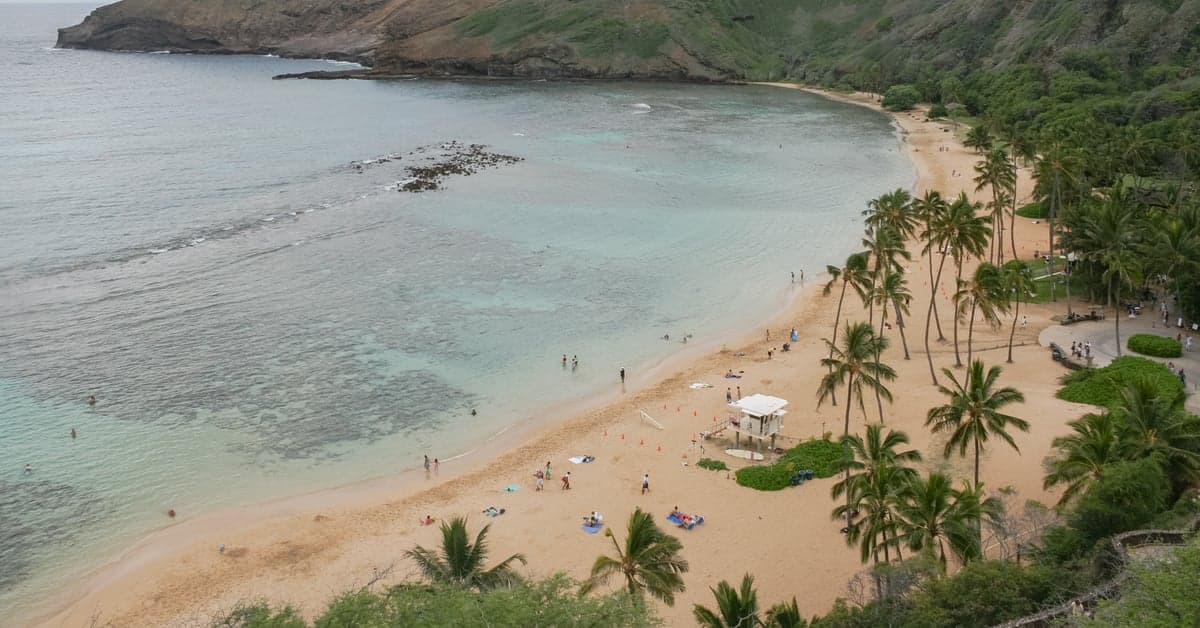
Hanauma Bay is a volcanic crater that collapsed on one side, letting the ocean flood in and create a sheltered, crescent-shaped bay. The result is a natural aquarium. Green sea turtles cruise through the shallows. Parrotfish, tang, butterflyfish, and humuhumunukunukuapua'a (the state fish — a reef triggerfish) swarm the inner reef in 5-15 feet of water.
Entry is by online reservation, which opens two days ahead at 7 a.m. Hawaii time, according to the City and County of Honolulu. Non-residents pay $25 (children 12 and under and Hawaii residents with ID enter free), parking is $3 for non-residents, and every visitor must watch an educational video about reef preservation before going down to the beach. Entry runs from 6:45 a.m. to 1:30 p.m., so book an early slot: the water is calmer and the crowds thinner in the morning.
Visibility typically runs 30-50 feet. Snorkel gear can be rented on site (cards only), but bringing your own saves money and guarantees a proper fit. Lifeguards are on duty. The preserve is closed on Mondays and Tuesdays, plus Christmas Day and New Year's Day.
Trunk Bay, St. John, U.S. Virgin Islands
Trunk Bay has an underwater snorkeling trail: a marked route with plaques on the seafloor identifying coral and fish species. According to the National Park Service, it follows the west side of Trunk Bay Cay for about 300 feet before turning back toward the beach. It's designed for beginners and works well as an introduction to Caribbean marine life.
The beach itself is a crescent of white sand backed by sea grape trees and palms. Trunk Bay is the only beach on St. John with an amenity fee: $5 per person aged 16 and over, paid by card or phone only (the booth went cashless on October 1, 2026). The fee covers showers, food concessions and snorkel rentals on site. The farther you swim past the cay toward its northern tip, the rougher the water tends to be.
You'll see brain coral, elkhorn coral, sergeant majors, blue tang, spotted eagle rays, and occasional hawksbill turtles. Visibility averages 40-60 feet. The best conditions are in the morning before the wind picks up; by afternoon, chop can reduce visibility significantly. Peak season runs December through April. Cruise ship passengers fill the beach on days when several ships are in port at St. Thomas, so check the port schedule and plan around it.
Anse Lazio, Praslin, Seychelles
Anse Lazio regularly appears on best-beach lists for its scenery alone — huge granite boulders framing white sand and impossibly blue water. The snorkeling here is a bonus that most visitors discover accidentally.
The rocky outcrops at both ends of the beach hold resident fish: moorish idols, parrotfish, needlefish, and schools of fusiliers, with octopus sometimes tucked into the rocks at the base of the boulders. Visibility runs 40-60 feet on calm days.
There are a couple of restaurants at the tree line serving grilled fish and Creole dishes. Don't count on renting gear at the beach: bring your own or buy a set in Victoria (the capital, on Mahé) before heading to Praslin. Best months are April through May and October through November, between the two trade-wind seasons, when the sea is usually calmest.
Ningaloo Reef, Western Australia
Ningaloo is one of the world's largest fringing reefs, and it hugs the coast so tightly that you can wade in from the beach and be snorkeling over living coral within minutes. No boat required, which is Ningaloo's major advantage over the Great Barrier Reef (where most reef snorkeling requires a 1-2 hour boat ride).
The two best-known shore-entry sites are in Cape Range National Park, west of Exmouth (vehicle entry is $17 AUD). The Oyster Stacks, a row of small rocky islets on the reef, can only be snorkeled at high tide, when there is enough water over the coral; check the tide times before you drive out. Nearby Turquoise Bay has a drift snorkel where the current carries you along the reef: enter at the southern end and get out well before the sand spit at the northern end, where the current can carry swimmers out through a gap in the reef. Coral Bay, about 150 km south of Exmouth, has coral gardens in Bills Bay directly off the town beach.
Whale sharks gather off Ningaloo from about March to July, and full-day swim tours with licensed operators run out of Exmouth and Coral Bay. Manta rays are seen off Coral Bay year-round, and humpback whales pass from about June to October. The Ningaloo Coast is a UNESCO World Heritage Site.
Visibility at Ningaloo averages 15-30 meters. Water temps range from about 22°C in winter to 29°C in summer. Coral Bay town is small: a few places to stay, caravan parks and a general store. Exmouth, about an hour and a half north by road, has more services.
Grace Bay Reef, Providenciales, Turks and Caicos
Grace Bay's main beach gets the attention, but the barrier reef that parallels the shore well offshore is mostly reached by boat. The barrier reef protects the beach from waves and creates a calm lagoon, and two reefs close to shore at the western end of Grace Bay give you good snorkeling without one. Both are inside Princess Alexandra National Park, managed by the Department of Environment and Coastal Resources.
Smith's Reef, near Turtle Cove and reached from a small parking area on Lower Bight Road, is the larger and more varied of the two. Enter from the rocky shoreline (water shoes help) and you are quickly over hard and soft corals; spotted eagle rays, southern stingrays, juvenile barracuda, yellowtail snapper, queen angelfish and the occasional nurse shark are regulars. Bight Reef (also called Coral Gardens), off The Bight beach, is a single ridge of coral running about 350 feet out from the sand. Do not swim inside the ring of buoys there, which marks a coral conservation zone, and watch for boat traffic at both sites.
Visibility averages 60-80 feet. Gear can be rented from vendors on The Bight beach and from dive shops in Grace Bay. For the outer reef and nearby cays, several Providenciales operators run half-day snorkel boat trips. Best conditions run November through June.
Cozumel, Mexico
Cozumel's reef system, part of the Mesoamerican Barrier Reef and largely protected as Cozumel Reefs National Park, is world-class for diving, but the shore snorkeling is often overlooked. The best spots are the beach clubs along the western shore south of San Miguel town.
Money Bar Beach Club sits on the Dzul-Ha reef, one of the island's best-known shore snorkel sites, with the reef starting a few meters from the ladders. Coral heads there shelter French angelfish, queen triggerfish, trunkfish, and moray eels. Beach clubs farther south along the same coast offer similar shore access; check each club's entry or minimum-spend policy before you go.
The current runs south to north along Cozumel's west coast. Use it to your advantage — enter at the south end of a reef section and drift north. Visibility is typically 50-80 feet. The water is warm year-round (78-84°F).
For a boat snorkel experience, the Colombia Shallows and El Cielo (a shallow sandbar known for its sea stars) are the highlights. Half-day tours leave from San Miguel; the national park charges a separate entry fee, and handling or lifting the sea stars is not allowed. Tours sold to cruise passengers tend to run bigger groups and shorter stops, so smaller operators are worth the extra search.
Bonaire
Shore Diving and Snorkeling Capital of the Caribbean
All the waters around Bonaire and Klein Bonaire, from the high-tide mark down to 60 meters, have been protected as the Bonaire National Marine Park since 1979. Yellow-painted stones along the coast road mark more than 80 dive and snorkel sites, most of them accessible from shore. You park your car, walk to the water, and snorkel directly over the reef. Few Caribbean islands make it this easy.
The top snorkel sites: 1000 Steps (not actually 1,000: it's roughly 70 steps down a limestone cliff to a reef starting in shallow water), Te Amo Beach near the airport, and Lac Bay on the windward side for a completely different experience, with seagrass beds, mangroves and juvenile fish.
Everyone who enters the water must pay STINAPA's nature fee, which is valid for the calendar year (January to December) and is priced differently for divers and non-divers; pay online before you arrive. Gear can be rented from dive shops in Kralendijk. A waterproof fish identification card, sold at most dive shops, is worth having.
Bonaire's climate is desert-dry, and it sits south of the main hurricane track, so direct hits are rare, which makes it a reliable year-round destination. Visibility is usually 60 feet or more. Water temps hold steady at 79-82°F.
Maldives
Almost every resort in the Maldives has a house reef within swimming distance. The best house reefs — Vilamendhoo, Ellaidhoo, Bandos, and Reethi Beach — have reef drop-offs where the shallow lagoon gives way to a wall plunging into deep blue. Snorkeling along these edges puts you face-to-face with reef sharks, napoleon wrasse, manta rays, eagle rays, and dense clouds of tropical fish.
Budget guesthouses on local islands (Maafushi, Thulusdhoo, Rasdhoo) offer the same marine life at a fraction of resort prices. Rooms run $40-80/night, and snorkel excursions to nearby reefs cost $25-40. The tradeoff is less polished facilities and stricter dress codes on local island beaches (bikinis only at designated tourist beaches).
Visibility averages 50-100 feet depending on the atoll and season. The northeast monsoon (December through April) brings the calmest seas and best visibility on the eastern atolls. The southwest monsoon (May through November) shifts the best conditions to the western side. Manta ray season peaks from May through November in most atolls, with Hanifaru Bay in Baa Atoll being the premier aggregation site; it is a protected area where snorkelers go with a ranger and diving is not permitted.
Red Sea, Egypt
Sharm el-Sheikh and Dahab on the Sinai Peninsula offer some of the most accessible reef snorkeling in the world. At Ras Mohammed National Park (south of Sharm), the reef starts at the shoreline and drops into a wall teeming with anthias, lionfish, giant moray eels, and the occasional reef shark.
Dahab's Blue Hole is notorious among divers for its depth (over 100 meters) and the deaths of divers who went too deep, but the snorkeling around the rim is excellent in calm conditions. The Bells-to-Blue Hole snorkel — entering at a site called The Bells and drifting south to the Blue Hole — passes over some of the healthiest coral in the northern Red Sea. A mask and snorkel rental in Dahab costs about $5/day.
The Red Sea has unusually high salinity, which means you float higher in the water. It also means exceptional visibility — 80-120 feet on good days. Water temps range from 68°F in winter to 84°F in summer. The Red Sea holds more than 1,200 fish species, around a tenth of them found nowhere else.
Check your government's travel advice before booking. The UK Foreign Office, for example, advises against all travel to North Sinai and against all but essential travel to much of the South Sinai interior, while the coastal resorts, including Sharm el-Sheikh and Dahab, fall outside those warnings. Some governments, including the US, are stricter about Sinai.
Komodo National Park, Indonesia
You come for the dragons, you stay for the snorkeling. Komodo's waters sit at the convergence of the Indian and Pacific Oceans, creating nutrient-rich currents that support extraordinary marine density. Manta Point (Makassar Reef) has resident manta rays with wingspans exceeding 4 meters. Pink Beach (Pantai Merah) — named for the crushed red coral that tints the sand pink — has a reef starting in knee-deep water with giant clams, cuttlefish, and chromis clouds.
This one needs a boat. Most visitors base themselves in Labuan Bajo on Flores and take day trips or multi-day liveaboard trips through the park; liveaboards cover more sites, including the remote southern sections. National park entry fees are charged on top of the tour price and have been revised several times in recent years, so confirm the current amount with your operator. Currents in Komodo can be fierce: always snorkel with a guide and check conditions before entering.
Visibility varies wildly, from 10 feet in plankton-rich areas (which attract the mantas) to 80+ feet in clearer sections. Best months for snorkeling are April through August when seas are calmest.
Raja Ampat, West Papua, Indonesia
Raja Ampat has some of the highest recorded marine biodiversity on the planet: surveys have recorded more than 550 species of hard coral, roughly three-quarters of all known species, and the area is now a UNESCO Global Geopark. The fish life is proportionally dense — schools of bumphead parrotfish, wobbegong sharks draped over coral heads, pygmy seahorses on fan corals, and manta cleaning stations where the rays queue up like cars at a car wash.
This is not a budget destination despite being in Indonesia. Getting here requires flights to Sorong, then a ferry or speedboat to Waisai. Family-run homestays on local islands, with meals included, are the cheapest option; dive resorts cost several times more. Foreign visitors must also buy the Raja Ampat marine park entry pass, which is valid for a year; the price has been revised over time, so check the current figure before you travel.
Sawandarek Jetty, accessible from several homestays, has a house reef that's worth days of repeated exploration. Arborek village has a reef walk where you wade in waist-deep water over living coral and giant clams. Friwen Wall is a shore-entry snorkel over a dramatic drop-off.
Best conditions run October through April. June through September brings rougher seas but is still diveable. Visibility averages 50-80 feet.
Belize Barrier Reef
The Western Hemisphere's largest barrier reef runs the entire length of Belize's coast. Hol Chan Marine Reserve, a short boat ride from Ambergris Caye, is the most popular snorkel site. Zone A has a cut in the reef where currents channel nutrients, attracting nurse sharks, spotted eagle rays, grouper, and thick schools of snapper. The adjacent Shark Ray Alley lives up to its name — southern stingrays and nurse sharks swarm the sandy bottom, accustomed to boats and completely unfazed by snorkelers.
Hol Chan is reached by boat, and tours run from both Ambergris Caye and Caye Caulker, with the marine reserve's entry fee usually added to the tour price. Caye Caulker has a relaxed backpacker feel and cheaper accommodation than Ambergris Caye. The Split, a channel cut through the island during Hurricane Hattie in 1961, is a popular swimming spot with some snorkeling around the edges.
The Great Blue Hole, while iconic, is not great for snorkeling. It's a deep sinkhole (over 400 feet) primarily suited for diving, and the long boat day out to Lighthouse Reef is expensive for what snorkelers get on the rim. The Belize Barrier Reef Reserve System, which includes the Blue Hole, is a UNESCO World Heritage Site.
Visibility averages 50-70 feet. Water temps are 79-84°F year-round. Best months are March through June for the calmest seas.
Fernando de Noronha, Brazil
This volcanic archipelago about 354 km off Brazil's northeast coast has been part of a UNESCO World Heritage Site since 2001 and is one of the most regulated marine environments in the world. Visitors pay a daily environmental preservation fee (TPA) to the state for every night on the island, plus a separate national marine park entry fee; together they add up quickly over a week, so check current rates before you go. Those fees and the limited flights from Recife and Natal keep the crowds manageable.
Baía do Sancho consistently ranks among the world's best beaches, and the snorkeling off its shore is excellent, with visibility reaching 100 feet or more on good days. Spinner dolphins gather in large numbers in the neighboring Baía dos Golfinhos, which is closed to swimmers and watched from a clifftop lookout. Praia do Sueste has a snorkeling area where sea turtles graze on algae in shallow water; keep your distance and never touch them. Praia do Atalaia's natural pool is the most restricted site: visits are guided, timed and capped, and must be booked in advance.
Accommodation and food are expensive by Brazilian standards, since nearly everything is shipped or flown in. The costs are the main barrier to entry, but they also help preserve the environment that makes the snorkeling so good.
Best months are August through November when visibility peaks and seas are calmest. Water temps stay warm (78-82°F) year-round.
Gear Tips for Snorkelers
Bring Your Own Mask
A well-fitting mask is the single most important piece of snorkel gear. Rental masks leak, fog, and ruin the experience. Spend $30-50 on a quality silicone mask (Cressi, TUSA, and Scubapro all make reliable models) and bring it with you. Test the seal by pressing it to your face without the strap and inhaling through your nose — it should stay put.
Fins Make a Difference
Short travel fins ($25-40) fit in a carry-on and make a massive difference in your ability to cover distance and handle current. Without fins, you're limited to paddling around near shore. With them, you can reach outer reef sections and handle drift snorkeling comfortably.
Reef-Safe Sunscreen
Oxybenzone and octinoxate damage coral. Hawaii, Bonaire and the U.S. Virgin Islands have banned the sale of sunscreens containing them, and the National Park Service also lists octocrylene and other ingredients to avoid, noting that "reef safe" on a label is not regulated. Use mineral sunscreen with zinc oxide or titanium dioxide. Apply 30 minutes before entering the water and reapply after swimming. A long-sleeve rash guard eliminates the need for sunscreen on your torso and arms entirely.
Underwater Camera
A GoPro or similar waterproof action camera runs $150-300 and captures what your phone can't. Alternatively, waterproof phone pouches ($10-15) let you shoot photos and video with your phone to about 30 feet depth. Test the pouch in a sink before trusting it in the ocean.
Frequently Asked Questions
Where is the best snorkeling beach in the world?
Raja Ampat in Indonesia has some of the highest recorded marine biodiversity on the planet, with more than 550 hard coral species recorded. For easier access, Ningaloo Reef in Western Australia lets you wade in from the beach and snorkel over living coral within minutes, with whale shark encounters from about March to July.
What is the best snorkeling for beginners?
Trunk Bay in St. John, USVI has a marked underwater snorkeling trail with plaques identifying coral and fish, plus snorkel rentals and showers on site. Hanauma Bay on Oahu, Hawaii is a sheltered volcanic crater with calm, shallow water, abundant marine life, gear rental and lifeguards on duty. Hanauma Bay requires an online reservation, made two days ahead.
Do you need a boat for good snorkeling?
No. Many of the best snorkeling spots have quality shore entry. Bonaire's west coast has more than 80 marked sites, most of them reachable from shore. Ningaloo Reef starts at the beach. Smith's Reef and Bight Reef in Turks and Caicos, Cozumel's beach clubs, and the house reefs at many Maldives resorts all deliver without a boat. Belize's Hol Chan and Komodo National Park do need one.
How much does a snorkeling trip cost?
Shore-entry snorkeling is often free or covered by a small park fee. Equipment rental typically runs $10-20 a day. Hanauma Bay in Hawaii charges non-residents $25 entry plus $3 parking, Trunk Bay in the USVI charges $5, and Bonaire requires STINAPA's annual nature fee for anyone entering the water. Guided boat trips cost more, and marine park fees in places like Komodo, Raja Ampat and Fernando de Noronha are charged on top.
What snorkeling gear should I bring?
A well-fitting silicone mask ($30-50) is the most important piece — rental masks leak and fog. Short travel fins ($25-40) fit in carry-on luggage and make a massive difference in covering distance and handling current. Use reef-safe mineral sunscreen and consider a long-sleeve rash guard to eliminate sunscreen on your torso.
When is the best time to swim with whale sharks?
Ningaloo Reef in Western Australia has one of the world's best-known whale shark gatherings, from about March to July, with full-day swim tours from Exmouth and Coral Bay. In the Maldives, juvenile whale sharks are seen year-round in South Ari Atoll, where excursions run from resorts and local guesthouses.