Are There Nude Beaches in Morocco? The Law and Nearby Options (2026)
Table of Contents
Are There Nude Beaches in Morocco?
No. There are no nude beaches in Morocco, official or tolerated. Article 483 of the Moroccan Penal Code makes "voluntary nudity" in public an offence against public decency, punishable by one month to two years in prison and a fine, and topless sunbathing is not accepted on public beaches either. The nearest legal nude beaches are in Spain: Tarifa is about an hour from Tangier by ferry, and the Canary Islands are a short flight away.
This guide covers what the law says, what to expect on the Atlantic and Mediterranean coasts, and how to pair a Moroccan trip with a stop where clothing-optional beaches are legal.
What the Law Says About Nudity in Morocco
Article 483 is short and broad: anyone who commits a public outrage against decency "by voluntary nudity" or by obscene gestures or acts is liable to one month to two years in prison and a fine. It applies everywhere, beaches included, and there is no exception for designated areas because none exist. The same penal code makes it an offence for a Muslim to break the Ramadan fast in public (Article 222), which gives a sense of how closely public behaviour is regulated.
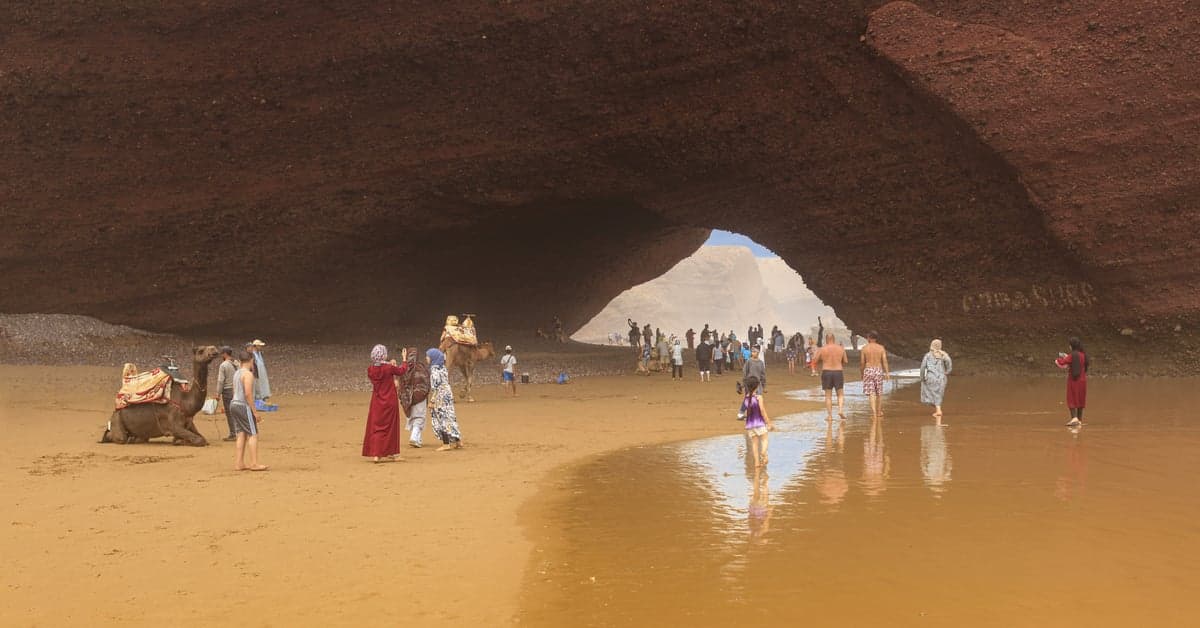
Beyond the statute, local norms are conservative. Many Moroccan women swim fully dressed or in a burkini, and families make up most of the crowd on summer weekends. The UK government travel advice for Morocco suggests loose-fitting clothing that covers the arms, legs and chest, and advises against public displays of affection, including in tourist areas. Swimsuits are normal on the sand itself; cover up when you walk into town.
The Atlantic Coast
Agadir
Agadir is Morocco's main purpose-built beach resort, rebuilt after the 1960 earthquake, with a long public beach and a promenade lined by large hotels. The beach is public, busy with families, and textile. Hotel pools are private space, but their house rules apply, and nothing in Moroccan law treats a hotel pool as a place where nudity is allowed.
Essaouira and Taghazout
Essaouira's wide, windy beach is known for kitesurfing and windsurfing, with fishing activity at the harbour end. Taghazout, the surf village north of Agadir, has the most international feel of any Moroccan coastal town, with surf camps and yoga retreats, but the beach rules are the same as anywhere else in the country.
Dakhla and the Far South
The coast south of Sidi Ifni is sparsely populated, and Dakhla's lagoon is a major kitesurfing destination. Remoteness does not change the law: the same penal code applies, and there is no naturist tradition anywhere on the southern coast.
The Mediterranean Coast
From Tangier and Asilah east to Tetouan, Al Hoceima and Saidia near the Algerian border, the Mediterranean beaches fill with Moroccan families in July and August. Spanish day visitors are common around Tangier, but beach dress follows Moroccan norms, not Spanish ones. Saidia is the largest resort on this coast and allows nothing that Agadir does not.
Private Villas and Riads
Riads in Marrakech, Fes and Essaouira, and rental villas on the coast near Oualidia and Sidi Kaouki, often have walled pools. A pool that no one else can see is private property rather than a public place, but the property's own rules decide what is acceptable, so ask before assuming anything. Rooftop terraces in a medina are usually overlooked by neighbours and should be treated as public.
The Closest Legal Alternatives
Spain Across the Strait
Spain is the practical answer. Ferries between Tangier and Tarifa take about an hour, and Spain does not treat nudity on its beaches as a crime, so the Costa de la Luz and the Costa del Sol both have long-established nude beaches. See our Spain guide for specific beaches.
The Canary Islands
The Canaries are Spanish territory off the southern Moroccan coast. Gran Canaria's Maspalomas dunes have a well-known nude section, and Fuerteventura has several clothing-optional beaches. Flights from Marrakech or Casablanca to the islands take about two hours. Our Canary Islands beach guide covers the islands in more detail.
Portugal
Portugal has officially recognised naturist beaches, including several near Lisbon and on the southwest coast. They are covered in our Portugal guide.
Practical Tips
Plan Morocco Around Its Strengths
Morocco's highlights are the medinas of Marrakech, Fes and Chefchaouen, trekking in the High Atlas from Imlil, the desert around Merzouga, surfing at Taghazout and the food everywhere. Beach dress is irrelevant in all of them. Treat the coast as a swimsuit stop and save clothing-optional time for Spain.
Combine Morocco With Spain
The simplest pairing is Morocco plus Andalusia, using the Tangier to Tarifa ferry as the crossing. A typical split is ten days in Morocco and five to seven on the Spanish coast. The Canary Islands are the other easy pairing by air.
What to Pack
Regular swimwear, a cover-up for the walk to and from the beach, and clothing that covers shoulders and knees for the medinas. Women may want a scarf for religious sites that admit non-Muslim visitors, such as the Hassan II Mosque in Casablanca.
When to Visit
Spring (April to June) and autumn (September to November) are the most comfortable months. July and August are very hot inland, with Marrakech often above 40°C, while the Atlantic coast stays mild. Winter brings cool nights in the north and the Atlas and reliable sun in the south. Surf season at Taghazout runs roughly October to April. Visit Morocco, the national tourism office, publishes regional travel information.
Final Thoughts
Morocco is one of the world's great cultural destinations, but it has no nude beaches and its penal code names voluntary nudity in public as a crime. Wear a swimsuit on Moroccan beaches, cover up in town, and if clothing-optional beach time matters to you, cross the Strait to Spain or fly to the Canary Islands.
This series: The World's Best Nude Beaches
Frequently Asked Questions
Are there any nude beaches in Morocco?
No. Morocco has no official or tolerated nude beaches. Article 483 of the Moroccan Penal Code makes voluntary nudity in public an offence against public decency, punishable by one month to two years in prison and a fine. Beach dress on both the Atlantic and Mediterranean coasts is conservative.
Is topless sunbathing allowed in Morocco?
No. Topless sunbathing is not accepted on Moroccan public beaches, and many local women swim fully dressed. Hotel pools are private, but their house rules apply. UK government travel advice suggests loose-fitting clothing that covers the arms, legs and chest in public.
What about private pools at riads and villas?
A walled pool that no one else can see is private property rather than a public place, but the property's own rules decide what is acceptable. Ask before assuming anything, and treat medina rooftop terraces as overlooked by neighbours.
What is the closest legal nude beach to Morocco?
Spain. Ferries between Tangier and Tarifa take about an hour, and Spain does not treat nudity on its beaches as a crime, so the Costa de la Luz and Costa del Sol have long-established nude beaches. The Canary Islands, including the nude section of the Maspalomas dunes on Gran Canaria, are about two hours by air from Marrakech or Casablanca.
Is Taghazout more relaxed about beach behaviour?
It is Morocco's most international surf town, with surf camps and yoga retreats, but the law and beach norms are the same as anywhere else in the country. Swimsuits are fine on the beach; nudity is not.
When is the best time to visit Morocco's coast?
April to June and September to November are the most comfortable. July and August are very hot inland but mild on the Atlantic coast. Surf season at Taghazout runs roughly October to April.
Can I combine Morocco with a naturist destination on the same trip?
Yes. The easiest pairing is Morocco plus Andalusia, crossing by ferry from Tangier to Tarifa. A typical split is ten days in Morocco and five to seven days on the Spanish coast. The Canary Islands are the other easy option by air.