The Best Beaches in the Maldives: Atoll by Atoll
Table of Contents
Prices in this guide are approximate and change often. Check with the hotel, airline or operator before you book.
How the Maldives Works
The Maldives is 26 atolls containing roughly 1,190 individual islands, of which about 200 are inhabited and another 160 operate as resort islands. Each resort occupies its own island — one island, one resort, no neighbors. This is the fundamental Maldives proposition: you get an entire island to share with a few dozen to a few hundred other guests, surrounded by a lagoon and a house reef.
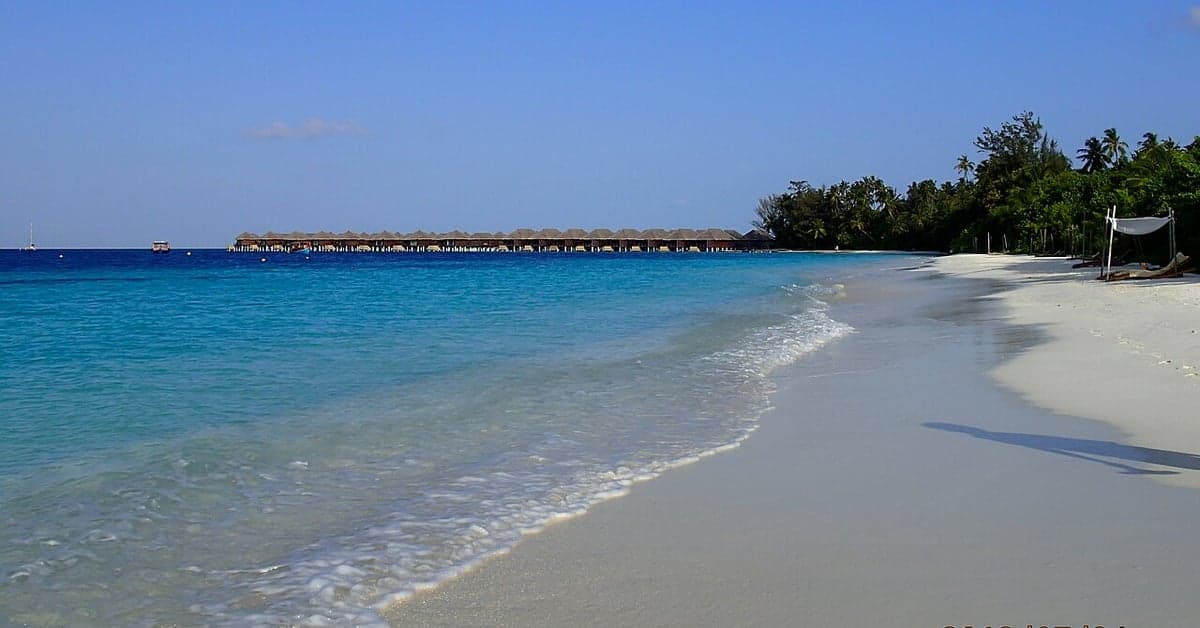
The geography is flat. The highest natural point in the entire country is 2.4 meters above sea level. Every island is a low ring of sand around a coconut palm core, fringed by coral reef, sitting in water that shifts from pale turquoise over sand to deep blue over the reef drop-off. The beaches are uniformly white coral sand, fine-grained and cool underfoot even in midday sun.
Choosing a Maldives destination means choosing an atoll, then choosing an island within that atoll. Each atoll has different marine life, different transfer logistics from Malé, and a different price range. Here's how they break down. For official planning information, see Visit Maldives.
North Malé Atoll: The Accessible One
North Malé Atoll contains the capital, Malé, and the international airport (Velana International, MLE). Resorts here are reached by speedboat in 20-60 minutes, meaning no seaplane transfer and no domestic flight. This makes North Malé the most practical choice for short trips or late arrivals.
The beaches at resorts like Baros (speedboat 25 minutes, rooms from $700/night) and One&Only Reethi Rah (speedboat 45 minutes, from $1,200/night) are pristine and private. Baros has a compact island with an exceptional house reef — you can snorkel directly from the beach and encounter blacktip reef sharks, green sea turtles, and dense schools of blue-lined snapper within 50 meters of shore.
For a more affordable North Malé option, Bandos Maldives (from $200/night, speedboat 15 minutes) offers solid diving, a decent house reef, and a beach that delivers the Maldives experience without the $800-per-night price tag. The sand is the same sand, the water is the same water — what changes at higher price points is the villa design, the food, and the staff-to-guest ratio.
Local Island: Huraa
The inhabited island of Huraa in North Malé Atoll has guesthouses starting at $50-80/night. The bikini beach (a designated section where tourists can wear swimwear — the Maldives is a Muslim country, and non-resort islands have dress codes) is small but clean, with snorkeling off the edge. Huraa gives you the Maldives water for a fraction of resort pricing, with the trade-off of basic accommodation and fewer amenities.
South Ari Atoll: Whale Shark Headquarters
South Ari Atoll has the highest concentration of whale sharks in the Maldives, with year-round sightings along the outer reef edge. The area around Dhigurah and Maamigili is the hotspot — whale sharks feed on plankton in the channels between the reef, and snorkeling or diving encounters are common enough that operators offer guarantees (no sighting, free repeat trip).
LUX* South Ari Atoll (seaplane from Malé, 25 minutes, rooms from $500/night) is a big resort spread across a 1.8-kilometer island with a 4-kilometer sandbank extending from the beach at low tide. The house reef is excellent, and the resort runs guided whale shark excursions as part of a marine biology program — guests can join survey trips where sightings are documented for research.
Dhigurah itself is an inhabited island with a 3-kilometer-long beach on its western side — one of the longest continuous beaches in the Maldives. Guesthouses here cost $60-100/night, and whale shark snorkeling trips run $80-100 per person through local operators. The beach is wide, empty, and backed by coconut palms. No resort infrastructure, no water villas — just sand and sea.
Baa Atoll: UNESCO Biosphere Reserve
Baa Atoll received UNESCO Biosphere Reserve designation in 2011, and the marine protection shows. Hanifaru Bay, inside the reserve, experiences mass feeding events between June and November when manta rays (sometimes 100+ at a time) and whale sharks gather to feed on concentrated plankton. Swimming with dozens of mantas in a single session is one of the most remarkable marine encounters available anywhere in the world.
Access to Hanifaru Bay is regulated — you need a permit (arranged through resorts or local operators), no scuba diving is allowed (snorkeling only), and group sizes are limited. The experience depends on conditions: plankton concentrations vary, and on some days the bay is empty while on others it's packed with mantas.
Soneva Fushi (seaplane from Malé, 30 minutes, from $1,500/night) is Baa Atoll's flagship resort and was one of the first luxury eco-resorts in the Maldives. The island is heavily vegetated — a rarity in the Maldives — with a Robinson Crusoe aesthetic: barefoot luxury, open-air restaurants, an overwater observatory for stargazing. The beach circles the island and has wide sandy sections on the north and south ends.
Dharavandhoo, the inhabited island in Baa Atoll with an airport, has guesthouses from $70/night. It's the budget base for Hanifaru Bay trips during manta season.
Lhaviyani Atoll: Diving and Sandbanks
Lhaviyani Atoll, north of North Malé, is known for its dive sites and sandbank excursions. Fushifaru Thila is the standout dive site, with overhangs covered in soft coral and dense schooling fish. Nurse sharks rest in the overhangs during the day.
Sandbank excursions are a Lhaviyani specialty. Resorts and guesthouses arrange trips to uninhabited sandbanks — small mounds of sand barely above the waterline — where you're dropped with a cooler, a snorkel set, and an umbrella for two to three hours. The feeling of being on a tiny sand island in the middle of the Indian Ocean, alone, with 360-degree turquoise water, is the distilled Maldives experience.
Hurawalhi Island Resort has an adults-only policy and an underwater restaurant, 5.8 (named for its depth in meters), where multi-course dinners cost $280 per person. The beach is small but the house reef drops into deep water close to shore, creating excellent snorkeling with pelagic sightings — eagle rays, reef sharks, and barracuda are common.
Addu Atoll: The Budget Frontier
Addu Atoll (also called Seenu Atoll) is the southernmost atoll in the Maldives, below the equator, and it's the best option for travelers who want Maldives beaches without Maldives resort prices. A 75-minute domestic flight from Malé to Gan Airport brings you to an atoll with multiple connected inhabited islands and a growing guesthouse scene.
The beaches on Addu's islands — particularly the southern coasts of Hithadhoo and Gan — have wide white sand with minimal tourist traffic. A few guesthouses on Maradhoo and Feydhoo offer rooms from $40-60/night with beach access. The atoll has a proper road network linking its main islands (rare in the Maldives, where most islands are car-free), and you can rent a bicycle or scooter to explore.
Addu used to have one big-name luxury resort, the Shangri-La on Villingili, but it has been closed since 2020, so this is guesthouse territory. The British Loyalty wreck, a WWII-era oil tanker sitting in the lagoon, is Addu's signature dive site.
Resort Islands vs. Local Islands
The Maldives guesthouse revolution started around 2009 when the government began allowing tourism on inhabited islands. Before that, all tourism was resort-only. Today, dozens of inhabited islands have guesthouses, dive shops, and bikini beaches catering to independent travelers.
What You Get at a Resort
- Private island with exclusive beach access
- Overwater villas and beach villas with direct lagoon access
- Multiple restaurants, bars, and all-inclusive options
- Organized excursions, diving, and water sports
- Alcohol freely available (Maldives resorts are exempt from the alcohol ban)
- Price: $300-2,000+/night
What You Get on a Local Island
- Guesthouse with basic to mid-range rooms
- Bikini beach (designated tourist swimming area)
- Local restaurants with Maldivian food ($5-15 per meal)
- Independent dive operators and excursion boats
- No alcohol (Maldives is a Muslim country; only resorts serve alcohol)
- Price: $40-150/night
The beach quality is comparable — the same white sand, the same clear water. What differs is privacy, comfort, and the drinking question. For many travelers, the local island experience is more interesting: you're in a Maldivian community, eating Maldivian food (mas huni, garudhiya fish soup, hedhikaa snacks), and interacting with residents rather than resort staff. The trade-off is less polish and no bar.
Bioluminescent Beaches
Several Maldives beaches experience bioluminescence — a blue-green glow in the water and wet sand caused by dinoflagellates (microscopic plankton) that emit light when disturbed. The effect is strongest on moonless nights between June and February, when plankton concentrations peak.
Vaadhoo Island in Raa Atoll became famous for bioluminescence photographs, but the phenomenon occurs across the Maldives. Resorts in South Ari, Baa, and Lhaviyani atolls all report bioluminescent events. It's not predictable — some nights the water glows intensely, other nights there's nothing. Walking along the waterline at midnight, watching each footstep spark blue light in the wet sand, is one of those experiences that justifies the cost and effort of reaching the Maldives.
Practical Details
Best Months
January through April is the northeast monsoon dry season — minimal rain, calm seas, best visibility for diving and snorkeling. This is peak season with peak pricing. May through November brings the southwest monsoon with more rain, stronger swells, and better surfing conditions on the eastern reefs. Manta ray and whale shark activity peaks during the wet season, particularly June through November in Baa Atoll. Shoulder months (May and November) offer reasonable weather with lower prices.
Seaplane Transfers
Resorts beyond speedboat range of Malé require seaplane transfers operated by Trans Maldivian Airways (TMA) or Maldivian Air Taxi. Round-trip costs run $300-600 per person depending on distance. Seaplanes operate only during daylight hours, so flights arriving in Malé after 3:30 PM typically require an overnight in Malé or the airport hotel before transferring to the resort the next morning. Factor this into your planning — losing a night to a Malé layover is annoying if unexpected.
Frequently Asked Questions
How much does a Maldives vacation actually cost?
A luxury resort stay costs $500-2,000+ per night for an overwater villa. But budget options exist: local island guesthouses cost $50-100 per night, and meals at local restaurants run $5-12. A week at a mid-range guesthouse on a local island can cost $800-1,200 total including activities. Seaplane transfers add $300-600 round trip to remote atolls.
When is the best time to visit the Maldives?
November through April is the dry season (northeast monsoon) with the best weather — minimal rain, clear skies, and excellent visibility for snorkeling and diving. January through March is peak season with highest prices. May through October is wetter and cheaper, with some resorts offering 30-40% discounts. Surfing is best from March through October.
Can you visit the Maldives on a budget?
Yes, since 2009 when local island guesthouses were legalized, budget travel became possible. Islands like Maafushi, Thulusdhoo, and Dhigurah have guesthouses from $50-80 per night. Local meals cost $5-10. Snorkeling trips run $25-40. A week on a local island costs roughly $700-1,000 per person, a fraction of the resort price.
Is the Maldives worth the money?
For the specific experience of overwater villas, house reefs, and turquoise lagoons visible from your room, nothing else compares. The Maldives delivers on its promise of extraordinary water clarity, abundant marine life, and total seclusion. If you mainly want beach time and snorkeling without the luxury markup, similar water quality exists in the Seychelles, Palawan, or Zanzibar for less.
Can you drink alcohol in the Maldives?
Alcohol is available at resorts and liveaboard boats but banned on local inhabited islands, as the Maldives is a Muslim country. Resort islands operate under a tourism exemption. If staying at a local island guesthouse, you will not have access to alcohol. Some guesthouses arrange floating bar excursions or sandbank trips where drinks are served.
How do you get around the Maldives?
Seaplanes connect Malé airport to remote resorts ($300-600 round trip, 20-60 minutes). Speedboats serve closer resorts and local islands ($25-150 per trip). Domestic flights on Maldivian Airlines reach regional airports. Public ferries connect local islands cheaply ($2-5) but are slow. Most resorts arrange all transfers as part of your booking.
Do you need to know how to swim to visit the Maldives?
You don't need to swim to enjoy the Maldives — the beaches and lagoons are beautiful from land, and most resorts have infinity pools. However, snorkeling and diving are the main activities, so non-swimmers miss out on a significant part of the experience. Many resorts offer life jacket snorkeling for non-swimmers, and lagoons are often shallow enough to stand.