Table of Contents
Prices in this guide are approximate and change often. Check with the hotel, airline or operator before you book.
A Reef-Protected Island
Mauritius is almost entirely surrounded by a coral reef that sits between 1 and 5 kilometers offshore. The lagoon between the reef and the beach acts as a natural swimming pool — calm, shallow, and warm year-round. This is why Mauritius beaches feel different from open-ocean islands like Réunion or Mauritius's own outer islands. The water inside the lagoon rarely has waves worth mentioning, the depth stays manageable, and you can wade far from shore without worrying about currents.
The reef also means the underwater life starts close to the beach. Snorkeling inside the lagoon turns up butterflyfish, parrotfish, damselfish, and the occasional small octopus. For more serious reef diving, boats take you outside the lagoon in 10-15 minutes to sites with better visibility and larger marine life.
Mauritius is a small island — 65 by 45 kilometers — and driving from coast to coast takes about an hour. The west coast gets the best weather (drier, less wind), the east coast gets the trade winds (good for kitesurfing, less good for lounging), and the north coast has the most tourist infrastructure.
Le Morne: The Mountain Beach
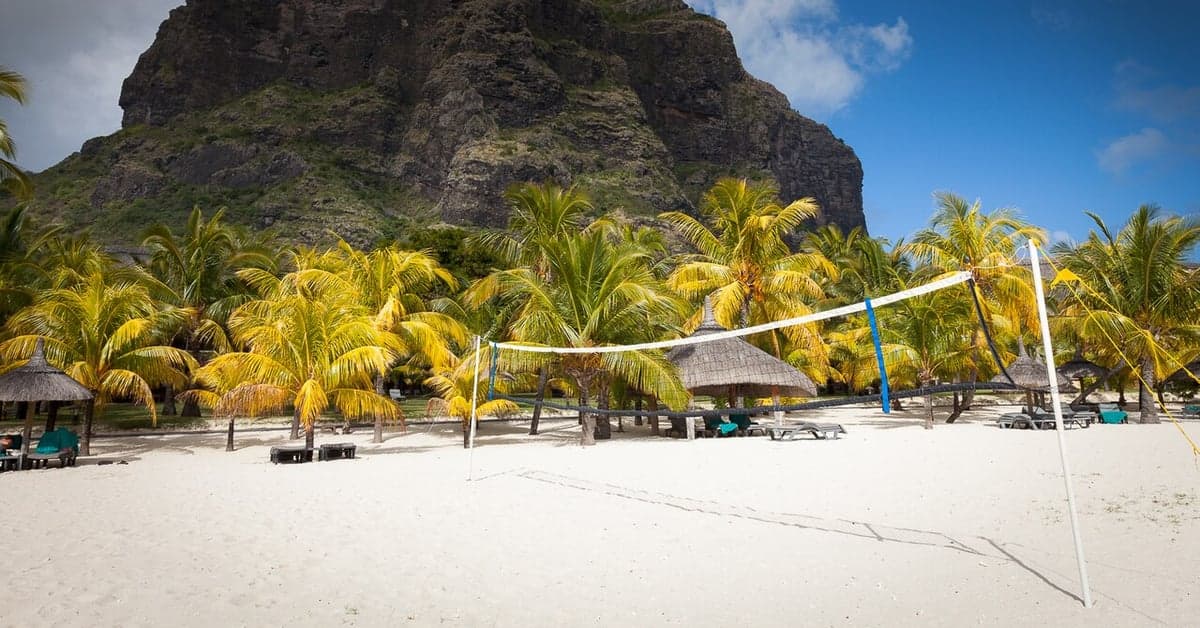
Le Morne beach runs along the base of Le Morne Brabant, a UNESCO World Heritage Site — a dramatic basalt monolith rising 556 meters from the southwestern tip of the island. The mountain has deep historical significance: during the 18th and 19th centuries, escaped enslaved people hid in the caves and summit forests of Le Morne. The UNESCO designation (2008) recognizes this history.
The beach itself is about 3 kilometers of white sand, wide and clean, with the mountain looming overhead. The lagoon here is broad and shallow, making it one of Mauritius's best swimming beaches. The left (southern) end of the beach, near the One Eye surf spot, is where kitesurfers gather — the wind funnels around the peninsula and creates consistent conditions from May through November.
The Lux* Le Morne resort occupies the prime beachfront position (rooms from €300/night). The St. Regis Mauritius sits nearby with rates starting around €500. Budget options are limited in Le Morne itself, but the town of La Gaulette, 10 minutes north, has guesthouses and Airbnbs from €40-60/night. La Gaulette's main strip has small restaurants serving Creole dishes — rougaille (tomato-based fish or sausage stew), mine frit (Mauritian fried noodles), and dholl puri (flatbread stuffed with split pea curry) — for 150-300 Mauritian rupees ($3.50-7).
The Underwater Waterfall
Viewed from the air — by helicopter or drone — the ocean off Le Morne's southern tip appears to contain an underwater waterfall, with sand and silt appearing to cascade into the deep. It's an optical illusion caused by sand deposits being pushed off the island's coastal shelf into the deeper ocean, but the visual effect is extraordinary. Helicopter tours from Domaine de L'Etoile or Corail Hélicoptères cost around €250-350 per person for a 15-minute flight. It's expensive, but the resulting photographs are worth the price for most visitors.
Flic en Flac: The Local Favorite
Flic en Flac is a long, wide public beach on the west coast that draws both tourists and Mauritian families. The beach stretches about 3 kilometers, with a promenade running its length, food vendors selling samosas and gateaux piment (chili cakes) for 10-20 rupees each, and a casuarina tree line providing shade.
The water is calm year-round, the sunsets are the island's best, and the vibe is more relaxed and local than the north coast resort zone. On weekends, Mauritian families set up picnics along the entire beach — coolers of Phoenix beer (the local brew, 60 rupees in shops), portable grills with chicken sausages, and cricket matches on the hard sand.
For diving, Flic en Flac is Mauritius's primary hub. The Rempart Serpent and Cathedral dive sites lie just outside the lagoon, accessible in 15 minutes by boat. Two-tank dive packages run €60-80 through operators like Sun Divers and Dive Dream. The Cathedral site — a large underwater cavern where sunlight filters through gaps in the ceiling — is Mauritius's most famous dive.
Trou aux Biches: The Postcard Beach
Trou aux Biches, on the northwest coast, has the widest stretch of white sand on the island and water so clear that you can see individual grains of sand on the bottom at 3 meters depth. The beach is about 2 kilometers long, backed by casuarina trees and a handful of upscale hotels, including the Beachcomber Trou aux Biches Resort & Spa.
Snorkeling directly off Trou aux Biches beach is among the best shore-entry snorkeling in Mauritius. Swim 50 meters from the northern end of the beach and you'll find coral formations alive with fish — look for the Moorish idols, which are Mauritius's most photogenic reef fish, with their long, trailing dorsal fins.
The village of Trou aux Biches is small but has enough restaurants and shops to be self-contained. Le Pescatore, inside the Beachcomber resort but open to outside guests, serves high-end seafood with beach views — count on €50-80 per person. For cheaper eats, roadside trucks along the Royal Road (the coast road) sell dholl puri for 15 rupees and biryani plates for 100 rupees.
Belle Mare: The East Coast Stretch
Belle Mare is a 5-kilometer beach on the east coast — arguably the longest continuous stretch of sand on the island. The sand is white, the water is turquoise inside the lagoon, and the palm trees lean at the cinematic angle that resort brochures depend on. The east coast catches the trade winds, which means Belle Mare has a light breeze most of the time — refreshing in summer (December-March), occasionally chilly in Mauritian winter (June-August).
The hotel density at Belle Mare is high. The Constance Belle Mare Plage (from €350/night) has two golf courses. The LUX* Belle Mare (from €280/night) is popular with honeymooners. The Long Beach hotel (from €200/night) attracts a younger crowd. Between the hotels, the public beach access points are well-maintained, with free parking and shower facilities.
Île aux Cerfs: The Day-Trip Island
Île aux Cerfs is a small island off the east coast, reached by a 15-minute speedboat ride from Trou d'Eau Douce (round trip €15-20 per person). The island has multiple white-sand beaches, a Bernhard Langer-designed 18-hole golf course (green fees €120), and a cluster of restaurants and beach bars.
The beaches on Île aux Cerfs are objectively beautiful — the water colors are intense, the sand is fine, and the setting feels more remote than it is. The downside: it's a highly organized tourist attraction. Tour operators pack the island from 10 AM to 3 PM, particularly when cruise ships dock in Port Louis. Parasailing, glass-bottom boats, and jet skis crowd the water. If you go, take the first boat over at 9 AM and claim a spot on the quieter eastern beaches before the crowds arrive.
The GRSE Waterfall boat trip, which combines a river journey through mangroves with a stop at Île aux Cerfs, is a better option than the straight transfer. These catamaran tours ($40-60 per person including lunch and drinks) take a scenic route up the Grande Rivière Sud-Est to a waterfall, then continue to the island.
Blue Bay: Glass-Bottom Boat Territory
Blue Bay, on the southeast coast near the airport, is a marine park with some of the healthiest coral formations in Mauritius. The bay is small and protected, with water that ranges from pale turquoise over sand to deep blue over coral. Glass-bottom boat tours ($10-15 per person, 30 minutes) leave from the beach and drift over brain coral, staghorn coral, and giant clams.
The beach at Blue Bay is relatively small and can feel crowded on weekends, but the marine park snorkeling makes up for it. Bring your own mask and snorkel — the coral starts about 50 meters from shore, and the diversity of fish life surpasses most lagoon snorkeling spots on the island.
Grand Baie: The Tourist Capital
Grand Baie is less a beach destination and more a base of operations. The bay itself is a harbor filled with catamarans, fishing boats, and tour vessels — not ideal for swimming. The beaches flanking Grand Baie — La Cuvette (small, sheltered, good for families) and Mont Choisy (long, wide, excellent for swimming) — are where you actually swim.
Grand Baie's value is in its infrastructure: the largest concentration of restaurants, bars, shops, and tour operators on the island. Sunset catamaran cruises to Gabriel Island and Flat Island depart from Grand Baie ($50-80 per person including lunch and drinks). Deep-sea fishing charters for blue marlin and yellowfin tuna leave from the harbor ($500-800 for a full-day boat, split between up to 4-6 anglers).
Night Market and Street Food
The Grand Baie bazaar runs Thursday evenings with food stalls, clothing, and souvenirs. For daily street food, the roadside stalls along Royal Road in Grand Baie serve Mauritius's best casual eating: gateaux piment (15 rupees), briani (100-150 rupees), and bol renversé (a dome of rice topped with chicken, vegetables, and a fried egg, 80-120 rupees).
Rum, Creole Food, and the Mauritian Mix
Mauritius has no indigenous population — everyone arrived from somewhere else. Indian laborers, African slaves, French colonists, Chinese merchants, and British administrators created a culture where a single family dinner might include rougaille, biryani, dim sum, and French pastry. The cuisine is the most tangible expression of this mix, and eating across the island's cultural spectrum is one of the genuine pleasures of a Mauritius trip.
Rum distilleries — Chamarel, Rhumerie de Mascareignes, and New Grove — offer tastings and tours for €10-15. Chamarel's distillery, in the island's volcanic interior, can be combined with a visit to the Seven Coloured Earths (a geological formation where exposed volcanic soil shows distinct color bands) and Chamarel Waterfall. The rum itself ranges from agricultural style (distilled from fresh cane juice rather than molasses) to aged varieties that compete with Caribbean producers.
Getting to Mauritius
Sir Seewoosagur Ramgoolam International Airport (MRU) has direct flights from London (12 hours, Air Mauritius and British Airways), Paris (11 hours, Air Mauritius and Air France), Dubai (6.5 hours, Emirates), Johannesburg (4 hours, Air Mauritius and South African Airways), and Mumbai (7 hours). From the US, the fastest routing goes through Dubai or London.
The island is in the GMT+4 time zone with no daylight saving — which means minimal jet lag from Europe and Africa, and significant adjustment from the Americas. November through April is summer (hot, humid, occasional cyclones), May through October is winter (warm, dry, trade winds). December and January are peak season with the highest hotel prices. September and October offer the best combination of dry weather and moderate rates.
Frequently Asked Questions
What is the best month to visit Mauritius?
May through November is the cooler, drier season with comfortable temperatures (72-79°F) and less humidity. September and October are the driest months with the calmest seas. December through April is hotter, more humid, and brings occasional cyclones. Water temperature stays warm (75-82°F) year-round.
Which side of Mauritius has the best beaches?
The west coast (Flic en Flac, Le Morne) has the best year-round swimming with calm, turquoise lagoons protected by the reef. The north (Grand Baie, Trou aux Biches) is popular with excellent snorkeling. The east coast (Belle Mare, Ile aux Cerfs) has the whitest sand but rougher conditions from June through August due to trade winds.
How much does a Mauritius vacation cost?
Mauritius caters to both budget and luxury travelers. Guesthouses and Airbnbs cost $40-80/night, mid-range hotels $100-200. Five-star resorts (the island's specialty) run $300-1,000+/night. Street food dholl puri costs $0.50-1. Restaurant meals average $10-20. Catamaran day trips with snorkeling and lunch cost $40-70 per person.
Is Mauritius worth the long flight?
If you want a tropical island with world-class resorts, excellent food (Indian-Creole-French fusion), and diverse activities beyond the beach (hiking Le Morne, rum distilleries, Chamarel Coloured Earth), Mauritius justifies the trip. Direct flights operate from London (12 hours), Paris (11 hours), Dubai (6.5 hours), and Johannesburg (4 hours).
Can you snorkel from the beach in Mauritius?
Yes, several beaches have good reef snorkeling directly from shore. Trou aux Biches and Flic en Flac have coral and fish within wading distance. Blue Bay Marine Park on the southeast coast has the best snorkeling, with glass-bottom boat access for non-swimmers. Snorkel gear rents for $5-10/day at most beaches.
Is Le Morne Beach good for swimming?
Le Morne has a large, shallow lagoon with calm turquoise water excellent for swimming and wading. The beach itself is wide and less crowded than the north coast. It's also one of the world's top kitesurfing spots -- the flat, waist-deep lagoon and consistent trade winds from June through October are ideal for riders of all levels.
Do you need a visa for Mauritius?
Visitors from the US, UK, EU, Canada and Australia don't need to apply for a visa in advance; a free visitor's permit is issued on arrival. Check the length of stay allowed for your passport before you go. You need a passport valid for at least 6 months, a return ticket, and proof of accommodation. No vaccinations are required for travelers from most countries.