The Best Beaches in Malta and Gozo
Table of Contents
Prices in this guide are approximate and change often. Check with the hotel, airline or operator before you book.
Malta's Coastline: Compact but Varied
Malta is one of the smallest countries in the EU — 316 square kilometers, roughly the size of a mid-tier London borough. You can drive from one end to the other in 45 minutes (in theory; Maltese traffic adds 20). But the coastline packs in a remarkable range of swimming spots: sandy bays, limestone slabs for sunbathing, deep-water cliff jumping spots, and rocky coves with water so clear it looks computer-generated.
The main island has most of the sandy beaches and the bulk of the tourist infrastructure. Gozo, the smaller sister island reached by a 25-minute ferry from Ċirkewwa (€4.65 return for passengers, free going to Gozo — you pay on the way back), has a more rural feel and some of the best swimming. Between them sits tiny Comino, population roughly three, home to the Blue Lagoon and not much else.
Blue Lagoon, Comino
The most famous swimming spot in Malta isn't technically a beach at all — it's a shallow channel between Comino and the uninhabited islet of Cominotto, where white sand on the seabed makes the water appear almost fluorescent blue. In July and August, it's packed beyond reason: tour boats from Sliema and Buġibba start arriving by 10am, and by noon there's barely room to lay a towel on the rocky shoreline.
The trick is timing. Visit in May, late September, or October and you'll have space. Better yet, take one of the sunset boat trips (Captain Morgan and other operators run them for €25-30) that arrive after the day-trippers leave. A few operators also run trips that include a stop at the Santa Marija caves on Comino's south side, which are worth the detour for snorkeling.
Getting There
- Regular ferries from Ċirkewwa (north Malta) and Mġarr (Gozo) — about €10-15 return
- Boat tours from Sliema, Buġibba, and Golden Bay — €20-35 including stops at other sites
- No accommodation on Comino except one hotel (the Comino Hotel, which has changed ownership repeatedly)
Golden Bay (Għajn Tuffieħa Bay's Neighbor)
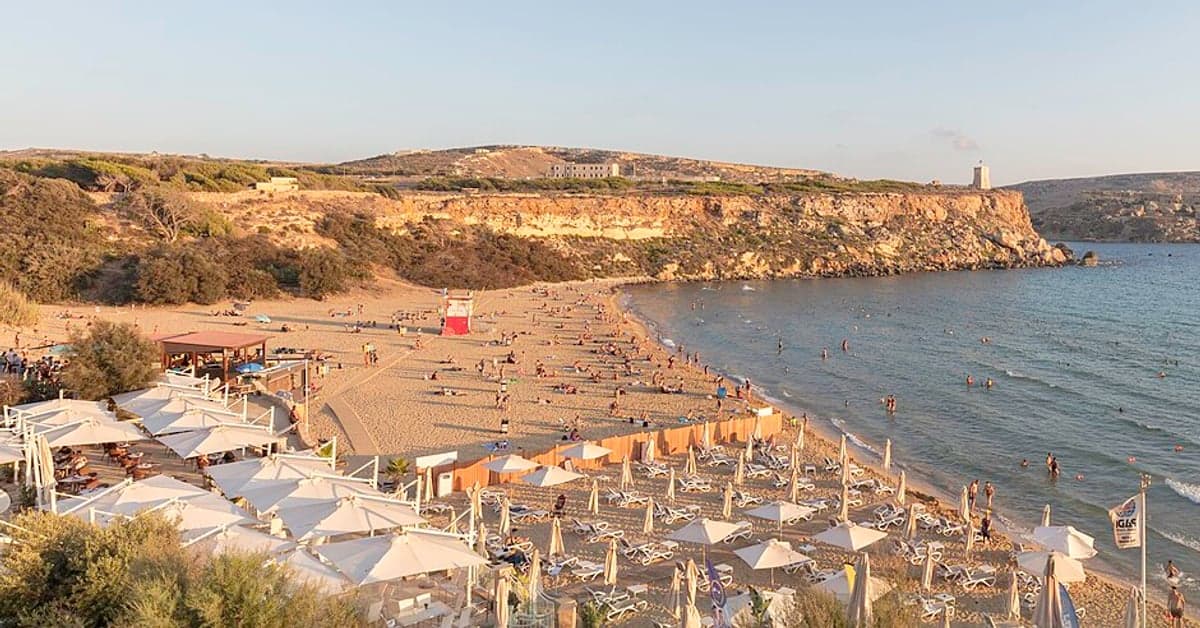
Malta's most popular sandy beach sits on the northwest coast, about 20 minutes' drive from Valletta. It's a wide arc of orange-gold sand at the base of clay slopes, with a large hotel (the Radisson Blu) perched on the cliff above. Lifeguards operate from June to September, there are sunbed rentals (€10-12 for two sunbeds and an umbrella), and a beach bar sells drinks and snacks.
The sand here is coarser than you'd find in the Caribbean — more gritty than powdery — but the swimming is good, with a gradual entry and relatively calm water most days. Bus 44 from Valletta runs directly to Golden Bay, making it one of the most accessible beaches without a car.
Għajn Tuffieħa (Riviera Beach)
Walk five minutes along the cliff path from Golden Bay and you'll reach the top of the staircase leading down to Għajn Tuffieħa — 200 clay steps cut into the hillside. This extra effort filters out a good portion of the crowd. The beach is slightly smaller than Golden Bay but noticeably quieter, with clay cliffs on three sides creating a natural amphitheater.
The clay from the cliffs has a tradition behind it: locals (and some tourists) smear it on their skin as a natural face mask. Whether it does anything for your pores is debatable, but it's a Maltese beach ritual. A small kiosk at the top of the stairs sells drinks, and there's a seasonal beach bar on the sand itself.
Important note: the clay slopes above the beach are unstable. There have been rockfalls, and the steps can be slippery after rain. Stick to the marked path.
Ramla Bay, Gozo
Gozo's largest sandy beach, and one of very few in the Mediterranean with genuinely red-orange sand (high iron oxide content in the local rock). It sits in a wide valley on Gozo's north coast, with the remains of Calypso's Cave — mythically associated with Homer's Odyssey — visible on the cliff above the eastern end.
Ramla Bay is popular with families because the water is shallow for a long way out. During summer, you'll find sunbed rentals and a couple of snack bars. In winter, the beach is completely deserted and the waves can be substantial. The sand has a distinctly orange tint that photographs well but stains lighter clothing if you sit directly on it.
Getting to Gozo's Beaches
The Gozo Channel ferry runs from Ċirkewwa to Mġarr every 45 minutes (more frequently in summer). Once on Gozo, buses connect Mġarr harbor to Victoria (the capital) and from there to most beaches, but service is infrequent. Renting a car on Gozo costs €25-40/day and is the practical choice if you want to beach-hop. Several rental agencies operate directly from Mġarr harbor.
St. Peter's Pool
Forget sand entirely. St. Peter's Pool, near the fishing village of Marsaxlokk in southeast Malta, is a natural limestone swimming hole carved into flat rock shelves. Swimmers climb down to the water's edge on the stepped rock formations and jump or lower themselves into deep, clear water.
The pool is about 30 meters across, surrounded by flat rock that serves as a natural sunbathing platform. The depth is around 4-5 meters in most places, making it popular for cliff jumping from the lower ledges (2-3 meters). Higher jumps exist but are genuinely dangerous — injuries happen every summer.
There are no facilities at St. Peter's Pool — no toilets, no shade, no food or drink vendors. Bring everything you need. Parking is limited to a dirt lot about 300 meters away. The walk in is flat and easy. After swimming, drive five minutes to Marsaxlokk for fresh fish at one of the harbor-front restaurants — the grilled lampuki (dolphinfish) is a Maltese specialty in autumn, and a full fish meal runs €15-20.
Paradise Bay
A small sandy cove near the Ċirkewwa ferry terminal in Malta's far northwest. Paradise Bay earned its name fairly: a steep staircase leads down to a compact beach of coarse golden sand, hemmed in by rocks, with clear swimming water and views toward Comino and Gozo.
The beach gets direct sun until mid-afternoon, when the western cliffs start casting shade. It's a logical stop before or after a Gozo ferry — the terminal is a 5-minute walk away. A hotel and restaurant sit on the cliff above, and there's a beach bar on the sand during summer months. The beach is small enough that it fills up by 11am on peak summer days, so arrive early or come in shoulder season.
Mellieħa Bay (Għadira)
The longest sandy beach in Malta — about 800 meters of gently sloping sand on the north coast. The water stays ankle-to-knee deep for 50 meters out, which is why it's the default choice for families with young children. Mellieħa Bay has the most infrastructure of any Maltese beach: sunbed rentals, water sports operators (jet skis, parasailing, pedal boats), beach bars, and lifeguards from June to September.
The main road runs directly behind the beach, separated by a thin strip of trees, so it's not the most scenic setting. But the swimming conditions are consistently good, and the town of Mellieħa, up the hill, has supermarkets, restaurants, and pharmacies. The Popeye Village film set — built for the 1980 Robin Williams movie and now a tourist attraction — is a 10-minute drive away, which is either charming or baffling depending on your sensibilities.
When to Visit Malta's Beaches
Season by Season
- June to September: Peak season. Water temperatures hit 26°C by August. Beaches are crowded, especially on weekends. Book accommodation well in advance.
- May and October: The sweet spot. Water is still swimmable (20-23°C), crowds thin dramatically, and hotel prices drop 30-40%.
- November to April: Off-season. Some beaches are good for walks but swimming is for the hardy. Valletta and the historical sites are better draws in winter.
Getting Around
Malta has an extensive bus network radiating from Valletta. The Tallinja card (€1.50 per trip, or €21 for a weekly Explore card with unlimited travel) covers all routes including night buses. Buses to popular beaches run frequently in summer but can be packed. Taxis are expensive by southern European standards — a Valletta to Golden Bay ride costs €20-25 via Bolt or eCabs. Car rental at the airport starts at roughly €15-20/day outside peak season.
Eating Near the Beaches
Skip the beach-adjacent tourist restaurants where possible. Maltese food is underrated: ftira (a local flatbread, similar to focaccia, stuffed with tuna, capers, and tomatoes) is the perfect beach lunch and costs €3-5 from bakeries. Pastizzi — flaky pastries filled with ricotta or mushy peas — are 50 cents each and sold at pastizzeri all over the island. For a proper meal, seek out village restaurants serving rabbit stew (fenkata), bragioli (beef olives), or fresh-caught fish.
Frequently Asked Questions
Does Malta have sandy beaches?
Malta has a mix of sandy and rocky beaches. The best sandy beaches are Mellieha Bay (the longest), Golden Bay, and Ghajn Tuffieha. Most swimming spots are rocky with ladder access or flat rock platforms for sunbathing. Gozo's Ramla Bay has distinctive orange-red sand. Bring water shoes for rocky entries.
What is the best month to visit Malta beaches?
June through September offers the warmest sea temperatures (74-82°F) and guaranteed sunshine. July and August are hottest (90°F+) and most crowded. May and October are pleasant for swimming with thinner crowds and lower hotel prices. Malta gets almost no rain from June through August.
How much does a Malta beach holiday cost?
Malta is affordable by European standards. Hotels average 70-140 euros/night in summer, Airbnbs 50-90 euros. Pastizzi (traditional pastries) cost 0.50 euros, restaurant meals 10-18 euros. The Gozo ferry is 4.65 euros round trip per person (paid on return only). Diving costs 35-55 euros per dive.
Is Gozo worth visiting from Malta?
Absolutely. Gozo is quieter and greener than Malta with excellent beaches (Ramla Bay, Mgarr ix-Xini), the Inland Sea at Dwejra, and better diving sites. The ferry from Cirkewwa to Mgarr takes 25 minutes and runs every 45 minutes. You can day trip or stay overnight -- Gozo has a slower, more rural charm.
Is Malta good for diving?
Malta is one of the best diving destinations in the Mediterranean, with visibility regularly exceeding 100 feet. Highlights include the Blue Hole at Dwejra (Gozo), the Um El Faroud wreck, and the underwater caverns at Ghar Lapsi. Dive centers are everywhere, and a single guided dive costs 35-55 euros with equipment.
Is the Blue Lagoon in Comino worth visiting?
The Blue Lagoon has stunning turquoise water over white sand, but it gets extremely crowded from 10am to 4pm in summer -- hundreds of boats and tour groups pack the small area. Visit early morning or late afternoon, or go in shoulder season (May/October). Boat trips from Sliema or Cirkewwa cost 15-25 euros round trip.