The Best Beaches in Ecuador and the Galápagos
Table of Contents
Prices in this guide are approximate and change often. Check with the hotel, airline or operator before you book.
Two Beach Worlds in One Small Country
Ecuador's coast runs about 1,400 miles along the Pacific, split between a mainland shoreline that's cheap, accessible, and largely off the international tourist radar, and the Galápagos Islands — 600 miles offshore, expensive to reach, and home to some of the most extraordinary beach experiences on the planet. The two couldn't be more different in character or cost, and both deserve attention.
The mainland coast stretches from the Colombian border south to Peru, lined with fishing villages, surf towns, and mangrove estuaries. The Galápagos, a volcanic archipelago straddling the equator, operate under strict national park regulations that limit visitor numbers and mandate guided access to most sites. You can visit both in a single trip, but the logistics and budgets are entirely separate conversations.
Quito's Mariscal Sucre International Airport (UIO) and Guayaquil's José Joaquín de Olmedo Airport (GYE) are the main gateways. The mainland coast is 4-8 hours by bus from either city. Galápagos flights depart from both airports, with Guayaquil being the shorter (and usually cheaper) route.
Mainland Beaches
Montañita
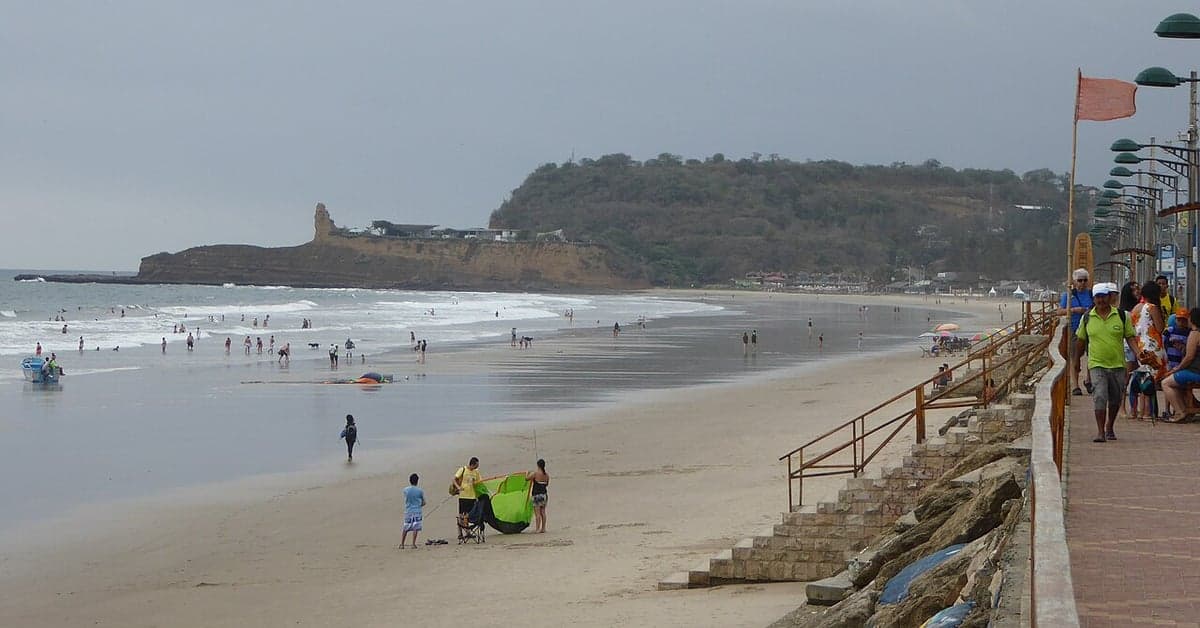
Montañita is Ecuador's party-surf town, a compact village on the Santa Elena peninsula that draws backpackers, surfers, and South American twenty-somethings in roughly equal measure. The main drag is a single pedestrian street lined with tattoo parlors, cocktail bars serving $2 mojitos, empanada vendors, and surf shops renting boards for $10-15/day.
The surf at Montañita is a consistent right-hand point break that works best on south and southwest swells from May through November. The wave is fun and forgiving at 3-4 feet, fast and hollow at 6-8 feet. The takeoff zone gets crowded — Montañita draws surfers from across Ecuador and neighboring countries, and the lineup on a Saturday afternoon can feel like rush hour. Midweek mornings are vastly better.
The party scene peaks on Friday and Saturday nights and during Carnaval (February/March), when the population triples and the bass from competing sound systems can be felt in your sternum. If that's not your thing, come on a Tuesday and you'll have a different experience entirely — mellow, uncrowded, and cheap.
Budget accommodations cluster along the main street: Hostal Dharma has dorms for $8-10 and a rooftop terrace. Balsa Surf Camp, on the quieter north end, charges $25-35 for a private room. The almuerzo (set lunch) at most comedores costs $1.50-2.50 and includes soup, a main plate with rice and protein, juice, and sometimes dessert. It remains one of the best food deals in South America.
Los Frailes
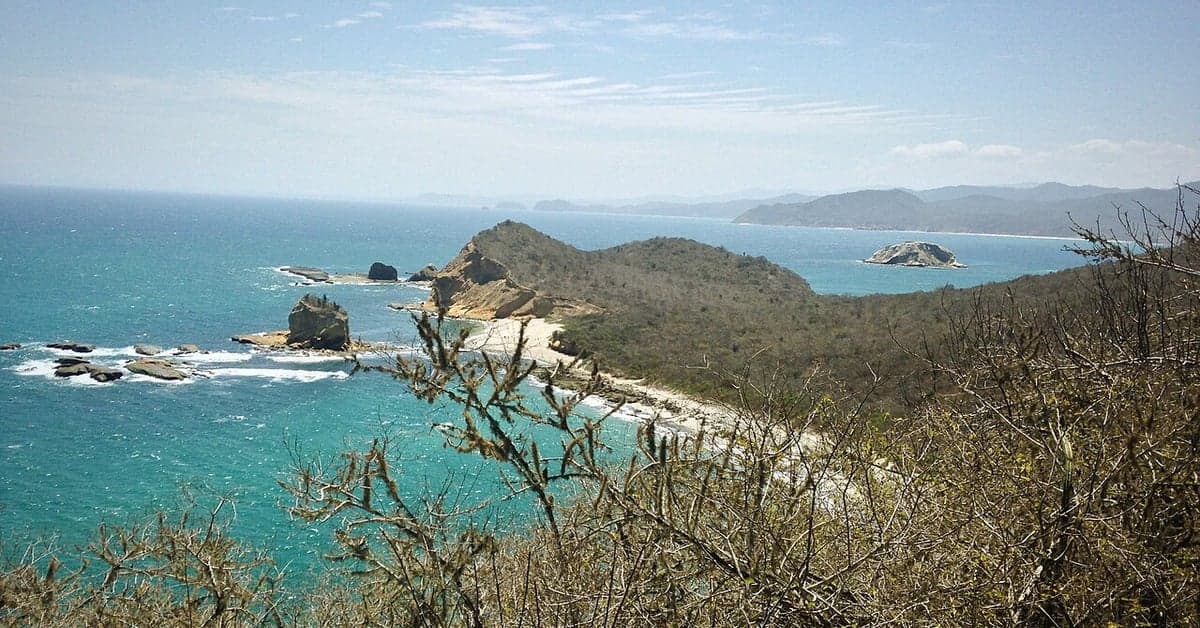
Inside Machalilla National Park, about an hour north of Montañita, Los Frailes is widely considered the most beautiful beach on Ecuador's mainland. A crescent of fine white sand sits in a sheltered bay, backed by dry tropical forest, with water that ranges from turquoise to deep blue depending on conditions. There are no buildings on the beach — the national park designation keeps it pristine.
Access requires a short hike from the park entrance (about 20 minutes on a well-maintained trail). Park entry is free, but you need to sign in and the beach closes at 4 PM. There's no shade, no vendors, and no facilities beyond a basic bathroom at the trailhead. Bring water, sunscreen, and a hat.
On the trail to Los Frailes, a turnoff leads to two smaller beaches — Playa La Tortuguita and a mirador (viewpoint) overlooking the entire bay. The viewpoint is worth the 10-minute detour for the panorama. Snorkeling at Los Frailes is decent when the water is calm — the rocky edges of the bay harbor parrotfish, damselfish, and sea stars.
Canoa
Canoa is a long, flat beach town in Manabí province, about 6 hours from Quito by bus. The town was heavily damaged by the 2016 earthquake and has rebuilt slowly, retaining a quiet, slightly rough-around-the-edges charm. The beach itself stretches for miles in both directions — wide, sandy, and suitable for long walks, horseback rides (offered by several operators for $10-15), and beginner surfing.
The surf here is gentle beach break, rarely exceeding 4 feet, making it one of the better learn-to-surf beaches in Ecuador. Rio Muchacho Organic Farm, a 30-minute ride from town, offers homestays and agro-tourism experiences that connect you to the rural Manabí culture — cacao processing, cheese-making, and cooking classes for $30-40/day including meals.
Canoa is cheap, even by Ecuadorian standards. Hostels charge $6-10 for a dorm, comedores serve almuerzos for $1.50, and a lobster dinner at one of the beachfront restaurants costs $8-12. The town is quiet most nights — this is not a party destination.
Ayangue
Ayangue is a tiny fishing village built around a nearly enclosed bay on the Santa Elena coast. The bay's horseshoe shape blocks the swell almost completely, creating a natural swimming pool with calm, warm water. This makes it popular with Ecuadorian families and anyone who wants to swim without fighting currents.
Snorkeling from shore is surprisingly good. The rocky sides of the bay harbor schools of tropical fish, and visibility reaches 20-30 feet on clear days. Dive operators in town offer PADI courses and recreational dives to nearby sites for $60-80 per two-tank trip.
The village has a handful of seafood restaurants that cook whatever the fishing boats brought in that morning. A plate of encebollado — a tuna and yuca soup that's Ecuador's national hangover cure — costs $2-3 and is legitimately excellent here.
Mompiche
Mompiche, in Esmeraldas province near the Colombian border, is the mainland's best-kept surf secret. A long left-hand point break wraps around a jungle-covered headland, producing rides of 200-300 meters on a good day. The wave works best from December through April on northwest swells, when the sets can reach double overhead.
The town is small, remote, and predominantly Afro-Ecuadorian. The culture here is distinct from the rest of the coast — the music is marimba and salsa, the food features coconut-based stews and green plantain patacones, and the pace is profoundly unhurried. Getting here involves a bus to Muisne or Esmeraldas, then a local connection — expect 7-8 hours from Quito.
Accommodation is basic but functional. Hostal Gabeal has rooms for $15-20. Mompiche Surf Retreat offers packages with meals and surf guiding for $40-60/day. The isolation is the attraction — there's no ATM in town (bring cash), cell service is spotty, and the closest pharmacy is an hour away.
Galápagos Beaches
Tortuga Bay (Santa Cruz Island)
Tortuga Bay is the most accessible beach in the Galápagos, reachable by a 45-minute walk along a paved trail from the town of Puerto Ayora. No boat required, no guide required, no entrance fee beyond the $200 Galápagos National Park fee (paid once upon arrival at the airport).
The first beach you reach is Playa Brava — a long, white-sand beach with strong currents and surf, where marine iguanas bask on the lava rocks and occasional reef sharks patrol the shallows. Swimming here is not recommended due to currents. Continue along the trail to Playa Mansa, a sheltered mangrove-lined lagoon with calm water, where you can swim alongside white-tipped reef sharks, sea turtles, and rays without any danger. The sharks are small, docile, and entirely uninterested in humans.
Kayak rentals are available at Playa Mansa for $10/hour. Paddle along the mangrove edge and you'll see blue-footed boobies perched on rocks, pelicans diving for fish, and baby blacktip sharks cruising the shallows.
Gardner Bay (Española Island)
Gardner Bay is one of the most spectacular beaches on the planet, full stop. A wide crescent of powder-white sand, turquoise water, and Galápagos sea lions — hundreds of them — lounging, playing, and body-surfing in the shorebreak. The sea lions have zero fear of humans and will swim directly up to you while snorkeling, spinning and blowing bubbles inches from your mask.
Gardner Bay is accessible only by boat as part of a multi-day Galápagos cruise or a day trip from Puerto Ayora (expensive — day trips to Española run $180-250 per person). Most visitors experience it on a 4-8 day cruise itinerary. Española Island also has the famous Punta Suárez trail with waved albatrosses (April through December), Nazca boobies, and the dramatic blowhole.
Other Galápagos Beaches
Playa de los Alemanes (Santa Cruz) is a quiet beach near the Itabaca Channel, good for snorkeling. Playa Mann (San Cristóbal) is a town beach where sea lions outnumber swimmers. Puerto Villamil (Isabela Island) has a long stretch of empty sand with flamingos feeding in the lagoons behind the beach.
Galápagos Logistics and Costs
The Galápagos are expensive. Return flights from Guayaquil or Quito cost $350-500 on LATAM or Avianca. The national park entry fee is $200 per person for most foreign adults (it doubled from $100 in August 2024), paid on arrival. The Ingala transit control card adds $20. Hotels in Puerto Ayora start at $40-60 for a basic room and run up to $300-500 for boutique lodges.
Cruise-based itineraries — which remain the best way to see the outer islands — range from $500 to $2,000+ per person for 4-8 day trips, depending on the boat class. Budget travelers can do a land-based trip staying in Puerto Ayora, Puerto Villamil, or Puerto Baquerizo Moreno and taking day trips, but this limits you to the central islands. Last-minute cruise deals are available in Puerto Ayora — show up and check the agencies along the waterfront, where unsold berths on boats departing that day or the next sometimes drop to $150-200/day all-inclusive.
Mainland Budget
The mainland coast is absurdly cheap. A backpacker eating almuerzos ($1.50), staying in dorm beds ($6-10), and riding buses ($5-10 for long distances) can manage on $20-30/day. Mid-range travel with private rooms, taxis, and restaurant meals runs $40-60/day. The $1.50 almuerzo remains the backbone of budget eating — soup, rice, protein, salad, juice, and sometimes a small dessert, at every comedor in every town.
When to Go
The mainland coast is warmest and driest from December through April (rainy season, confusingly, brings the heat). The Galápagos are good year-round: the warm/wet season (January-May) has calmer seas and warmer water for snorkeling, while the cool/dry season (June-November) brings nutrient-rich currents that attract more wildlife, including whale sharks around the northern islands.
Frequently Asked Questions
Can you swim at Galapagos beaches?
Yes, several Galapagos beaches have excellent swimming. Tortuga Bay on Santa Cruz has a calm lagoon section perfect for swimming and kayaking. Playa Mann on San Cristobal is a short walk from town with safe, calm water. The water is cooler than expected (65-75°F) due to the Humboldt Current, especially June through November.
What is the best month to visit Ecuador beaches?
For the mainland coast, December through April is the warm, sunny season with water temperatures of 76-82°F. The Galapagos has two seasons: warm and rainy (January-May) with calmer seas and warmer water, or cool and dry (June-December) with better wildlife activity but choppier seas.
How much does a Galapagos trip cost?
Budget travelers staying on inhabited islands (Santa Cruz, San Cristobal, Isabela) can manage $120-180/day including hotels, meals, and day tours. Cruise-based trips run $3,000-8,000+ per person for 5-8 days. The Galapagos National Park entrance fee is $200 per person for most foreign adults, plus a $20 transit control card.
Is Montanita safe for tourists?
Montanita is generally safe during the day but exercise caution at night, especially on weekends when the party scene attracts large crowds. Petty theft increases during busy periods. Keep valuables secure, avoid walking alone on the beach after dark, and stick to well-lit areas near the main strip.
What are the best beaches on Ecuador's mainland coast?
Los Frailes in Machalilla National Park is the most beautiful mainland beach, a pristine crescent of white sand backed by dry forest. Montanita is the surf and party town. Canoa offers a quieter, more local vibe with consistent waves. Playa Escondida near Mompiche is a secluded black-sand beach.
How do you get to the Galapagos from mainland Ecuador?
Flights depart from Quito or Guayaquil to Baltra (near Santa Cruz) or San Cristobal. TAME, Avianca, and LATAM operate daily flights taking about 2-2.5 hours from Guayaquil or 3 hours from Quito. Round-trip fares for foreigners run $350-500. There is no boat service from the mainland.