Best Beaches for Night Swimming and Bioluminescence
Table of Contents
How Bioluminescence Works
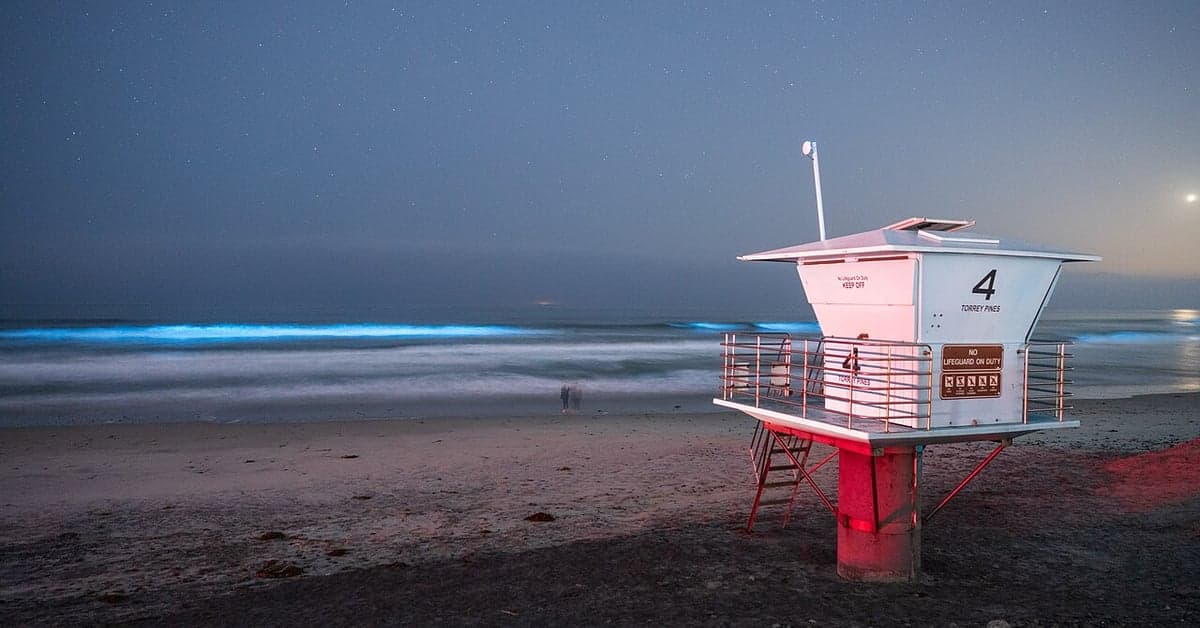
Bioluminescence is "the production and emission of light by a living organism," in the words of NOAA's National Ocean Service, which notes that marine animals use it to warn off or evade predators, to lure prey and to communicate. In glowing bays and on glowing beaches the light usually comes from dinoflagellates, single-celled plankton that flash blue-green when the water around them is disturbed. Drag a hand or a paddle through the water and it leaves a trail of sparks.
In Puerto Rico's bays the organism is Pyrodinium bahamense; on many temperate coasts it is Noctiluca scintillans. Both concentrate in warm or nutrient-rich water, and the bays with the strongest displays are shallow and narrow-mouthed, so the plankton are not flushed out to sea. Brightness changes with water temperature, rainfall and nutrients, so it varies from week to week.
The moon is the factor you can plan around. Moonlight drowns out even a strong glow, so aim for nights near the new moon and avoid the days either side of a full moon.
Where to See It, Compared
| Place | What glows | Can you swim? | When | How to see it |
|---|---|---|---|---|
| Mosquito Bay, Vieques, Puerto Rico | Dinoflagellates (Pyrodinium bahamense) | No, it is a nature reserve | Year-round; best near the new moon | Licensed kayak or electric-boat tours |
| Laguna Grande and La Parguera, Puerto Rico | Dinoflagellates | La Parguera tours have traditionally allowed it; check current rules | Year-round | Tours from Fajardo and Lajas |
| Luminous Lagoon, Falmouth, Jamaica | Dinoflagellates | Yes, from the tour boats | Every night of the year | Night boat tours from Glistening Waters |
| Toyama Bay, Japan | Firefly squid | No | Spring | Pre-dawn sightseeing boats from Namerikawa |
| Vaadhoo, Raa Atoll, Maldives | Plankton and ostracods | - | Most often June to October, on moonless nights; never guaranteed | The island's eastern beach |
| Holbox, Mexico | Plankton | - | Dark nights | Guided night trips by foot, kayak or boat |
| Railay and Ton Sai, Krabi, Thailand | Plankton | - | Some calm, moonless nights; no guarantee | Ton Sai, with the least artificial light |
| San Juan Islands, Washington | Dinoflagellates, including Noctiluca scintillans | Only in a wetsuit: the water is 10 to 13°C | Late summer and early fall | Guided night kayak paddles |
Mosquito Bay (Puerto Mosquito), Vieques, Puerto Rico
Mosquito Bay on the south coast of Vieques is the best-known bioluminescent bay in the world. Guinness World Records has listed it as the brightest, and its glow comes from very dense populations of Pyrodinium bahamense. The bay is protected as the Vieques Bioluminescent Bay Natural Reserve and was designated a National Natural Landmark in 1980.
Swimming is not allowed in the reserve. Licensed operators run guided tours by kayak and by electric boat, so you can still trail your hands in the glow. Go on a night close to the new moon and book ahead in winter and on holiday weekends. Vieques is reached by passenger ferry from Ceiba on the main island (fares are a few dollars) or by short flights from San Juan and Ceiba.
Puerto Rico has two other bioluminescent bays: Laguna Grande in Fajardo and La Parguera in Lajas, on the southwest coast. Both are easier to reach from San Juan than Vieques, and La Parguera is the one where boat tours have traditionally allowed swimming. Check current rules with your operator, since they change.
When to Visit
The bay glows year-round. Brightness depends on recent rain and water conditions as well as the moon, so ask the tour operator about conditions in the days before your trip.
Luminous Lagoon (Glistening Waters), Falmouth, Jamaica
The Luminous Lagoon sits where the Martha Brae River meets the sea next to Falmouth, on Jamaica's north coast about 29 km (18 miles) east of Montego Bay, roughly 30 to 40 minutes by road. The mix of fresh and salt water supports dense dinoflagellate populations, and the glow can be seen every night of the year.
Unlike Puerto Rico's bays, this one is known for letting visitors swim: night boat tours run out onto the lagoon, the boat stops, and passengers can get into the water. Tours leave from the Glistening Waters area just east of Falmouth.
Toyama Bay, Japan
Toyama Bay's light comes from an animal, not plankton: the firefly squid (Watasenia scintillans), about 7.5 cm (3 inches) long. In spring, large numbers rise from deep water to spawn near the coast, and their light organs glow blue. The waters off Namerikawa, where the squid gather, are designated a Special Natural Monument by the Japanese government.
Namerikawa's Hotaruika Museum, opened in 1998 and dedicated to the squid, is the place to start. During the spring season, pre-dawn sightseeing boats leave the harbor to watch fishermen haul in the glowing squid; check the museum or the Toyama tourism office for current dates, times and booking. On some nights squid also wash onto the beaches, which locals call hotaruika no minage. The squid is a local delicacy, served boiled, as sashimi or in tempura.
Vaadhoo Island, Raa Atoll, Maldives
The Maldives' "sea of stars" photographs, waves breaking in blue light on a dark beach, made Vaadhoo in Raa Atoll famous. The glow there is attributed to phytoplankton or dinoflagellates, with ostracods (tiny crustaceans) credited for longer-lasting light. The eastern beach of the island is the usual viewing spot.
It is most often seen from about June to October, on moonless nights; the clearer dry season from November to April tends to bring weaker displays. It is never guaranteed. Plan a Maldives trip around other things and treat the glow as a bonus. For official planning information, see Visit Maldives.
Holbox Island, Mexico
Holbox is a car-free island (people get around by golf cart) off the north coast of the Yucatán Peninsula, inside the Yum Balam protected area, and reached by ferry from Chiquilá. Its bioluminescence is best known at Punta Cocos, the lagoon area at the island's western tip, on dark nights.
Local guides run night trips by foot, kayak or boat. Whale shark season, June to September, brings the most visitors, so book ahead in summer.
Railay and Ton Sai, Krabi, Thailand
The Andaman coast around Railay and Ton Sai produces bioluminescent plankton on some nights, most noticeable on calm, moonless nights. This is opportunistic: there is no dedicated bay, and you may see nothing. The setting makes it worth trying anyway, with limestone karst towers around the bay and longtail boats anchored offshore. Ton Sai, with less artificial light than the main resort beaches, gives the best chance.
San Juan Islands, Washington State
The San Juan Islands, in the Salish Sea north of Puget Sound, see bioluminescence from dinoflagellates including Noctiluca scintillans, most often in late summer and early fall. It is visible from shore on dark nights but is best from a kayak, and kayak outfitters in Friday Harbor and elsewhere on the islands run guided night paddles in season.
The water stays around 50 to 55°F (10 to 13°C) even in summer, so this is a paddle, not a swim, unless you have a wetsuit. Washington State Ferries sail from Anacortes to Friday Harbor; passenger fares on the San Juan routes are collected only on the westbound trip from Anacortes, and vehicle reservations are recommended in summer.
Is It Safe?
Swimming or paddling among glowing plankton is not considered dangerous in itself. The real caution is about food: Pyrodinium bahamense, the organism that lights Puerto Rico's bays, also produces paralytic shellfish toxins, including saxitoxin, which build up in shellfish and some fish. Do not eat shellfish gathered from a glowing bay or a bloom area. Thick, discolored blooms (often called red tides) are a different thing from a clear bay that sparkles when disturbed, and can irritate skin, eyes and airways; stay out of discolored water.
Tour operators at protected bays ask visitors not to wear sunscreen or insect repellent in the water, to limit what washes off into these small, enclosed ecosystems.
Tips for Chasing Bioluminescence
- Check the moon phase: New moon nights give the best visibility. Plan around the lunar calendar.
- Let your eyes adjust: Full dark adaptation takes 20 minutes or more. Avoid looking at phone screens.
- Skip the flash: Flash ruins night vision and cannot capture the glow. Use a tripod and a long exposure (15 to 30 seconds, ISO 3200 or higher, a wide aperture).
- Wear dark clothing: Pale colors reflect ambient light and reduce contrast.
- Be patient: The glow varies night to night. Some evenings are bright; others are faint.
Frequently Asked Questions
Where is the brightest bioluminescent bay in the world?
Mosquito Bay (Puerto Mosquito) on Vieques, Puerto Rico, which Guinness World Records has listed as the brightest. Its glow comes from dense populations of the dinoflagellate Pyrodinium bahamense. The bay is a protected natural reserve, swimming is not allowed, and visitors go out on guided kayak or electric boat tours.
Can you swim in bioluminescent water?
Sometimes. Boat tours on Jamaica's Luminous Lagoon near Falmouth let passengers swim, and La Parguera in southwest Puerto Rico has traditionally allowed it. Mosquito Bay on Vieques does not allow swimming. Rules change, so confirm with the operator, and follow requests not to wear sunscreen or insect repellent in protected bays.
What time of year is best for bioluminescence?
It depends on the place. Puerto Rico's bays and Jamaica's Luminous Lagoon glow year-round. Vaadhoo in the Maldives is most often seen from about June to October. Toyama Bay's firefly squid gather in spring. The San Juan Islands in Washington are best in late summer and early fall. Everywhere, nights near the new moon are best.
Is bioluminescence safe to swim in?
Swimming or paddling among glowing plankton is not considered dangerous in itself. The caution is about food: Pyrodinium bahamense, which lights Puerto Rico's bays, produces paralytic shellfish toxins such as saxitoxin, so never eat shellfish gathered from a glowing bay or bloom area. Stay out of thick, discolored blooms (red tides), which can irritate skin, eyes and airways.
Can you see bioluminescence every night?
In the strongest bays, such as Mosquito Bay and Jamaica's Luminous Lagoon, the glow is there every night but varies with rainfall, water conditions and moonlight. On open beaches such as Vaadhoo in the Maldives or Railay in Thailand it is unpredictable, and you may see nothing on a given night.
How do you photograph bioluminescence?
Use a camera with manual settings on a sturdy tripod: ISO 3200 to 6400, an aperture of f/2.8 or wider, and an exposure of 15 to 30 seconds, with the flash off. A remote shutter release prevents shake. Phone night modes can record faint results at best.
What causes the ocean to glow blue at night?
Usually dinoflagellates, single-celled plankton that flash when the water around them is disturbed. The light comes from a chemical reaction in which the enzyme luciferase acts on luciferin. NOAA notes that marine organisms use bioluminescence to warn off or evade predators, lure prey and communicate.