The Best Beaches in Corsica, France
Table of Contents
Prices in this guide are approximate and change often. Check with the hotel, airline or operator before you book.
France's Wild Island
Corsica sits 170 kilometers from the French Riviera and 80 kilometers from Sardinia, but it feels like neither. The island has the mountains of Switzerland, the beaches of the Caribbean, and the attitude of a place that has spent centuries resisting outside control. Napoleon was born here in 1769, and while France has officially owned Corsica since 1768, the island maintains a fierce cultural independence that extends to its cuisine, its language (Corsu, closer to Italian than French), and its approach to development — which is to say, there has not been much.
That lack of development is precisely why Corsica's beaches remain extraordinary. While the Cote d'Azur long ago surrendered to concrete, Corsica's 1,000 kilometers of coastline are largely undeveloped, protected by the Conservatoire du Littoral and by the Corsicans' own resistance to the kind of mass tourism that has consumed other Mediterranean islands. The beaches here are backed by maquis scrubland, pine forests, or granite mountains, not by resort complexes.
The island is divided between Haute-Corse (Upper Corsica, capital Bastia) in the north and Corse-du-Sud (Southern Corsica, capital Ajaccio) in the south. Both have exceptional beaches, but the character differs — the south tends toward dramatic granite coastlines and deep turquoise coves, while the north offers wider sandy beaches and the extraordinary Desert des Agriates wilderness.
Southern Corsica
Palombaggia
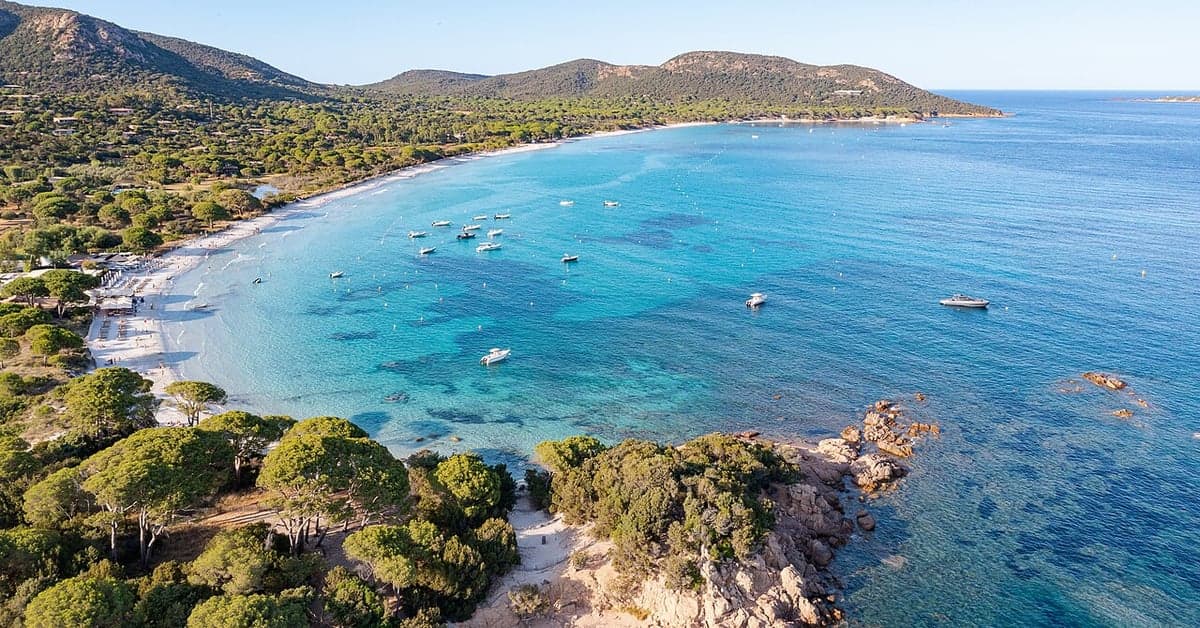
Palombaggia, near Porto-Vecchio, is routinely named the best beach in Corsica and often ranks among the top beaches in Europe. A long crescent of fine white sand backed by umbrella pines, with red granite rocks punctuating the shoreline and water that transitions from pale turquoise to deep sapphire as the bottom drops off. The setting is genuinely remarkable — Mediterranean beach perfection without the concrete backdrop.
The catch, inevitably, is popularity. In July and August, Palombaggia fills up early and parking becomes a nightmare. The beach clubs (paillotes) charge €20-30 for a sunbed and umbrella. Come in June or September and you get 80% of the beauty at 30% of the crowd. Early morning arrivals (before 9 AM) in peak season also work — the light is better for photographs anyway.
Santa Giulia
A perfectly enclosed bay five kilometers south of Porto-Vecchio, Santa Giulia has shallower, calmer water than Palombaggia and a wider beach. It is the better choice for families with young children — the water stays knee-deep for a considerable distance and the sandy bottom is free of rocks. Paddle board and kayak rentals are available, and the bay's protected shape keeps conditions calm even when wind hits the exposed beaches.
Several paillotes (beach restaurants) serve fresh seafood, salads, and rosé. U Funtaneddra is the pick — their grilled calamari and chilled Corsican Vermentinu white wine make a perfect beach lunch for €20-25 per person.
Rondinara
Between Porto-Vecchio and Bonifacio, Rondinara is a near-perfect circle of sand enclosed by low, maquis-covered headlands. The shape creates a natural sheltered lagoon with water so calm it looks like a lake. From above (and the aerial photographs are extraordinary), the beach forms an almost perfect horseshoe. Access is down a dirt road that can be rough, and parking is limited to about 100 cars — once full, you are out of luck. This natural bottleneck keeps the crowd manageable even in peak season.
The Lavezzi Islands
The Iles Lavezzi, a granite archipelago in the Strait of Bonifacio between Corsica and Sardinia, are accessible by boat from Bonifacio port (€35-40 round trip, 30 minutes). The islands are a nature reserve with small beaches of surreal beauty — smooth granite boulders, white sand, and water so clear and turquoise it looks tropical. Bring everything you need (water, food, sun protection) as there are no facilities on the islands. Snorkeling among the rocks is excellent, with grouper, barracuda, and moray eels in the protected waters.
Northern Corsica
Saleccia
Saleccia is regularly described as the most beautiful beach in Corsica — ahead of even Palombaggia — by those who have made the effort to reach it. And effort is the key word. The beach sits in the Desert des Agriates, a 16,000-hectare wilderness of maquis scrubland on the north coast, accessible only by a brutal 12-kilometer dirt track (4WD only, 45 minutes of bouncing), by boat from Saint-Florent (€25-30 round trip), or by a 4-hour hike from the trailhead.
What you get for the trouble is a kilometer of white sand backed by pine forest and sand dunes, with crystal-clear water and, outside of July-August, very few people. The beach was used as a filming location for the Normandy landing scenes in the 1962 movie "The Longest Day". There are zero facilities. Bring everything.
Lotu
Next to Saleccia, separated by a short walk through the dunes, Lotu is smaller and shallower, with fine sand that extends into the water, creating a wading pool effect in pale turquoise. The boat from Saint-Florent serves both beaches. Most visitors stop at Lotu and do not continue to Saleccia, which means Lotu is busier but Saleccia rewards the extra walk.
Ostriconi
At the western edge of the Desert des Agriates, Ostriconi is easier to access — a 20-minute walk down from a roadside parking area on the N1197. The beach sits at the mouth of the Ostriconi river, with sand dunes, juniper bushes, and a wild, undeveloped feel. The water can be rougher here than the sheltered coves, with waves that make body surfing possible. The surrounding landscape is windswept and dramatic — more Irish coast than French Riviera.
The West Coast
Capo di Feno
Just north of Ajaccio, Capo di Feno consists of two beaches — Petit Capo and Grand Capo — that are Corsica's answer to the surfing question. The Atlantic-facing orientation (unusual for the Mediterranean) produces consistent swell from autumn through spring, and the breaks are fun for intermediate surfers. Grand Capo has a beach bar and board rentals. The setting, with granite headlands and wild scrubland, feels more Galicia than Cote d'Azur.
Arone
South of the Calanques de Piana (one of Corsica's UNESCO sites), Arone is a wide, sandy beach in a deep bay surrounded by maquis-covered hills. It is one of the larger west coast beaches and offers decent facilities — a paillote restaurant, sunbed rentals, and kayak hire. The drive down from the main road through the maquis, with views of the red granite Calanques, is scenic enough to be an attraction on its own.
Practical Information
Getting to Corsica
Ferries from Nice, Toulon, or Marseille take 4-12 hours depending on the route and the speed of the vessel. Corsica Linea and Corsica Ferries are the main operators, with deck passage from €30-50 one way and car transport from €50-100. Flights from Paris, Nice, Lyon, and other French cities to Ajaccio, Bastia, Figari, or Calvi take 90 minutes and are cheapest on Air Corsica.
Getting Around
A rental car is essential. Public transport exists but is inadequate for beach exploration. Roads are narrow, winding, and slow — a 50-kilometer drive can take 90 minutes. Budget more time than the map suggests. In summer, parking at popular beaches fills by 10 AM; arriving early or late (after 4 PM, when people start leaving) solves this.
When to Visit
June and September are the golden months — warm water (70-75°F), sunshine, and a fraction of the July-August crowds and prices. July and August bring 85-95°F heat, packed beaches, and accommodation prices that double or triple. The water stays swimmable into late October. Corsica's interior mountains are snow-capped into May, creating the bizarre possibility of skiing in the morning and swimming in the afternoon in late spring.
Food and Drink
Corsican cuisine is mountain food meeting sea food. Charcuterie (especially figatellu, a smoked liver sausage, and lonzu, cured pork loin) is exceptional. Brocciu, a fresh cheese made from sheep or goat whey, appears in everything from omelettes to pastries. Corsican wines, particularly the whites from the Patrimonio region (Vermentinu grape) and the reds from Figari (Niellucciu grape), are underappreciated and excellent. A carafe of local wine at a restaurant costs €8-12.
Frequently Asked Questions
What is the best beach in Corsica?
Palombaggia near Porto-Vecchio is the most famous and most accessible, with fine white sand, red granite rocks, and stunning turquoise water. Saleccia in the Desert des Agriates is arguably more beautiful but requires a 4WD track, a boat ride, or a 4-hour hike to reach. Both rank among the best beaches in the Mediterranean.
How do you get to Corsica from mainland France?
Ferries from Nice, Toulon, or Marseille take 4-12 hours with Corsica Linea or Corsica Ferries. Deck passage costs €30-50 one way, car transport €50-100. Flights from Paris, Nice, and Lyon to Ajaccio, Bastia, Figari, or Calvi take about 90 minutes. Air Corsica typically offers the cheapest fares.
Do you need a car in Corsica?
A rental car is essential for exploring Corsica's beaches. Public transport exists but does not serve most coastal areas adequately. Roads are narrow and winding — budget more time than GPS estimates suggest. In summer, arrive at popular beaches before 10 AM or after 4 PM to avoid parking problems.
When is the best time to visit Corsica beaches?
June and September offer warm water (70-75°F), sunshine, and a fraction of the July-August crowds and prices. July and August bring extreme heat, packed beaches, and accommodation prices that double or triple. The sea stays swimmable into late October. May is pleasant on land but the water is still cool at 62-66°F.
How do you get to Saleccia beach in Corsica?
Three options: a 4WD-only dirt track from Casta (12 km, about 45 minutes of rough driving), a boat from Saint-Florent harbor (€25-30 round trip, 30 minutes), or a hiking trail from the Desert des Agriates trailhead (approximately 4 hours one way). The boat is the most practical for most visitors.
Can you visit the Lavezzi Islands from Corsica?
Yes, boats depart from Bonifacio port daily in summer for the 30-minute crossing (€35-40 round trip). The Lavezzi Islands are a nature reserve with stunning granite formations, white sand beaches, and excellent snorkeling. Bring all supplies as there are no facilities on the islands. Boats typically allow 3-4 hours on the islands before the return trip.
Is there surfing in Corsica?
Capo di Feno near Ajaccio offers consistent swell from autumn through spring, with fun waves for intermediate surfers at both Petit Capo and Grand Capo beaches. Board rentals and a beach bar are available at Grand Capo. The Mediterranean generally produces smaller waves than the Atlantic, but Capo di Feno's western exposure catches more swell than most Mediterranean spots.