Table of Contents
Prices in this guide are approximate and change often. Check with the hotel, airline or operator before you book.
Year-Round Beach Weather Off the African Coast
The Canary Islands sit in the Atlantic Ocean 60 miles off the coast of Morocco, which means two things that matter for beach travel: the weather is warm year-round (65-85°F), and the landscape is volcanic rather than tropical. Forget palm-lined Caribbean white sand — the Canaries offer black volcanic beaches, golden Saharan sand dunes, red lava coastlines, and everything in between. The islands are Spanish territory with European infrastructure, making them accessible and well-organized while feeling geographically African.
There are seven main islands, each with a distinct personality. Tenerife and Gran Canaria are the largest and most developed, with resort zones, nightlife, and the widest range of accommodation. Lanzarote and Fuerteventura are flatter and more arid, with dramatic volcanic landscapes and some of the archipelago's best beaches. La Palma, La Gomera, and El Hierro are smaller, greener, and oriented toward hiking and nature rather than beach tourism. For dedicated beach trips, Fuerteventura, Tenerife, Gran Canaria, and Lanzarote deliver the most options.
Fuerteventura: The Beach Island
Playa de Sotavento
Sotavento is the Canary Islands' most spectacular beach — a 9-kilometer strip of white sand on the southeast coast that shifts shape with the tide. At low tide, a lagoon forms between the beach and an offshore sandbar, creating a shallow, warm-water playground that's become one of Europe's premier kitesurfing locations. At high tide, the lagoon fills and the beach narrows. The wind is consistent (the PWA Windsurf and Kitesurf World Championships are held here annually), which makes Sotavento better for water sports than calm sunbathing on windy days. On calm days — more common in summer — the beach is a vast, empty expanse of sand and crystal water.
Playa de Cofete
Cofete is a 12-kilometer wild beach on Fuerteventura's remote southwest coast, accessible only by a rough dirt road over the Jandía mountains. The drive is an adventure in itself — hairpin turns on unpaved roads with views of barren volcanic peaks. The beach is massive, empty, and dramatic — Atlantic surf, no facilities, no development, just sand stretching to the horizon with mountains behind. Swimming is dangerous due to strong currents and waves. This is a landscape beach, not a swimming beach. Bring food, water, and sun protection — there's nothing at Cofete except a single abandoned villa with mysterious Nazi-era history.
Corralejo Dunes
The Corralejo Natural Park at Fuerteventura's northern tip contains a field of white sand dunes alongside turquoise-water beaches. The dunes look Saharan — they're actually made from crushed shells and coral blown onshore by trade winds. The beaches along the dune field (Playa del Moro, Playa del Médano) have fine white sand, clear water, and enough space that you can find solitude even during tourist season. The town of Corralejo, 10 minutes away, has restaurants, shops, and ferry service to Lanzarote (35 minutes) and the tiny island of Lobos (a nature reserve with a volcanic lagoon beach, €3 ferry, day-trip permits required).
Tenerife: Volcano Meets Beach
Playa de las Teresitas
Las Teresitas is Tenerife's most beautiful beach — a 1.5-kilometer crescent of imported Saharan sand (the original volcanic beach was too coarse and dark for tourism) in a sheltered bay near the island's capital, Santa Cruz. Palm trees line the promenade, a breakwater keeps the water calm, and the beach faces south for maximum sun. The village of San Andrés at the eastern end serves some of the island's best fresh seafood — order the "sama frita" (fried red snapper) at any waterfront restaurant.
Playa del Duque and Costa Adeje
The Costa Adeje resort zone on Tenerife's southwest coast has the island's most developed beach infrastructure. Playa del Duque is the premium end — golden sand, calm water, upscale beach clubs, and proximity to the Bahía del Duque and Ritz-Carlton hotels. Playa de Fañabé and Playa de las Américas continue south with progressively more commercial and party-oriented atmospheres. Las Américas is the package-holiday strip — dense with British and German tourists, bars, and nightclubs. Playa del Duque is the antidote — same coast, different energy.
Playa de Benijo
On the remote northeast coast in the Anaga Rural Park, Playa de Benijo is a wild black-sand beach below rugged volcanic cliffs. Offshore rock formations (Roques de Anaga) rise from the ocean. The beach is accessed by a steep trail from the hilltop village of Benijo. Swimming is possible in calm conditions but the north coast gets significant surf — assess conditions before entering. The Anaga mountains above the beach are a UNESCO Biosphere Reserve with ancient laurel forest hiking trails. The drive from Santa Cruz takes 40 minutes through winding mountain roads.
Gran Canaria: Dune Drama
Maspalomas Dunes
The Maspalomas dune field at Gran Canaria's southern tip is the most iconic landscape in the Canary Islands — a 400-hectare expanse of golden sand dunes reaching 30 feet high, bordered by the Atlantic Ocean on one side and a palm oasis on the other. The beach along the dunes (Playa de Maspalomas) stretches 6 kilometers from the lighthouse to Playa del Inglés. The sections nearest the lighthouse and within the dunes are traditionally naturist. The Playa del Inglés end is the resort and nightlife zone.
Playa de Amadores
Amadores is a man-made beach west of Puerto Rico resort town — imported sand, a concrete breakwater, and a sheltered crescent that produces some of the calmest swimming water on the island. The sand is fine and golden, the water is clear and warm, and the beach has full facilities including sun lounger rental (€8-12), restaurants, and water sport vendors. This is the best family swimming beach on Gran Canaria — the breakwater eliminates waves entirely.
Playa de Güi Güi
Güi Güi is Gran Canaria's most remote beach — accessible only by a 3-hour hike through a rugged volcanic valley or by boat from Puerto de Mogán ($25-40 round-trip). The beach is a wide strip of golden sand backed by a steep ravine, with no facilities and typically fewer than 20 people. The hike is challenging (600-meter descent and ascent on a rough trail) but rewards with complete isolation and dramatic volcanic scenery. Bring all water and food you need.
Lanzarote: Volcanic Art
Playa de Papagayo
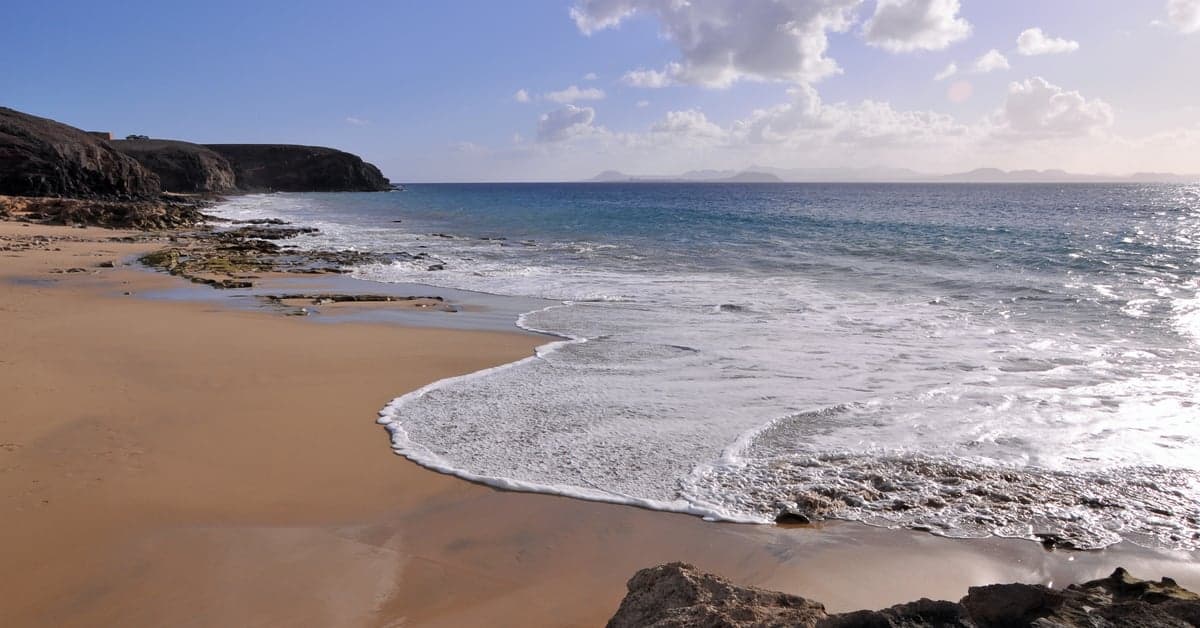
A cluster of small coves at Lanzarote's southern tip within the Los Ajaches Natural Monument. Papagayo is the largest — a crescent of golden sand in a sheltered bay with clear turquoise water and volcanic rock walls on each side. Five coves line this stretch of coast, each accessible by footpath. Entry to the natural monument costs €3 per vehicle. The beaches have minimal facilities (a single restaurant at Papagayo, nothing at the smaller coves). This is the best swimming and snorkeling on Lanzarote.
Playa de Famara
Famara is a 6-kilometer beach on Lanzarote's northwest coast, backed by the 600-meter Famara cliffs that create one of the most dramatic beach backdrops in the Canary Islands. The beach is wide and sandy with consistent Atlantic surf — it's Lanzarote's surfing hub, with several surf schools in the nearby village of Caleta de Famara (lessons €30-50). Swimming is restricted in areas due to strong currents. The setting is wild and beautiful in a different register from the calm southern beaches. Compare flight options to the island airports for the best fares.
Practical Information
Getting There
Tenerife (TFS — South, TFN — North) and Gran Canaria (LPA) have the most flight connections from mainland Spain and Europe. Low-cost carriers (Ryanair, easyJet, Vueling) fly from most European cities with fares as low as €20-80 one way. Inter-island flights on Binter Canarias cost €30-80. Inter-island ferries (Fred Olsen, Naviera Armas) connect all seven islands — Fuerteventura to Lanzarote takes 35 minutes ($15-25).
When to Visit
The Canary Islands are a year-round destination. Winter (December-March) offers 65-72°F air temperatures and 66-68°F water — comfortable for beach days but cooler than tropical destinations. Summer (June-September) brings 80-88°F air and 72-75°F water. The warmest water and air are in September-October. Trade winds keep summer heat manageable on all islands. Rain is rare on the southern coasts of all islands year-round.
Budget
The Canaries are affordable by European resort standards. Package holidays from the UK and Germany start at €400-600 per person for a week including flights and hotel. Independent travel with car rental costs €50-100/day total (€25-40 car, €25-60 accommodation). Beach restaurants charge €8-15 for a main course. The islands use the euro. No visa is required for EU citizens; Schengen visa rules apply for others.
Frequently Asked Questions
Which Canary Island has the best beaches?
Fuerteventura has the most and best beaches — Sotavento (9 km of shifting sand and lagoon), Corralejo dunes (white sand with turquoise water), and Cofete (12 km of wild Atlantic beach). Gran Canaria's Maspalomas dunes are the most iconic single beach. Lanzarote's Papagayo coves have the clearest water for snorkeling.
Can you swim in the Canary Islands in winter?
Yes, though it's cooler than tropical destinations. Winter water temperature is 66-68°F (December-March) — comfortable for many swimmers, especially on sunny days with 65-72°F air temperature. South-facing beaches on all islands get the most winter sun. The Canaries are Europe's warmest winter beach destination.
Are the Canary Islands expensive?
By European beach standards, no. Package holidays from the UK or Germany start at €400-600 per person for a week with flights and hotel. Rental cars cost €25-40/day. Beach restaurants charge €8-15 for main courses. The islands are significantly cheaper than the Balearics (Ibiza, Mallorca) or the Amalfi Coast.
How do you get between the Canary Islands?
Binter Canarias flies between all seven islands (€30-80 per flight, 30-50 minutes). Fred Olsen and Naviera Armas ferries connect the islands — Fuerteventura to Lanzarote takes 35 minutes ($15-25). The ferry from Tenerife to Gran Canaria takes 1-2.5 hours depending on the service.
What are the black sand beaches in the Canary Islands?
Volcanic black sand beaches are found on Tenerife (Playa de Benijo, Playa Jardín in Puerto de la Cruz), La Palma, and El Hierro. The black sand comes from volcanic basalt eroded by the ocean. These beaches are dramatic and photogenic but absorb heat — the sand gets hot in direct summer sun.
Is Fuerteventura good for kitesurfing?
Fuerteventura is one of Europe's best kitesurfing destinations. Playa de Sotavento hosts the annual PWA World Championships. Consistent trade winds (15-25 knots) and a shallow lagoon at low tide create ideal conditions. Flag Beach near Corralejo is the main surf and kite spot in the north. Equipment rental and lessons cost €50-100/session.