The Best Beach Day Trips from London
Table of Contents
Prices in this guide are approximate and change often. Check with the hotel, airline or operator before you book.
British Beach Culture: Fish and Chips, 99 Flakes, and Optimistic Swimwear
Going to the beach in England requires a different calibration than going to the beach in, say, the Bahamas. The water temperature peaks at about 18°C (64°F) in August and sits closer to 12°C (54°F) in June. The sky may be overcast, the wind may be stiff, and there is always a non-trivial chance of rain. None of this stops the English from going to the beach. When a warm, sunny day arrives — and they do, more often than the reputation suggests — the entire city of London empties toward the coast with a determination that borders on military.
British beach culture has its own rituals. Fish and chips eaten from paper while sitting on a sea wall. A 99 Flake (soft-serve ice cream with a Cadbury Flake stuck in the top, about £2.50-3.50). Windbreaks — nylon screens stuck into the sand to block the wind, creating little private encampments. Beach huts, those brightly painted wooden sheds that line the shore in certain towns and sell for astonishing prices (£50,000-300,000 in Southwold, for a shed with no plumbing). Pebble-skimming. Crabbing off harbor walls with a bucket and a piece of bacon on a string. And the refusal to acknowledge that the water is cold, even as your lips turn blue.
London sits roughly 60-80 miles from the nearest coast in multiple directions, making a surprising number of beaches reachable within one to two hours by train. No car needed.
Brighton
Brighton is the default London beach trip and has been since the Prince Regent built his fake-Mughal pleasure palace here in the 1780s. The train from London Victoria or London Bridge takes 60-70 minutes (Southern or Thameslink, £15-25 return off-peak). You step off the train, walk 10 minutes south, and you're on the beach.
The beach is pebbles, not sand. This is the defining fact of Brighton and the source of endless disappointment for first-time visitors expecting Bondi. The stones are smooth, the water is clean (Blue Flag certified in several sections), and the swimming is fine if you don't mind the temperature. Wetsuits are common from May onward. Brighton Swimming Club, founded in 1860, meets at the beach near the Palace Pier for daily swims year-round.
The Palace Pier has arcades, rides, and doughnuts. The burned skeleton of the West Pier, 500 meters offshore, is more photogenic. Between the two piers, the seafront promenade runs past basketball courts, bars, the British Airways i360 observation tower (£18.50 adult), and a row of arches converted into shops, studios, and restaurants.
The Lanes, a tangle of narrow streets behind the seafront, have vintage shops, record stores, and some of the best independent restaurants on the south coast. Riddle & Finns serves oysters (£15 for six) and champagne at a marble bar. Lucky Beach, a burger shack on the seafront, does a smash burger for £8 that draws hour-long queues in summer. Terre à Terre, a vegetarian restaurant on East Street, has been proving since 1993 that meatless food can be genuinely exciting (mains £16-20).
Broadstairs
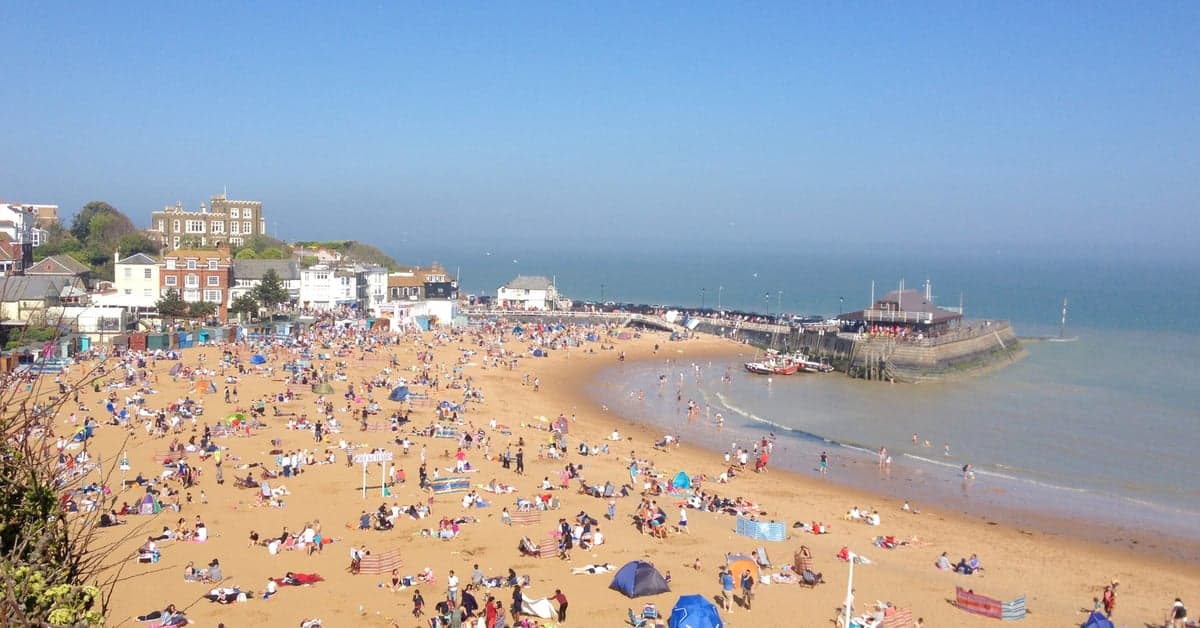
Broadstairs is a small town on the Kent coast, reachable in about 80-90 minutes by high-speed train from London St Pancras (Southeastern, £20-35 return). The town is built around Viking Bay, a compact sandy beach enclosed by chalk cliffs and a harbor wall. At low tide, the sand is wide and golden. At high tide, it compresses to a narrow strip but remains usable.
Charles Dickens spent summers here and wrote parts of "David Copperfield" and "Bleak House" in the clifftop house that now bears the latter name. The Dickens connection is taken seriously — there's an annual Dickens Festival in June with costumed parades and readings.
The town itself is charming without being twee. Morelli's Gelato has served ice cream on the seafront since 1932 (two scoops, £3.80). Wyatt & Jones, an all-day restaurant overlooking Viking Bay, does excellent brunch (£9-14) and evening seafood (mains £16-22). The Tartar Frigate, perched on the harbor wall, serves fish and chips for about £12 with a view of the entire bay. Botany Bay, a 15-minute walk north along the cliffs, is a wilder, less crowded beach backed by chalk stacks that look like they belong in a geology textbook.
Whitstable
Whitstable is an oyster town. The Romans farmed oysters here, and the Whitstable Oyster Company has operated in some form since the 1850s. The town sits on the north Kent coast, about 75 minutes from London Victoria (Southeastern, £15-28 return).
The beach is a long stretch of shingle (pebbles, again — this is England) backed by a promenade and rows of pastel beach huts. The swimming is gentle, the water is shallow, and the views look north across the Thames Estuary to the Essex shore. It is not dramatic coastline, but it is pleasant and calm.
The real draw is eating. The Whitstable Oyster Company restaurant serves native oysters (September-April, £18 per half dozen) and rock oysters (year-round, £14 per half dozen) in a converted warehouse on the waterfront. Wheelers Oyster Bar, a tiny blue-fronted restaurant on the high street that's been open since 1856, takes no reservations and serves a four-course seafood menu for about £55 that routinely gets called one of the best meals in Kent. For something less formal, buy a pint of prawns or a tub of cockles from the fishmonger's stalls on the harbor for £4-6 and eat on the sea wall.
The Whitstable Oyster Festival happens in late July — a week of oyster eating, live music, parades, and a blessing of the waters. Book accommodation months ahead if visiting during the festival.
Camber Sands
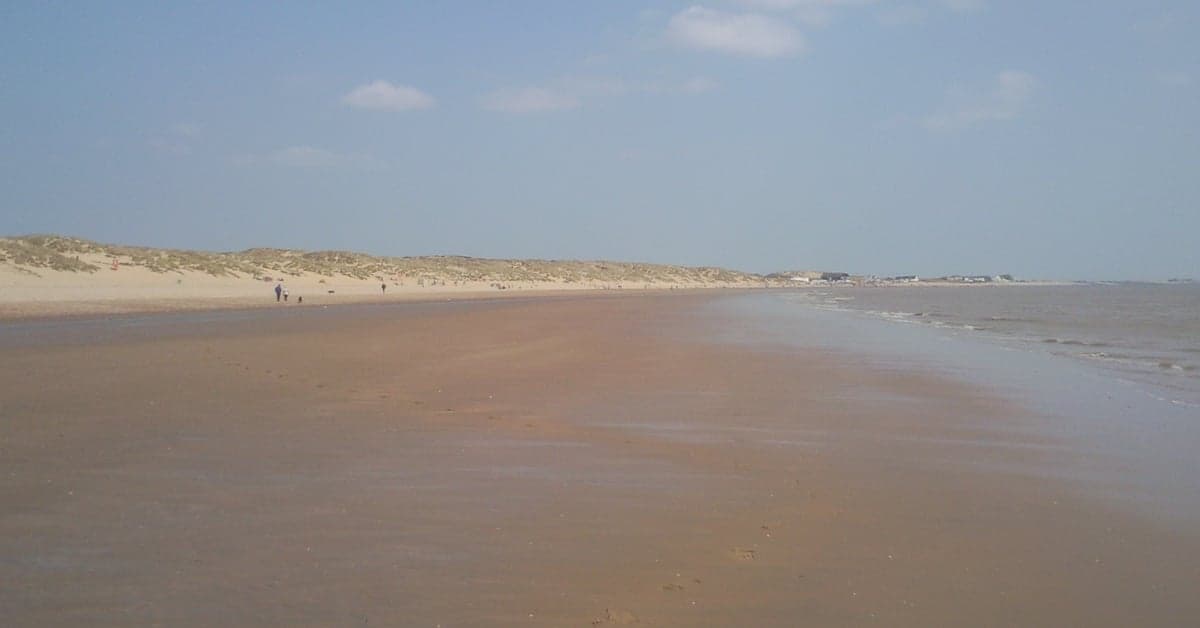
Camber Sands is the exception to the English-beaches-are-pebbles rule. This is genuine sand — a wide, flat expanse of golden dunes on the East Sussex coast, about 90 minutes from London by car (train access requires going to Rye and taking a bus or taxi, adding complexity). The beach is popular with kitesurfers when the wind blows and families when it doesn't.
The dune system behind the beach is a Site of Special Scientific Interest, home to rare plants and insects. Walk over the dunes and the beach opens up to what feels like a different country — wide, windswept, and empty for long stretches. Swimming is safe in calm conditions, but the beach has strong rip currents and fast-rising tides. Check tide times and swim near the lifeguarded area (summer only). See National Weather Service rip-current safety guide for current guidance.
The village of Camber has a pub (The Owl) and a few cafes. For a proper meal, drive or take a bus to Rye, a medieval hilltop town two miles inland. The Mermaid Inn (its cellars date to 1156 and the building was rebuilt in 1420) serves traditional English food. Ypres Castle Inn, with a garden overlooking the marshes, has local ales and a pub menu. The Globe Inn Marsh serves a more modern menu.
Margate
Margate spent decades in decline after cheap flights killed the English seaside holiday. Then the Turner Contemporary gallery opened in 2011 — a David Chipperfield-designed building on the site where J.M.W. Turner used to paint the local light — and the town began its slow resurrection. The gallery is free, the exhibitions rotate quarterly, and the building itself, all glass and angles on the harbor, is worth seeing.
Margate Main Sands is a wide, sandy beach directly below the Old Town, with Dreamland amusement park (a restored 1920s theme park, rides £3-5 each or £20 wristband) at the back. The Old Town has vintage shops, independent galleries, and a food scene that punches above its weight. Angela's, a tiny seafood restaurant on the harbour arm, serves a tasting menu (£55) that has drawn national critics. Hantverk & Found, in the Old Town, does Swedish-influenced cafe food (£8-12 for lunch).
The train from London St Pancras takes 75-90 minutes on the high-speed service (£20-35 return). Margate is close enough to Broadstairs that you could visit both in a long day — they're separated by about 15 minutes by bus.
Bournemouth
Bournemouth has seven miles of sandy beach, the warmest sea water on the English south coast (a relative term — it reaches 18-19°C in August), and a two-hour train ride from London Waterloo (South Western Railway, £25-45 return). The town is more conventional than Brighton — retirement flats, chain restaurants, and a long promenade — but the beach is genuinely excellent.
The sand is fine and golden, the water is clean, and the beach is divided into sheltered sections by wooden groynes (sea barriers). Beach huts line the promenade and rent for £20-40 per day through the council website. The pier has a zip line (£25) and a climbing wall. Boscombe, the eastern extension of the beach, has an artificial surf reef (results debatable), a surfer-friendly cafe culture, and a more independent vibe than the main Bournemouth strip.
Urban Reef, a restaurant built into the sea wall at Boscombe, serves locally sourced brunch and dinner (mains £12-18) with floor-to-ceiling ocean views.
Southend-on-Sea
Southend is the closest seaside to London — 50 minutes from Fenchurch Street station (c2c, £10-15 return). It is not glamorous. The pier, at 1.34 miles, is the longest pleasure pier in the world, and a train runs its length for £5 return. The beaches are sandy at low tide and muddy at the edges. Adventure Island amusement park is free to enter.
Southend's appeal is its accessibility and honesty. It does not pretend to be the Riviera. Fish and chips from The Peterboat by the old town (cod and chips, £11), a walk to the end of the pier, an ice cream, and a train home — that's a Southend day trip, and it's been that way for a century. The Leigh-on-Sea section, at the western end, has a more upscale food scene: Osborne Bros fishmonger sells cockles and jellied eels from a stall, and The Crooked Billet pub serves modern British food (mains £16-22) in a 16th-century building.
West Wittering
West Wittering, on the West Sussex coast, is one of the best sandy beaches in southeast England. The sand is wide and firm at low tide, the water is shallow and sheltered by a sand spit (East Head, a National Trust nature reserve), and the views across Chichester Harbour to the South Downs are quietly beautiful.
The catch: it's hard to reach by public transport. The nearest train station is Chichester (90 minutes from London Victoria, £15-25), then a 20-minute bus or taxi to the beach. By car, it's about 90 minutes from London. Beach parking costs £8-14 depending on season and fills up by 10 AM on summer weekends. Arrive early.
Facilities are basic — a cafe, toilets, and a beach shop. The East Head spit is a 20-minute walk from the main beach and offers dunes, wading pools at low tide, and excellent birdwatching. Billy's on the Beach, a seafood shack near the car park, serves fish tacos (£9) and crab sandwiches (£10) that are a cut above typical beach food.
Practical Tips for English Beach Days
- Weather: Check the forecast, but don't trust it completely. Bring layers — a windbreaker, a fleece, sunscreen, and sunglasses. You may need all of them in the same afternoon.
- Trains: Book advance tickets online (Trainline, National Rail) for the cheapest fares. Off-peak returns are significantly cheaper than peak. A family railcard (£30/year) gives a third off fares.
- Tides: Sandy beaches in England can be dramatically different at high and low tide. Check tide times (BBC Weather or Magic Seaweed) and plan to arrive on a falling or low tide for maximum beach area.
- Swimming: The water is cold. A shorty wetsuit (3/2mm) makes a significant difference from May to September. Decathlon sells basic wetsuits from £30. Swim near lifeguarded areas, which operate from late May to September at major beaches.
- The 99 Flake: Soft-serve ice cream from a van, with a half-size Cadbury Flake pushed into the top. It costs £2.50-3.50 and is non-negotiable on a British beach day. Ask for "a 99" and you'll be understood at any seaside ice cream van in the country.
Frequently Asked Questions
What is the closest beach to London?
Southend-on-Sea is 50 minutes from Fenchurch Street station by c2c train ($10-15 return). The beach is sandy at low tide, and the pier at 1.34 miles is the longest pleasure pier in the world. Brighton is 60-70 minutes from Victoria station and is the most popular day trip.
Does Brighton have a sandy beach?
No. Brighton's beach is pebbles, which surprises first-time visitors. The stones are smooth and the water is clean (Blue Flag certified), but you will not find sand. For sandy beaches near London, head to Camber Sands (90 minutes by car), Broadstairs (80-90 minutes by high-speed train), or Bournemouth (2 hours by train).
How much does a train to Brighton cost from London?
Off-peak return tickets from London Victoria or London Bridge cost 15-25 pounds on Southern or Thameslink services, taking 60-70 minutes. Book advance tickets on Trainline or National Rail for the cheapest fares. A family railcard (30 pounds/year) gives a third off all fares.
What is the best sandy beach near London?
Camber Sands in East Sussex has genuine golden sand dunes and wide, flat beaches, about 90 minutes from London by car. Broadstairs' Viking Bay has golden sand in a cliff-enclosed cove, reachable in 80-90 minutes by high-speed train from St Pancras. Bournemouth has seven miles of fine golden sand, two hours from Waterloo.
Can you swim in the sea near London?
Yes, but the water peaks at about 64 degrees F in August. A 3/2mm shorty wetsuit makes a significant difference from May through September (available from Decathlon for about 30 pounds). Swim near lifeguarded areas, which operate from late May to September at major beaches. Bournemouth has the warmest water on the south coast.
Is Whitstable worth visiting from London?
Whitstable is excellent if you love seafood. The town has farmed oysters since Roman times, with native oysters at 18 pounds per half dozen at the Whitstable Oyster Company. The beach is pebbles but calm and pleasant. The train takes 75 minutes from Victoria. The late July Oyster Festival draws large crowds -- book accommodation months ahead.