Adventure Sports in the Caribbean (2026): 8 Best Beaches
Table of Contents
The best adventure sports in the Caribbean are tied to specific beaches: shore diving in Bonaire, kitesurfing at Cabarete in the Dominican Republic, windsurfing at Aruba's Fisherman's Huts, surfing Rincon in Puerto Rico and Barbados' Soup Bowl, snorkeling with stingrays at Grand Cayman's Stingray City, cliff jumping at Rick's Cafe in Negril, and bioluminescent kayaking in Vieques' Mosquito Bay. Each of these is a genuine world-class spot, not a resort gimmick.
How We Chose These Adventure Sports in the Caribbean
The region is full of beaches that will rent you a jet ski or a banana boat, and none of those made this list. We picked places where the beach itself is the reason the sport works: a reef that starts at the shoreline, a bay with more bioluminescence than anywhere else on Earth, a break that a world champion rates in his personal top three. Each entry below is a named beach with conditions you cannot easily replicate elsewhere, plus the honest catch, whether that is a season, a boat ride, or a wind window.
We weighted three things: how good the conditions genuinely are, how accessible the sport is to a first-timer versus an expert, and reliability across the year. Where a spot only works in a specific season or moon phase, we say so, because turning up at the wrong time is the most common way these trips disappoint.
1. Shore Diving in Bonaire — The Easiest World-Class Diving
Bonaire is the shore-diving capital of the Caribbean, and arguably the world. The entire coastline is protected as the Bonaire National Marine Park, managed by STINAPA, with roughly 86 marked dive sites, about 51 of which you can reach by simply parking, gearing up, and wading in from the sand. Yellow-painted stones along the coastal road mark the entry points.
Because the reef sits close to shore and the water is calm on the leeward west coast, you dive on your own schedule rather than a boat's, which is why divers buy multi-tank packages and log four or five dives a day. The park protects more than 350 recorded fish species and dozens of coral types, and a nature fee applies before you get in the water. It is the rare place where beginners and technical divers use the same shoreline. For a wider look at the region's dive beaches, see our guide to the best snorkeling spots in the Caribbean.
2. Kitesurfing and Windsurfing at Cabarete, Dominican Republic
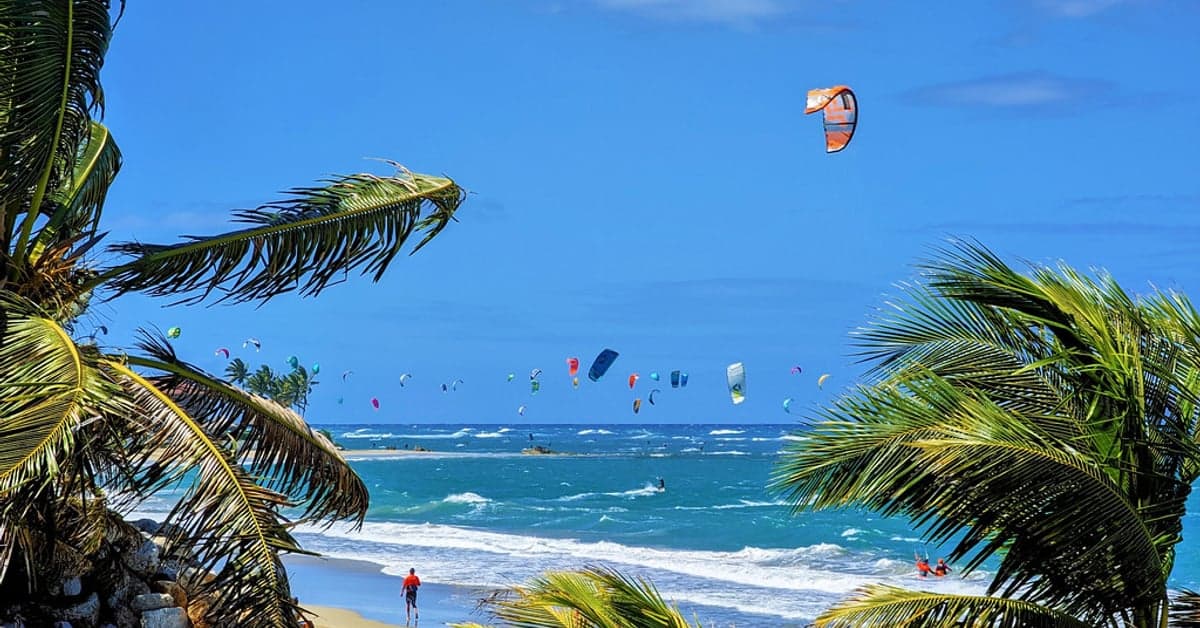
Cabarete on the north coast of the Dominican Republic is the watersports capital of the Caribbean, and it earned the title honestly. Atlantic trade winds blow across the bay on roughly 250 to 300 rideable days a year, and a thermal effect ramps them up in the early afternoon, so mornings are for surfing and flat-water lessons while the wind fills in later for kiting.
The layout does the teaching for you. Kite Beach is the dedicated kitesurfing strip, Bozo Beach handles downwinders and progression, and the main bay's reef flattens the inside water for beginners while sending waves to the outside for experts. Cabarete built its name on windsurfing in the mid-1980s before kiteboarding took over, and both still run side by side. Our roundup of the best beaches for kitesurfing and windsurfing puts it in a global context.
3. Windsurfing at Aruba's Fisherman's Huts
If Cabarete is the Caribbean's watersports capital, Aruba's Hadicurari Beach, better known as Fisherman's Huts, is its windsurfing arena. The island's near-constant trade winds average around 15 knots and blow almost daily, and the water directly off the beach is shallow and flat, which makes it one of the friendliest places anywhere to take a first windsurfing lesson.
The pedigree is real: every June or July the beach hosts the Aruba Hi-Winds, described by the tourism board as the largest amateur windsurfing event in the Caribbean, with slalom racing and freestyle over five days. Beginners stick to the protected inside water while advanced sailors head out to the chop and swell beyond it. Multiple wind- and kitesurf schools cluster on the sand, so gear and instruction are easy to find.
4. Surfing at Rincon, Puerto Rico, and the Soup Bowl, Barbados
The Caribbean has two surf towns that serious surfers plan trips around. Rincon, on Puerto Rico's west coast, hosted the 1968 World Surfing Championship and still delivers: Domes is a punchy right-hand reef break that works most of the winter, while neighboring Maria's runs smaller and is a better place to learn. The season is roughly November through March, when North Atlantic swells arrive.
The other is the Soup Bowl at Bathsheba, on the rugged Atlantic coast of Barbados. It is a barreling right-hand reef break that world champion Kelly Slater has named among his three favorite waves anywhere, and on a winter north swell it can jump well overhead. Both spots break over rock and reef, so they reward experience; beginners should book a lesson on the calmer Caribbean side rather than paddle out cold.
5. Snorkeling with Stingrays at Stingray City, Grand Cayman
Stingray City in Grand Cayman is the Caribbean's most famous animal encounter, and it is genuinely beginner-friendly. It is a natural sandbar in the calm, protected North Sound where dozens of large southern stingrays gather in about three to five feet of clear water, shallow enough to stand in. A boat ride of roughly 20 to 30 minutes from the Seven Mile Beach area gets you there.
The rays are wild but habituated, and the site is managed under the Cayman Islands' Wildlife Interaction Zone rules, so tours brief you on safe handling before you get in. Because you can stand, it works for non-swimmers and children as well as snorkelers, which sets it apart from most marine encounters. Divers who want more can pair it with the island's walls and wrecks in our Grand Cayman beach diving guide. See the Wikipedia entry on Stingray City for the site's background.
6. Cliff Jumping at Rick's Cafe, Negril, Jamaica
For adrenaline without any gear at all, Rick's Cafe on the West End cliffs of Negril, Jamaica, is the classic. Open since 1974, it built its reputation on a set of jumping platforms rising from a tame 10 feet to a genuinely intimidating 35 feet straight into deep water, with local divers launching from the trees even higher.
It is as much a sunset bar as an adventure spot, so you can watch before you commit, and the water below is deep enough for the jumps to be relatively safe when you follow the staff's guidance. Two honest cautions: entry is over rock, so wade in carefully, and the place gets crowded when cruise and tour buses arrive in the late afternoon, so come early if you want a clean jump without a queue.
7. Bioluminescent Kayaking in Mosquito Bay, Vieques
Mosquito Bay on the island of Vieques, off Puerto Rico's east coast, has been recognized by Guinness World Records as the brightest bioluminescent bay on the planet. The glow comes from dinoflagellates, single-celled organisms that flash blue-green when the water is disturbed, and the bay holds an extraordinary concentration of them, so every paddle stroke and fish dart lights up.
The bay is reached by guided kayak only, which protects the ecosystem, and it glows year-round rather than seasonally. The catch is the moon: book within a few days of a new moon, because a bright moon washes out the effect. It is a low-effort paddle suitable for beginners, and it is the one experience on this list that is genuinely unlike anything else in the region. Puerto Rico's official tourism site details all three of the island's bioluminescent bays.
8. Diving the Underwater Sculpture Park, Grenada
Off Molinere Bay on the west coast of Grenada lies one of the world's first underwater sculpture parks, created in 2006 by sculptor Jason deCaires Taylor. Cast-concrete figures were sunk in shallow, calm water where they now double as an artificial reef, colonized by coral and fish, and you explore them by snorkeling from the surface or on a shallow scuba dive.
Because most of the sculptures sit in relatively shallow water, this is one of the few marine-art sites that snorkelers can enjoy as fully as divers. It pairs naturally with Grenada's quiet Grand Anse beach and the island's reef diving, and it is a good change of pace from pure reef exploration. Boat and snorkel tours run from the capital, St. George's, a short trip up the coast.
Safety and When to Go
The calendar matters more here than for a typical beach holiday. Surfing at Rincon and the Soup Bowl peaks in the winter, roughly November through March, when North Atlantic swells arrive. Wind sports at Cabarete and Aruba are strongest in the trade-wind months, broadly December through July. Diving, snorkeling, and the bioluminescent bay run year-round, though the Atlantic hurricane season from June to November can disrupt any plan, so build in flexibility if you travel then.
On safety, match the spot to your skill honestly. Reef breaks and 35-foot cliffs are not the place to try something for the first time; book a lesson, hire a guide, and never dive or jump alone. For help timing the trip island by island, see our best time to visit the Caribbean by island guide.
How to Choose Your Caribbean Adventure
Pick by the sport, then the island. Choose Bonaire for self-guided diving, Cabarete or Aruba for wind and kite, Rincon or Barbados for surf, Grand Cayman for a family-friendly stingray snorkel, Negril for cliff jumping, Vieques for the bioluminescent bay, and Grenada for underwater art. If you want more than one, the Dominican Republic pairs kiting with easy diving, and Puerto Rico combines Rincon's surf with Vieques' glow on a single trip.
Final Thoughts
The Caribbean's best adventure sports are not evenly spread; they cluster on a handful of specific beaches where the conditions are exceptional. Go to the place that owns the sport you care about rather than settling for whatever your resort beach happens to offer, and time it to the season. Do that, and each of these lives up to its reputation instead of becoming a story about the day the wind, the swell, or the moon did not cooperate.
Frequently Asked Questions
What is the best adventure sport in the Caribbean?
It depends on your skill and interest, but Bonaire shore diving is the most accessible world-class option because you can dive straight from the beach with no boat. For thrill-seekers, cliff jumping at Rick's Cafe in Negril and surfing the Soup Bowl in Barbados are the standouts. For families, snorkeling with stingrays at Grand Cayman's Stingray City is hard to beat.
Where is the best kitesurfing in the Caribbean?
Cabarete on the north coast of the Dominican Republic is widely considered the watersports capital of the Caribbean, with trade winds on roughly 250 to 300 rideable days a year and a dedicated Kite Beach. Aruba's Fisherman's Huts (Hadicurari Beach) is the other top pick, with steady 15-knot winds and flat, shallow water ideal for learning.
Can beginners do adventure sports at Caribbean beaches?
Yes. Several spots are genuinely beginner-friendly: windsurfing lessons on Aruba's shallow, flat Fisherman's Huts, snorkeling with stingrays in the stand-up shallows of Stingray City, and the low-effort bioluminescent kayak in Mosquito Bay all suit first-timers. Save the reef breaks at Rincon and the Soup Bowl, and the 35-foot cliff jumps at Rick's Cafe, for once you have experience or a guide.
When is the best time for surfing in the Caribbean?
Winter, roughly November through March, is the surf season for the region's best breaks, because that is when North Atlantic swells reach spots like Domes in Rincon, Puerto Rico, and the Soup Bowl at Bathsheba, Barbados. Summer is generally flatter and better suited to learning on the calmer Caribbean-facing coasts.
Why is Bonaire the best place to dive in the Caribbean?
Bonaire is known as the shore-diving capital of the world because roughly 51 of its 86 marked dive sites can be reached directly from the beach, marked by yellow stones along the coastal road. The entire coast is a protected marine park with over 350 fish species, and the calm leeward water lets divers log several self-guided dives a day without a boat.
Is Stingray City in Grand Cayman safe for kids?
Generally yes. Stingray City's sandbar sits in about three to five feet of calm, clear water in the protected North Sound, shallow enough for children and non-swimmers to stand. The southern stingrays are wild but habituated, and tours operate under the Cayman Islands' Wildlife Interaction Zone rules with a safety briefing on handling. Supervise children closely and follow the guide's instructions.
How high are the cliff jumps at Rick's Cafe in Negril?
Rick's Cafe on Negril's West End cliffs has jumping platforms ranging from a tame 10 feet to an intimidating 35 feet straight into deep water, and local divers often launch from the trees even higher. The water below is deep enough for the jumps to be relatively safe when you follow the staff's guidance, but entry is over rock, so wade in carefully.